Bharadwaja
Rishi · Bharadwaja
Descended from Rishi Bharadwaja, son of Brihaspati. One of the most populous gotras in India.
Many Brahmin and warrior families across India.
Every traditional sankalpa - the formal declaration before any Hindu ritual - names four things about you: the rishi-lineage of your father (gotra), the lunar mansion you were born under (nakshatra), the zodiac sign of the moon at your birth (rashi), and the ritual code your family follows (sutra). This page explains each one in plain English and, where you can, helps you find your own.
A gotra(literally “cowshed” - the family enclosure) is the patrilineal descent from one of the seven (or eight) saptarshis - the great seers of the Vedic age. The classical seven are Bharadwaja, Vishvamitra, Jamadagni, Vasishtha, Kashyapa, Atri, and Gautama; Agastya is the eighth in many South Indian counts.
Why it matters today:the gotra is named in every sankalpa so the universe and the deity know “who is requesting” this offering. It also governs the marriage rule of sapinda: traditionally, two people of the same gotra are not allowed to marry, since they are considered descended from the same rishi and therefore siblings in spiritual lineage. This is the oldest documented exogamy rule in any culture.
Rishi · Bharadwaja
Descended from Rishi Bharadwaja, son of Brihaspati. One of the most populous gotras in India.
Many Brahmin and warrior families across India.
Rishi · Vishvamitra
Descended from Rishi Vishvamitra, the only kshatriya to attain Brahmarshi status. Composer of the Gayatri.
Found across South India and northern Hindi belt.
Rishi · Jamadagni
Descended from Rishi Jamadagni, father of Parashurama (sixth avatar of Vishnu).
Common in Maharashtra and Karnataka Brahmin families.
Rishi · Vasishtha
Descended from Brahmarshi Vasishtha, the family priest of the Suryavamsha (Rama's lineage).
Widely spread; many Smartas and Vaishnavas.
Rishi · Kashyapa
Descended from Rishi Kashyapa, the cosmic ancestor of devas, asuras, nagas, and humans alike.
Geographically widest; found in nearly every region.
Rishi · Atri
Descended from Rishi Atri, husband of Anasuya, father of Dattatreya, Chandra, and Durvasa.
Common in Andhra and Tamil Brahmin lineages.
Rishi · Gautama
Descended from Rishi Gautama, husband of Ahalya. Author of the Nyaya Sutras.
Found across many sub-castes; not to be confused with Gautama Buddha's gotra.
Rishi · Agastya
Descended from Rishi Agastya, who carried Vedic knowledge to the south. The eighth gotra in some lists.
Common in Tamil and Kerala Brahmin families; sometimes counted separately from the seven.
Note: hundreds of sub-gotras (pravarachains) exist; the eight above are the parent lineages from which the rest descend. A typical pravara names three rishis - for example a Bharadwaja might recite “Angirasa, Barhaspatya, Bharadwaja”.
The moon takes 27.3 days to circle the earth and passes through 27 evenly spaced sectors of the sky. Each sector is a nakshatra - a lunar mansion - with a presiding deity, a symbol, a ruling planet (one of the navagraha, pictured), and characteristic qualities.
Why it matters today: the nakshatra under which the moon was located at your moment of birth is your janma nakshatra. It is named in every sankalpa, used to compute your name (the first syllable traditionally matches one of the four padas of the nakshatra), and consulted to choose auspicious dates for any new beginning - marriage, house entry, a journey, the start of a venture.
| # | Nakshatra | Symbol | Deity | Ruling planet | Rashi | Quality |
|---|---|---|---|---|---|---|
| 1 | Ashwini | Horse's head | Ashwini Kumaras | Ketu | Mesha | Quick, healing, pioneering. |
| 2 | Bharani | Yoni | Yama | Venus | Mesha | Carrying, transformative. |
| 3 | Krittika | Razor / flame | Agni | Sun | Mesha/Vrishabha | Sharp, purifying, fiery. |
| 4 | Rohini | Cart / temple | Brahma / Prajapati | Moon | Vrishabha | Fertile, beautiful, growing. |
| 5 | Mrigashira | Deer's head | Soma | Mars | Vrishabha/Mithuna | Searching, gentle. |
| 6 | Ardra | Teardrop | Rudra | Rahu | Mithuna | Stormy, transformative, cleansing. |
| 7 | Punarvasu | Quiver of arrows | Aditi | Jupiter | Mithuna/Karka | Renewal, returning, generous. |
| 8 | Pushya | Cow's udder / lotus | Brihaspati | Saturn | Karka | Nourishing, most auspicious nakshatra. |
| 9 | Ashlesha | Coiled serpent | Naga | Mercury | Karka | Mysterious, intuitive, hypnotic. |
| 10 | Magha | Throne | Pitrs (ancestors) | Ketu | Simha | Royal, ancestral, traditional. |
| 11 | Purva Phalguni | Front legs of bed | Bhaga | Venus | Simha | Pleasure, leisure, romance. |
| 12 | Uttara Phalguni | Back legs of bed | Aryaman | Sun | Simha/Kanya | Friendly, contractual, helpful. |
| 13 | Hasta | Hand | Savitr (Sun) | Moon | Kanya | Skilful, dexterous, crafty. |
| 14 | Chitra | Pearl / bright jewel | Vishvakarma | Mars | Kanya/Tula | Brilliant, artistic, designing. |
| 15 | Swati | Sword / coral | Vayu | Rahu | Tula | Independent, restless, free. |
| 16 | Vishakha | Triumphal arch | Indra & Agni | Jupiter | Tula/Vrischika | Goal-oriented, branching, determined. |
| 17 | Anuradha | Lotus / staff | Mitra | Saturn | Vrischika | Devotional, friendly, organising. |
| 18 | Jyeshtha | Earring / umbrella | Indra | Mercury | Vrischika | Eldest, protective, authoritative. |
| 19 | Mula | Bunch of roots | Nirriti | Ketu | Dhanu | Investigative, going to the root. |
| 20 | Purva Ashadha | Elephant tusk / fan | Apas (waters) | Venus | Dhanu | Invincible, victorious, purifying. |
| 21 | Uttara Ashadha | Elephant tusk | Vishvedevas | Sun | Dhanu/Makara | Universal, achieving, righteous. |
| 22 | Shravana | Ear | Vishnu | Moon | Makara | Listening, learning, devotional. |
| 23 | Dhanishta | Drum / flute | Vasus | Mars | Makara/Kumbha | Wealthy, musical, generous. |
| 24 | Shatabhisha | Empty circle | Varuna | Rahu | Kumbha | Healing, mystical, secretive. |
| 25 | Purva Bhadrapada | Sword / front of bier | Aja Ekapada | Jupiter | Kumbha/Meena | Intense, transformative, ascetic. |
| 26 | Uttara Bhadrapada | Snake in water | Ahir Budhnya | Saturn | Meena | Deep, withdrawn, compassionate. |
| 27 | Revati | Fish / drum | Pushan | Mercury | Meena | Nurturing, completing, journeying. |
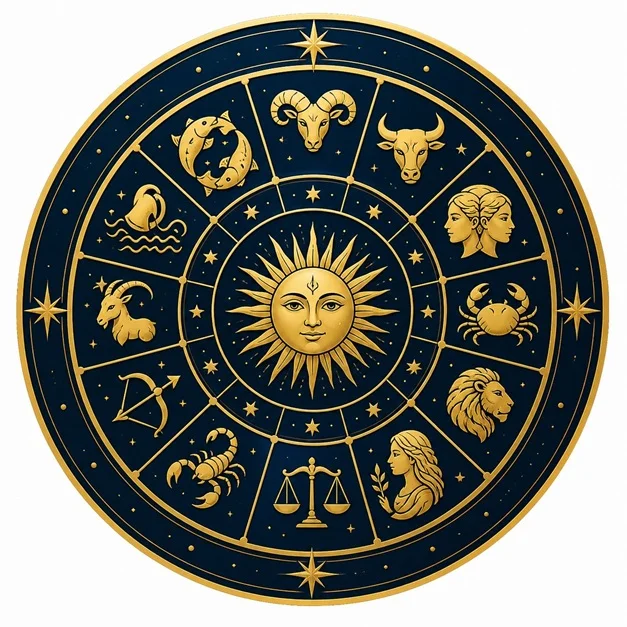
The zodiac is divided into twelve rashis of 30° each. Indian astrology uses the sidereal zodiac (anchored to the actual stars), which is offset from the Western tropical zodiac by about 24°. So if you are an Aries in the Western system, you are likely a Pisces (Meena) in the Indian system - your rashi is determined by where the moon was, not the sun.
Why it matters today: your chandra-rashi (moon sign) is the principal indicator in Vedic astrology - used for daily readings, compatibility checking before marriage (guna milan), and selecting muhurtas. The lord of your rashi (graha) governs how favourable each year will feel based on the planet's transit.
Aries · Ram
Energetic, pioneering, impatient.
Taurus · Bull
Steady, patient, sensual.
Gemini · Twins
Curious, communicative, restless.
Cancer · Crab
Nurturing, emotional, protective.
Leo · Lion
Regal, generous, dramatic.
Virgo · Virgin
Analytical, precise, helpful.
Libra · Scales
Balanced, diplomatic, indecisive.
Scorpio · Scorpion
Intense, transformative, secretive.
Sagittarius · Archer
Philosophical, expansive, frank.
Capricorn · Sea-goat
Disciplined, ambitious, patient.
Aquarius · Water-bearer
Eccentric, humanitarian, abstract.
Pisces · Fishes
Compassionate, intuitive, dreamy.
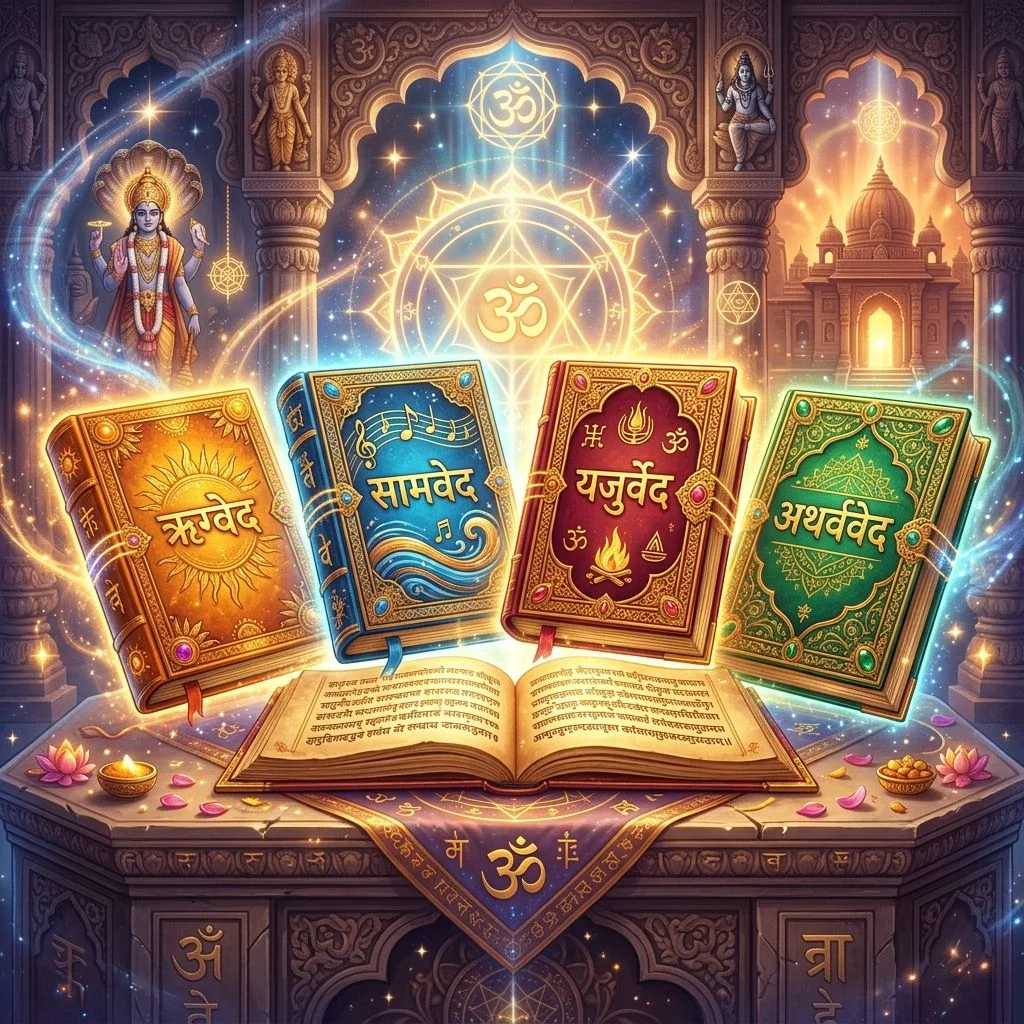
Each of the four Vedas (above) gave rise to its own family of sutras - each sutra a tight chain of prose aphorisms that specifies, syllable by syllable, how a ritual is performed. Your family follows one specific sutra, inherited by lineage.
The Kalpa Vedanga - the “limb” of the Vedas dealing with ritual procedure - is preserved as four genres of short aphoristic texts: Srauta Sutras (large public yajnas), Grihya Sutras (household rites), Dharma Sutras (law and conduct), and Shulba Sutras (geometry of fire altars). Together they specify, syllable by syllable, exactly how every traditional ritual is performed.
Why it matters today:different rishis composed different sutra collections, and each Brahmin family inherits the sutra of one specific rishi. Your sutra determines which mantras your priest uses at your wedding, which procedure is followed at your child's naming ceremony, and what version of the Sandhya Vandana you perform. If you ever wonder why the wedding at your cousin's house in Mumbai looked different from the one at your aunt's in Bangalore - different sutras.
Krishna Yajurveda · Taittiriya Shakha
Components: Dharma Sutra · Grihya Sutra · Srauta Sutra · Shulba Sutra (geometry of altars)
Region / community: Smarta Brahmins of Andhra, Karnataka, Tamil Nadu, Maharashtra; many South Indian families
One of the oldest and most widely followed sutras in South India. The Bodhayana Grihya Sutra is the day-to-day reference for samskaras (life-cycle rituals) - namakarana, upanayana, vivaha, antyeshti - in countless Smarta and Vaidika households. The Bodhayana Shulba Sutra also contains some of the earliest known statements of the Pythagorean theorem in mathematical history.
Krishna Yajurveda · Taittiriya Shakha
Components: Dharma Sutra · Grihya Sutra · Srauta Sutra · Shulba Sutra
Region / community: Andhra, Tamil Nadu, parts of Karnataka
A close cousin of Bodhayana, slightly later in date and more systematic. The Apastamba Dharma Sutra is one of the most lawyer-like of the Dharma Sutras, organising rules into clear topics. Many South Indian Smartas and Sri Vaishnavas follow Apastamba.
Rigveda
Components: Grihya Sutra · Srauta Sutra
Region / community: North India, Bengal, parts of Maharashtra; Rigvedi Brahmins generally
The default for almost all Rigvedi Brahmin families. The Ashvalayana Grihya Sutra is the source for most of the standard Rigvedic samskara verses still recited at weddings and naming ceremonies.
Krishna Yajurveda · Taittiriya Shakha
Components: Grihya Sutra · Srauta Sutra · Dharma Sutra (shared with Apastamba)
Region / community: Maharashtra (Konkanastha and Deshastha Brahmins), parts of Karnataka
A subdivision of the larger Apastamba family. Maharashtrian Chitpavan and Deshastha Brahmin families typically identify as Hiranyakeshis when asked their sutra. Practical content is very close to Apastamba.
Rigveda
Components: Grihya Sutra · Srauta Sutra · Aranyaka
Region / community: North India, parts of Bengal
A second Rigvedi sutra, less common than Ashvalayana but still in active use in some North Indian Brahmin families.
Samaveda · Kauthuma branch
Components: Srauta Sutra primarily
Region / community: Tamil Nadu, Andhra; Samavedi Brahmins
For families whose lineage maintains Samaveda chanting. Comparatively rare; closely paired with Latyayana for the Kauthuma branch.
Samaveda · Kauthuma branch
Components: Srauta Sutra
Region / community: Tamil Nadu, Andhra
Companion Samavedic sutra to Drahyayana.
Atharvaveda
Components: Grihya Sutra (the only complete Atharvavedic Grihya Sutra)
Region / community: Limited; some Atharvavedi Brahmin families in Maharashtra and Gujarat
For families that maintain the Atharvaveda. Atharvavedi families are the rarest of the four Vedic streams in modern India.
One tap helps us learn what to improve. Add a note if you would like to see something specific on this page.
Anonymous votes are stored against a per-session ID; signed-in votes link to your profile. We use this only to decide what to add or improve. We never share or sell this data.