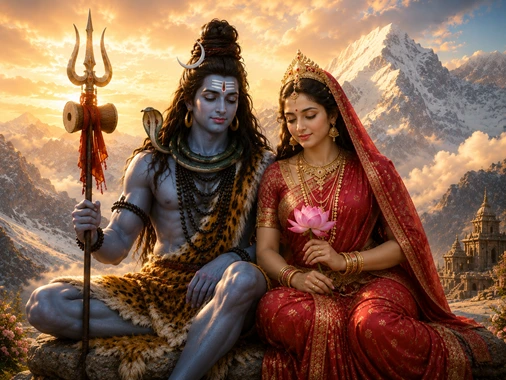
The daughter of Himavat, the mountain. The name is a patronymic and the form is relational: Parvati is named as consort of Shiva and mother of Ganesha and Kartikeya, and most household worship addresses her in that setting.
Uma उमा
The older name, and the one that reaches furthest back — Uma Haimavati appears in the Kena Upanishad as the figure who reveals Brahman to the gods. Where a text wants the goddess as teacher and revealer rather than as consort, it tends to use Uma.
Gauri गौरी
The fair or radiant form, associated with the tapas by which the goddess is said to have won Shiva. Gauri is the form invoked in marriage rites and in the vratas kept for a husband's wellbeing, which is why it dominates the domestic ritual calendar.
Annapurna अन्नपूर्णा
The goddess as the one who is full of food and gives it. A distinct iconography — ladle and vessel — and a distinct centre of worship at Kashi. Annapurna is approached for the sustaining of a household rather than for its protection.
Durga दुर्गा
The identification here is where traditions genuinely differ. Many Shaiva and Smarta traditions read Durga as a form of Parvati; independent Shakta traditions read Durga, and Mahadevi behind her, as the supreme reality in her own right, of whom Parvati is a form rather than the other way round. The Devi Mahatmya, the central text for that reading, does not derive her from a consort relationship. Follow your own sampradaya; this page does not settle it.
Parvatimantras & stotras(10 mantras)
Parvati Vandana
पार्वती वन्दना
Daily salutation to Parvati as Shiva’s consort and the gentle mother.
girijāyai — "gi" as in give, not as in giraffe. "ṣ/ś" in śiva is closer to English "sh". The final "ḥ" (visarga) is a soft echo of the preceding vowel, not a hard "ha".
Where it comes from
A Smarta and Shaiva household salutation rather than a scriptural verse. It circulates in printed stotra collections; we have not traced it to a critical edition of any named work, and say so rather than assigning it one.
How it is recited
Recited as a daily namaskara, commonly on Monday and at Pradosha. No initiation is required for it.
oṃ himavat-sutāyai vidmahe śūla-hastāyai dhīmahi | tan no pārvatī pracodayāt ||
Pronunciation
vid-ma-hé, dhī-ma-hi, pra-cho-da-yāt. The long "ī" in dhīmahi is held about twice the length of a short "i"; the "c" in pracodayāt is the "ch" of church, never the "k" of cat.
Where it comes from
A deity-Gayatri: an invocation built on the vidmahe / dhīmahi / pracodayāt frame of Rigveda 3.62.10. That frame is Vedic; this invocation is not. It belongs to the large body of deity-Gayatris found in tantric and puranic compilations, and it is not attested in a Vedic samhita. The Mahanarayana Upanishad does carry Gayatris of this shape for several deities, which is probably why the whole family is loosely called Vedic — but a form is not a provenance.
How it is recited
Recited before Parvati worship and during Navaratri. Freely available; no initiation is attached to it in the sources we could trace.
vāg-ar-thā-vi-va sam-pṛk-tau. The "ṛ" in saṃpṛktau is a vowel, roughly the "ri" of rich said quickly. Read the two lines as one sentence; the salutation lands only at the end.
Where it comes from
Kavya, not scripture: the opening benediction of Kalidasa's Raghuvamsha. It is recited before study of literature and music, and by householders as a joint salutation to Shiva and Parvati. The previous version of this entry printed Kalidasa's second line as its first, followed by a line that is not in the poem — corrected 2026-08-31 against the text at sanskritdocuments.org.
How it is recited
Commonly recited on Pradosha and at the start of study. Open to all; no initiation.
The Gauri Gayatri (distinct from the "Himavat-sutayai" Parvati Gayatri already in the library), invoking the consort of Shiva (Maheshvara/Rudra) for grace, harmony and gentle strength.
ॐ महादेव्यै च विद्महे विष्णुपत्न्यै च धीमहि।
तन्नो गौरी प्रचोदयात्॥
Transliteration (IAST)
oṃ mahā-devyai ca vidmahe viṣṇu-patnyai ca dhīmahi | tan no gaurī pracodayāt ||
Pronunciation
vid-ma-hé, dhī-ma-hi, pra-cho-da-yāt. "viṣṇu" carries a retroflex ṣ — the tongue curls back — and is not the "sh" of ship.
Where it comes from
Worth being precise about, because two different verses travel under this name. The Mahanarayana Upanishad (Krishna Yajurveda, Taittiriya Aranyaka X) does carry a Gauri Gayatri, and it reads "subhagāyai vidmahe kamalamālinyai dhīmahi, tanno gaurī pracodayāt". The verse above is not that one: it is the widely recited Devi/Lakshmi Gayatri frame with Gauri named in the final line. Both are in use; only the first is Vedic. Note also that viṣṇupatnyai means consort of Vishnu — later traditions that read Gauri as Vishnu's sister are glossing against the literal sense, not translating it.
How it is recited
Recited in daily Devi upasana and during Navaratri. No initiation is attached to it.
The foundational mantra of Parvati, joining the Maya-bija Hrim with salutation to the daughter of the mountain. Repeated as japa for the grace of the Mother and harmony in the home.
ॐ ह्रीं पार्वत्यै नमः॥
Transliteration (IAST)
oṃ hrīṃ pārvatyai namaḥ ||
Pronunciation
hrīṃ is one syllable, not two: the h, r and long ī run together and close on a nasal hum. Say it slowly before saying it often.
Where it comes from
A bija mantra: hrīṃ is the maya-bija, and the verse is a salutation built around it rather than a quotation from a text. It circulates through living upasana lineages rather than through a critical edition, which is why no work is named here.
How it is recited
Used for japa, commonly on a count. Several Shakta lineages give bija mantras only after initiation from a guru. If you have a family tradition or a teacher, follow theirs; if you do not, reciting it as a simple salutation is the ordinary householder practice.
A meditation verse on Gauri/Parvati - fair-complexioned, gentle, seated beside Shiva, the universal Mother who bestows auspiciousness. Recited before her worship, especially in Mangala Gauri and Gauri vratas.
An Upajati metre — eleven syllables to the line. Read it in four even lines rather than as prose and the rhythm carries itself.
Where it comes from
A dhyana shloka: a verse that describes the form to be visualised before worship begins. It appears in vrata manuals rather than in a single named scripture, and the four names it strings together — Parvati, Haimavati, Bhavani, Gauri — are the reason this page keeps a note on how the forms differ.
How it is recited
Recited at the start of Gauri worship, especially in the Mangala Gauri vrata kept on Shravana Tuesdays. Open to all.
The most beloved verse of the Annapurna Stotram (ascribed to Adi Shankaracharya), addressed to Annapurna - Parvati’s form at Kashi as the Goddess who is "full of food", granting nourishment and the grace of Shiva-Parvati. Recited before meals and for sustenance.
अन्नपूर्णे सदापूर्णे शङ्करप्राणवल्लभे।
ज्ञानवैराग्यसिद्ध्यर्थं भिक्षां देहि च पार्वति॥
Transliteration (IAST)
annapūrṇe sadā-pūrṇe śaṅkara-prāṇa-vallabhe | jñāna-vairāgya-siddhy-arthaṃ bhikṣāṃ dehi ca pārvati ||
Pronunciation
jñāna begins with a conjunct most English speakers approximate as "gyā" in the north and "jñā" in the south; either is accepted. bhikṣāṃ has an aspirated bh, closer to "b-huh" than to "b".
Where it comes from
Ascribed to Adi Shankaracharya, as much of the stotra corpus is; the ascription is traditional and is not established by manuscript evidence. What the verse asks for is worth noticing — not food, but alms for the sake of knowledge and dispassion.
How it is recited
Recited before meals and at Annapurna worship, especially at Kashi. Open to all.
The universally-loved Devi verse from the Durga Saptashati, addressing the Mother as Gauri/Narayani - "auspiciousness of all that is auspicious", the refuge of all, granter of every aim. Recited at the close of Devi worship and aarti.
tryambake is three syllables — trya-mba-ke — and the initial cluster is said as one gesture, not as "tri-yam".
Where it comes from
From the Devi Mahatmya, the central text of the Shakta traditions, where the Goddess is the supreme reality rather than a consort. The verse addresses her as Gauri and as Narayani in the same breath, which is exactly the identification the note on her forms discusses — read it as the Devi Mahatmya reads it, not as a claim that the names are interchangeable elsewhere.
How it is recited
Recited at the close of Devi worship and aarti, and daily in many households. Open to all.
The opening verse of the Uma-Maheshwara Stotram (ascribed to Adi Shankaracharya), saluting the divine couple Parvati and Shiva together as the parents of the universe. Recited by householders for marital harmony.
namaḥ śivābhyāṃ nava-yauvanābhyāṃ paraspara-āśliṣṭa-vapur-dharābhyām | nagendra-kanyā-vṛṣa-ketanābhyāṃ namo namaḥ śaṅkara-pārvatībhyām ||
Pronunciation
Every line ends in the dual case (-ābhyām), which is the point: the couple is addressed as two-in-one throughout, never singly.
Where it comes from
A stotra of the Shankaracharya corpus by tradition rather than by established authorship. It addresses Uma and Maheshvara as a pair in the dual case from first line to last, which is why householders use it for marital harmony rather than as a petition to either one.
How it is recited
Recited by householders, commonly on Pradosha and Monday. Open to all.
The opening names of the Parvati / Gauri Ashtottara-shatanama (108 names of the Mother), a daily litany recited for her protective and nourishing grace.
Each name takes the dative -yai or -ai ending before namaḥ. Pause fully after every namaḥ; the litany is counted, not run together.
Where it comes from
An opening extract, not the whole litany. Ashtottara lists circulate in several recensions that differ in the order of names and in a number of the names themselves, so treat the sequence here as one current form rather than as the authoritative 108.
How it is recited
Recited as a daily litany, usually with a count. Open to all.