Skip to content
WisdomRamayana deep

Ramayana deep - characters + Sundara Kanda

Valmiki Ramayana - 7 kandas, 24,000 shlokas. 17 central characters profiled below with birth, feats, fate, and dharmic lesson. Plus a 11-event detailed map of Sundara Kanda - the most-recited single kanda of the Ramayana (Hanuman's leap to Lanka + finding Sita + burning Lanka).

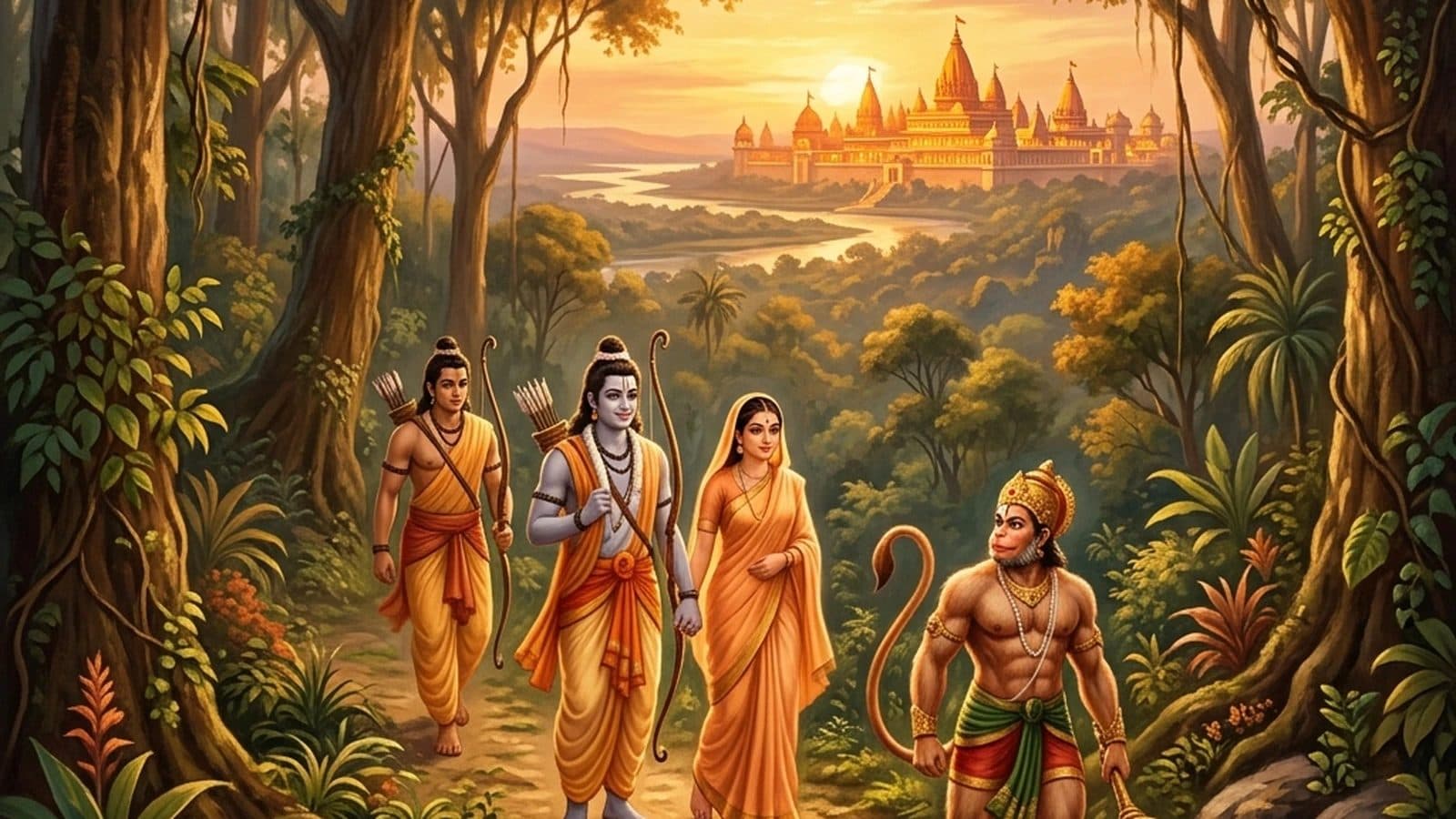
Rama, Sita, Lakshmana in the forest - Ramayana

The 17 central characters

Rama · राम

Hero

Birth - Eldest son of Dasharatha + Kausalya. Born at Ayodhya on Chaitra Shukla Navami (Rama Navami). 7th avatar of Vishnu.

Feats - Strung the bow of Shiva at Mithila + won Sita. Slew Tataka, Subahu (in childhood). Vanquished Khara, Dushana, Trishira in the Dandaka forest. Killed Vali (Sugriva's brother). Built the Setu-bandhana bridge to Lanka. Slew Ravana with the Brahmastra.

Fate - Coronated emperor of Ayodhya. Ruled the Rama-rajya for ~11,000 years. Departed by walking into the Sarayu river (sasarira).

Lesson - Maryada Purushottama - the man who never broke maryada (boundary of dharma) even at terrible personal cost. The model of every relational dharma.

Rama portraitRama - alternate portrait

Sita · सीता

Heroine

Birth - Found in a furrow by King Janaka of Mithila - hence "Janaki / Maithili / Vaidehi". Incarnation of Lakshmi.

Feats - Won by Rama at the bow-breaking swayamvara. Voluntarily accompanied Rama into 14-year exile. Abducted by Ravana while Rama chased the golden Maricha-deer. Refused Ravana's every advance during her year in Ashoka Vatika. Trial-by-fire (agni-pariksha) to prove her purity.

Fate - After return to Ayodhya, exiled by Rama (responding to public rumour) when she was pregnant. Lived in Valmiki's ashrama; gave birth to Lava + Kusha. Years later, summoned again - asked Mother Earth to receive her - the earth opened and she descended.

Lesson - Pativrata supreme. Yet her final return to the earth is her dharmic verdict on Rama's having doubted her - the dharma of self-respect.

Sita portrait

Lakshmana · लक्ष्मण

Brother

Birth - Son of Dasharatha + Sumitra. Twin of Shatrughna. Considered the avatar of Adi-Shesha (Vishnu's serpent-bed).

Feats - Voluntary companion of Rama through 14-year exile. Slept for the entire 14 years (Nidra-jit - conqueror of sleep) so that Rama + Sita could be guarded continuously. Cut off Surpanakha's nose. Fought + defeated Indrajit (Ravana's eldest son). Drew the Lakshmana-rekha at the parnashala that Sita then crossed.

Fate - After Rama's decision to part with Sita, Lakshmana was assigned an impossible task by Rama; failed; entered the Sarayu river. Returned to Adi-Shesha form.

Lesson - Bhratri-dharma supreme. Service to the elder brother above own family, own pleasure, own life.

Lakshmana portraitLakshmana - alternate portrait

Bharata · भरत

Brother

Birth - Son of Dasharatha + Kaikeyi.

Feats - Refused the throne his mother won for him. Travelled to Chitrakoot to plead with Rama. Rama refused to break their father's word. Bharata took Rama's sandals (paduka) back to Ayodhya - placed them on the throne + ruled in Rama's name for 14 years from Nandigrama (not in the palace).

Fate - On Rama's return, joyfully restored the kingdom. Lived a kingly life. On Rama's departure, also entered the Sarayu.

Lesson - Renunciation supreme. The throne offered by his own mother - declined, because dharma is to follow the eldest brother.

Bharata portrait

Shatrughna · शत्रुघ्न

Brother

Birth - Son of Dasharatha + Sumitra. Lakshmana's twin. Considered partial avatar of Vishnu's chakra.

Feats - Served Bharata as Lakshmana served Rama. Killed Lavanasura (rakshasa terrorising the Mathura region). Established Mathura as his capital.

Fate - Followed Bharata into the Sarayu after Rama's departure.

Lesson - The youngest, the least-songed - yet equally dharmic. The dharma of supporting your supporting brother.

Shatrughna portrait

Hanuman · हनुमान्

Devotee

Birth - Son of Anjana + Vayu (god of wind). Born after Anjana's tapas. Also identified as a partial avatar of Shiva.

Feats - Leaped from Rishyamukha mountain to Lanka in a single leap (~100 yojanas). Found Sita at Ashoka Vatika. Burnt down Lanka with his fiery tail. Carried the Drona-giri mountain back to Lanka twice to save Lakshmana with the Sanjivani herb. The supreme bhakta of Rama in all of Itihasa.

Fate - Chiranjivi (immortal). Said to still walk the earth wherever Ramayana is recited. Promised to appear at every Hanuman-mantra recitation.

Lesson - Bhakti supreme. Sevak-dharma at its highest. Strength + intellect + humility - combined in one being.

Hanuman portrait

Sugriva · सुग्रीव

Vanara ally

Birth - Son of Surya + Aruni. Younger brother of Vali.

Feats - Wrongly exiled by his elder brother Vali (a misunderstanding about a magical battle). Sheltered on Rishyamukha. Met Rama in exile through Hanuman. Rama killed Vali (controversially, from behind cover) to restore Sugriva to Kishkindha throne. Sugriva then ordered the vanara armies to find Sita - the entire Kishkindha Kanda + Sundara Kanda mobilisation.

Fate - After Ravana's defeat, returned to rule Kishkindha. Long-lived. After Rama's departure, lineage continued.

Lesson - A fallen prince restored by alliance with the dharmic. Loyalty pays.

Sugriva portrait

Vali · वालि

Vanara ally

Birth - Son of Indra. Elder brother of Sugriva. King of Kishkindha.

Feats - Possessed a boon - half of any opponent's strength flowed to him during single combat. Defeated Ravana himself. Exiled his brother Sugriva over a misunderstanding. Took Sugriva's wife Ruma.

Fate - Killed by Rama - Rama shot from concealment while Vali was fighting Sugriva. The ethics-question still discussed by Vedanta scholars: was this dharma or adharma? Rama justified it: a kshatriya may use any method against an adharmic king.

Lesson - Power abused destroys the wielder. Vali's strength + boon could not protect him from a single hidden arrow.

Vali portrait

Jambavan · जाम्बवान्

Vanara ally

Birth - Bear-king. Witness of all the avatars (he is chiranjivi). Said to have circumambulated Vamana when he became Trivikrama, which is why he is so ancient.

Feats - Senior counsellor of Sugriva. Reminded Hanuman of his own forgotten powers, igniting the leap to Lanka. Fought Krishna himself in the Bhagavata (Krishna won the Syamantaka jewel + Jambavan's daughter Jambavati).

Fate - Chiranjivi. Continues from age to age. Also met Krishna 5,000 years later in the Bhagavata.

Lesson - The wise elder. Without Jambavan reminding Hanuman of his strength, the entire Sundara Kanda would not have happened.

Jambavan portrait

Ravana · रावण

Rakshasa villain

Birth - Son of Sage Vishrava + the rakshasi Kaikesi. Born with 10 heads + 20 arms. Half-brother of Kubera. Performed thousand-year tapas - received boon from Brahma that no deva or asura could kill him (forgot to include "man" - Rama's loophole).

Feats - Conquered the 3 worlds. Defeated even Yama himself. King of Lanka (the golden city). Vasthrahara of Sita. Refused EVERY request - from Mandodari, Vibhishana, Hanuman as envoy - to return Sita.

Fate - Slain by Rama on the 10th day of the war at Lanka. The Brahmastra hit his navel-nectar-store (the only vulnerable spot, hidden in his body).

Lesson - A brahmana by birth, a great scholar (knew all the Vedas), great Shiva-bhakta (composed the Shiva Tandava Stotram). YET destroyed by one desire - the abduction of another's wife. The cautionary tale of how a single adharmic act outweighs lifetimes of merit.

Ravana portrait

Kumbhakarna · कुम्भकर्ण

Rakshasa villain

Birth - Younger brother of Ravana. Of mountain-size. Performed tapas with Ravana - asked for "Nirdevatvam" (godlessness) but said "Nidravatvam" (sleepiness) by Saraswati's tricky tongue-twist. Cursed to sleep 6 months at a time.

Feats - Devoured villages when awake. Loyal to Ravana even when he knew Ravana's cause was wrong. On Day 6 of the war, awakened from sleep to fight the vanaras. Killed countless vanaras + ate them.

Fate - Slain by Rama. His head was severed and rolled into the city.

Lesson - Loyalty to adharma is adharma. He KNEW his brother was wrong but chose blood over dharma. The choice cost him his life + his loka.

Kumbhakarna portrait

Indrajit / Meghanada · इन्द्रजित् / मेघनाद

Rakshasa villain

Birth - Son of Ravana + Mandodari. Earned the title "Indrajit" (Indra-conqueror) by defeating Indra in heavenly war.

Feats - Master of all the divyastra. Captured Indra (which is how he earned the name). Defeated Lakshmana with the Nagastra (snake-arrow) - only Garuda revived Lakshmana. Killed countless vanaras + maharathas during the war.

Fate - Slain by Lakshmana on Day 7-8 of the Lanka war, at Nikumbhila yajna (where Indrajit was performing a death-immortality yajna; if completed, he would have been invincible). Vibhishana revealed the yajna location to Rama.

Lesson - The supreme warrior who could have been Rama's equal - born to the wrong family. Family-loyalty in the wrong direction destroys.

Indrajit / Meghanada portrait

Vibhishana · विभीषण

Rakshasa ally

Birth - Youngest brother of Ravana + Kumbhakarna. Performed tapas + received boon of dharmic mind (unlike his brothers).

Feats - Argued with Ravana to return Sita. Was kicked out of Lanka by Ravana. Came to Rama at the seashore as sharanagati. Rama accepted him IMMEDIATELY - his "sakrid-prapanna" boon ("one who comes even once, I grant abhaya") is the foundation of all sharanagati doctrine.

Fate - After Ravana's death, anointed king of Lanka by Rama. Chiranjivi - said to still rule Lanka.

Lesson - Dharma above family. Vibhishana left his brother's side at terrible personal cost, but won eternal kingship + Rama's eternal protection.

Vibhishana portrait

Jatayu · जटायु

Bird-warrior

Birth - Son of Aruna (Surya's charioteer) + Shyeni. Brother of Sampati. Ancient friend of Dasharatha.

Feats - On seeing Ravana abducting Sita, Jatayu (old and frail) attacked Ravana's flying chariot. Battled Ravana until Ravana cut off his wings + struck him down. Lived just long enough to tell Rama + Lakshmana what direction Ravana had taken.

Fate - Rama performed Jatayu's funeral rites personally - an extreme dharmic honour (kshatriyas not normally performing funeral rites for non-relatives).

Lesson - Sacrifice for dharma. An old bird willing to die for an injured woman - and granted moksha by Rama's final-rites.

Jatayu portrait

Sampati · सम्पाति

Bird-warrior

Birth - Elder brother of Jatayu. Burned his wings shielding Jatayu from the heat of the sun in their youth.

Feats - On the vanaras' search for Sita, Sampati (now wingless) appeared. Told them that he had SEEN Ravana take Sita to Lanka (across the sea). With this information, Hanuman knew where to leap.

Fate - On seeing Rama-katha-shravana, Sampati's wings regrew + he flew away.

Lesson - Even past actions of love (shielding his brother) yield future fruit. Hearing Rama-katha can restore what was lost.

Dasharatha · दशरथ

Father / Mother

Birth - King of Ayodhya, descendant of Raghu, of the Ikshvaku dynasty.

Feats - Performed Putra-Kameshti yajna with sage Rishyashringa → received the divine kheer that produced Rama, Bharata, Lakshmana, Shatrughna. 3 wives - Kausalya, Sumitra, Kaikeyi. Had once granted Kaikeyi 2 boons for saving his life in war - she cashed them on the eve of Rama's coronation.

Fate - Died of grief after Rama left for exile. Could not survive without his eldest son.

Lesson - A vow taken in passion bound a king for life. Word given is sacred. But also: the danger of granting open-ended boons.

Dasharatha portrait

Kaikeyi · कैकेयी

Father / Mother

Birth - Princess of Kekaya. Married Dasharatha as his 3rd wife.

Feats - Saved Dasharatha's life in the war between devas + asuras (replaced a missing chariot-axle with her own finger). Received 2 boons. Influenced by her maid Manthara, demanded those 2 boons: (1) Bharata be crowned king; (2) Rama be exiled for 14 years. Forced Dasharatha to fulfil them.

Fate - After Dasharatha's death + Bharata's refusal of the throne, lived in shame. After Rama's return, restored to royal honour by Rama's compassion.

Lesson - A single moment of greed (Manthara's whispering) destroyed everything Kaikeyi loved - her husband, her sons' respect, her own peace. The tragic catalyst of the entire epic.

Sundara Kanda - Hanuman\'s journey, in detail

Sundara Kanda ("the beautiful kanda") is the only kanda named after a quality, not a place - said to be so beautiful that even hearing it grants moksha. It covers Hanuman's leap to Lanka, his search for Sita, the burning of Lanka, and his return. The most-recited kanda for any new venture or to overcome fear / depression.

1

The leap from Mahendra mountain

After Jambavan reminds Hanuman of his powers, Hanuman climbs Mahendra mountain at the southern shore of the Indian ocean. He swells to enormous size, presses down on the mountain (which sinks into the earth), and leaps. The leap is ~100 yojanas (~1300 km) across open sea to Lanka.

Significance - Hanuman's leap is one of the most-described moments in all of Sanskrit literature. Valmiki devotes ~30 verses to it. The leap is the supreme metaphor for spiritual breakthrough - leaving the known shore, mid-air with no support, reaching the unknown.

2

Encounter with Mainaka

A mountain (Mainaka) rises from the ocean to offer Hanuman a resting-place. Hanuman, touched by the offer but not stopping, touches the mountain in salutation (not landing) and continues.

Significance - Even in mid-leap, Hanuman does not break his vow. The detail shows his unwavering focus on Rama's mission.

3

Encounter with Surasa

A rakshasi (Surasa, the mother of nagas) demands to swallow Hanuman as her food. Hanuman first swells in size; she swells more. Then he shrinks to the size of a thumb, enters her mouth, comes out. She blesses him.

Significance - Intelligence over force. Hanuman could have fought Surasa but solved her by tactic - the supreme buddhi-mata-varishtam (most-intelligent) quality.

4

Encounter with Simhika

Simhika the shadow-grasping rakshasi catches Hanuman's shadow. Hanuman pierces her body, kills her.

Significance - Force when warranted. Hanuman's discernment of when to bypass + when to confront.

5

Encounter with Lankini

On reaching the shore of Lanka, Hanuman shrinks to cat-size to enter the city by night. Lankini (the city-guardian) appears + blocks his path. Hanuman strikes her with a single light blow + she falls. Recovering, she recognises that her fall fulfils an ancient prophecy: when she falls, Lanka will fall.

Significance - The blow that breaks the city's magical defence. Lankini's prophecy-recognition is the moment Lanka's fate is sealed.

6

Search through Lanka

Hanuman roams Lanka by night, observing the rakshasa lifestyle (which Valmiki describes in detail - luxury, music, drinking, women). Goes through Ravana's palace. Finds Mandodari, mistakes her for Sita briefly. Searches every quarter.

Significance - Patient search. Hanuman never gives up - searches every room of every palace despite immense risk.

7

Finding Sita at Ashoka Vatika

Hanuman finally finds Sita in the Ashoka grove, surrounded by guarding rakshasis. She is gaunt, dressed in single garment, refusing food. Hanuman climbs a tree above + observes. Witnesses Ravana approaching Sita + threatening her with death if she doesn't consent within 2 more months. Witnesses Sita's unwavering refusal.

Significance - The mission's climax - Sita found alive. Sita's pativrata-strength tested + proven.

8

Hanuman's self-introduction to Sita

After Ravana leaves, Hanuman drops a ring (Rama's) at Sita's feet from above. Sita is amazed. Hanuman descends, introduces himself: "Dootoham Ramakarmartha hanuman vatajah kapih" - "I am an envoy, here for Rama's work - Hanuman, the wind-born monkey." He shows Rama's signet ring as proof.

Significance - The supreme self-introduction in 8 Sanskrit words. Sita knows him + the ring is Rama's.

9

Sita refuses to leave with Hanuman

Hanuman offers to carry Sita back on his back. Sita refuses: (1) she will not voluntarily touch another man's body; (2) Rama himself must come to rescue her, kill Ravana, and reclaim her - anything less would diminish his honour. She gives Hanuman her chudamani (hair-jewel) as proof of meeting.

Significance - Sita's dharmic verdict. She insists on the FULL restoration of dharma - not a private rescue but a public victory. This decision sets up the war.

10

Burning of Lanka

Before leaving, Hanuman wants to assess Lanka's defences. He destroys the Ashoka grove deliberately to draw attention. Rakshasa-soldiers attack; Hanuman kills countless. Eventually captured + brought to Ravana. Ravana orders his tail set on fire. The rakshasas wrap oil-soaked cloth around it + light it. Hanuman shrinks + escapes the bonds + uses the burning tail to set fire to every rooftop of Lanka.

Significance - Reconnaissance + intimidation in one act. Hanuman now knows every street of Lanka (he's been carried through it) + has demonstrated to Ravana that his envoy alone can burn the city.

11

Return leap

Hanuman extinguishes the fire on his tail in the ocean. Leaps back to Mahendra. Arrives + tells Jambavan + Angada: "DRISHTA SITA" - "I have seen Sita." The simplest, most direct delivery of a 5-month mission.

Significance - "Drishta Sita" - those 2 words electrify the vanara army. The decision to march to Lanka is taken.
Continue - Itihasa (Ramayana + Mahabharata structure), Itihasa teachings (Rama\'s + Hanuman\'s signature lines), Kavachams (Hanuman Kavacham + Rama Raksha Stotram in full).
Explore our free Vedic toolsExplore all →
Free previewVedic Kundli (Janma)Rashi + nakshatra free. Unlock the full chart – lagna, navagrahas, dashas, North + South.Daily PanchangaTithi, nakshatra, yoga, karana, vara – unlimited timeline. + Rashi phala + ceremonial muhurta.Muhurta CalculatorAuspicious dates for chudakarana, upanayana, vivaha, griha-pravesha – 11 samskaras.Rashi Bhavishya (Today)Daily rashi forecast based on your janma rashi + moon transit. Includes do/avoid + Vimshottari dasha context if DOB+time provided.Kundli MatchAshtakoota 36-point compatibility – Varna, Vashya, Tara, Yoni, Graha, Gana, Bhakoot, Nadi.Personal Vastu AnalyserDirection recommendations from your lagna + moon-rashi + current Mahadasha.PopularFind YourselfGotra, nakshatra, kuladevata, lineage – start here.PopularComplete Sanatan Library130+ wisdom pages – Vedas, Puranas, Yoga, Tantra, Pilgrimage, Sciences.Search the Library (A–Z)Find any of the 180+ wisdom pages by name, term, or URL – across all 12 categories. One-tap copy + CSV export.Sacred SciencesYoga, Ayurveda, Jyotisha, Vastu – the four applied disciplines of Sanatana Dharma.Mantras + StotrasFull text mantras for every major deity – 16+ deities, 500+ mantras + stotras.Sacred Pilgrimage12 Jyotirlingas, 51 Shakti Peethas, 108 Divya Desams, Char Dham.