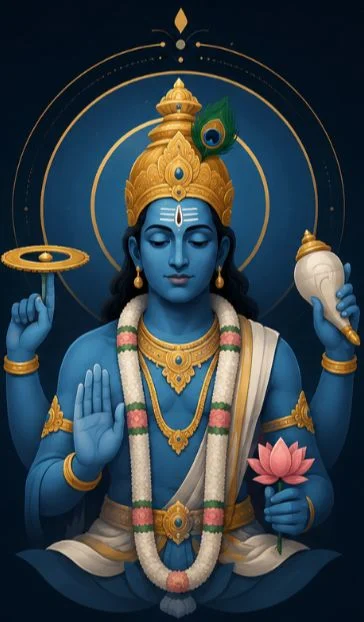
"Sahasra" = thousand. Each sahasranama is a chain of a thousand epithets of one deity - each name a meditation, each chain a complete upasana. Recitation grants the merit of all yajnas combined. Five major hymns below, each with dhyana shloka, signature opening names, and the phala-shruti (fruit-statement). The full namavali for the four sahasranamas runs into thousands of verses - commission a purohita-led full path for the complete recitation.
Vishnu Sahasranama · विष्णु सहस्रनाम
Deity: Maha Vishnu
Source: Mahabharata, Anushasana Parva 149. Bhishma's teaching to Yudhishthira on his bed of arrows.
Who: Recited by Vaishnavas of all sub-traditions - Sri-Vaishnavas, Madhvas, Gaudiyas, Smartas. Commentaries by Adi Shankara (Advaita), Parashara Bhattar (Vishishtadvaita), and Madhva.
When: Daily morning after bath. Mandatory on Ekadashi, Vaikuntha Ekadashi, Krishna Janmashtami, every Saturday (Shanivar - Vishnu's shanti day in some traditions).
Phala - Removal of all sins (recital alone equals reading the entire Veda). Cures disease, removes fear, grants moksha. Recited as antima-prayoga (final-rite reading) at death-bed.
Dhyana shloka
शान्ताकारं भुजगशयनं पद्मनाभं सुरेशं
विश्वाधारं गगनसदृशं मेघवर्णं शुभाङ्गम्।
लक्ष्मीकान्तं कमलनयनं योगिभिर्ध्यानगम्यं
वन्दे विष्णुं भवभयहरं सर्वलोकैकनाथम्॥
I bow to Vishnu - of peaceful form, reclining on the serpent, lotus-naveled, lord of devas, support of the universe, vast as the sky, dark as a cloud, of auspicious limb, lover of Lakshmi, lotus-eyed, attainable by yogis in meditation, remover of the fear of existence, sole lord of all worlds.
Signature opening names
विश्वं विष्णुर्वषट्कारो भूतभव्यभवत्प्रभुः।
भूतकृद्भूतभृद्भावो भूतात्मा भूतभावनः॥
(1) Vishvam - the universe itself. Vishnu - the all-pervader. Vashatkara - the sacrificial sound. Bhuta-bhavya-bhavat-prabhu - lord of past, future, and present. Bhutakrit - creator of beings. Bhutabhrit - supporter of beings. Bhava - existence. Bhutatman - soul of all beings. Bhutabhavana - nourisher of all beings.
पूतात्मा परमात्मा च मुक्तानां परमा गतिः।
अव्ययः पुरुषः साक्षी क्षेत्रज्ञोऽक्षर एव च॥
(2) Putatma - pure soul. Paramatma - supreme soul. Muktanam parama gati - supreme destination of the liberated. Avyaya - imperishable. Purusha - primordial person. Sakshi - witness. Kshetrajna - knower of the field. Akshara - indestructible.
योगो योगविदां नेता प्रधानपुरुषेश्वरः।
नारसिंहवपुः श्रीमान् केशवः पुरुषोत्तमः॥
(3) Yoga - the union. Yoga-vidam neta - leader of yoga-knowers. Pradhana-purusheshvara - lord of prakriti and purusha. Narasimha-vapu - of man-lion form. Sriman - abode of Sri. Keshava - having beautiful hair / slayer of Keshi. Purushottama - the supreme person.
Phala-shruti
य इदं शृणुयान्नित्यं यश्चापि परिकीर्तयेत्।
नाशुभं प्राप्नुयात्किञ्चित्सोऽमुत्रेह च मानवः॥
Whoever hears this daily, or recites it - that person never meets any misfortune, neither here nor hereafter.
Lalita Sahasranama · ललिता सहस्रनाम
Deity: Sri Lalita Tripurasundari (Maha Devi)
Source: Brahmanda Purana - Lalitopakhyana section. Revealed by Hayagriva to Agastya.
Who: Sri-Vidya upasakas, Shaktas, Smartas. The supreme tantra of Sri-Vidya.
When: Daily by Sri-Vidya upasakas. Mandatory on Fridays + Navaratri + Lalita Jayanti (Magha Purnima).
Phala - Conquest of all desires through the Devi herself. Removes Sri-Vidya doshas. Grants beauty, prosperity, scholarship, and ultimately Sri-Vidya moksha. The Devi resides where the namavali is daily recited.
Dhyana shloka
सिन्दूरारुणविग्रहां त्रिनयनां माणिक्यमौलिस्फुर-
त्तारानायकशेखरां स्मितमुखीमापीनवक्षोरुहाम्।
पाणिभ्यामलिपूर्णरत्नचषकं रक्तोत्पलं बिभ्रतीं
सौम्यां रत्नघटस्थरक्तचरणां ध्यायेत्परामम्बिकाम्॥
I meditate on the Supreme Mother - of vermilion-red form, three-eyed, her crown of rubies blazing with the moon as ornament, smiling-faced, full-breasted, holding in her hands a jewelled cup full of bee-nectar and a red lotus, gentle, her red feet resting on a jewelled pot.
Signature opening names
श्रीमाता श्रीमहाराज्ञी श्रीमत्सिंहासनेश्वरी।
चिदग्निकुण्डसम्भूता देवकार्यसमुद्यता॥
(1) Sri-Mata - the auspicious mother. Sri-Maharajni - the great queen. Srimat-simhasaneshwari - empress of the lion-throne. Chid-agni-kunda-sambhuta - arisen from the fire-pit of consciousness. Deva-karya-samudyata - risen for the work of the devas.
उद्यद्भानुसहस्राभा चतुर्बाहुसमन्विता।
रागस्वरूपपाशाढ्या क्रोधाकाराङ्कुशोज्ज्वला॥
(2) Udyad-bhanu-sahasrabha - radiant as a thousand rising suns. Chatur-bahu-samanvita - having four arms. Raga-svarupa-pashadhya - holding the noose of attraction. Krodhakarankushojvala - blazing with the goad of anger.
मनोरूपेक्षुकोदण्डा पञ्चतन्मात्रसायका।
निजारुणप्रभापूरमज्जद्ब्रह्माण्डमण्डला॥
(3) Manorupekshu-kodanda - her sugarcane bow being the mind. Pancha-tanmatra-sayaka - her five arrows being the five tanmatras (sense-objects). Nijaruna-prabha-puramajjad-brahmanda-mandala - submerging the cosmos in her own red effulgence.
Phala-shruti
श्री ललिताम्बिकायाश्च नाम्नां साहस्रकं जपेत्।
जपान्ते दुग्धभोजी स्यात्तेन तृप्तिमुपागतः॥
One should chant the thousand names of Sri Lalitambika. After japa, take milk-only food; thus the Devi becomes satisfied.
Shiva Sahasranama · शिव सहस्रनाम
Deity: Mahadeva - Shiva
Source: Mahabharata, Anushasana Parva 17. Vyasa's teaching to King Yudhishthira. Alternate version in the Linga Purana.
Who: Shaivas of all schools - Smarta, Veera-shaiva, Kashmir Shaiva, Pashupata, Lingayat.
When: Daily on Pradosha (13th tithi). Mandatory on Maha-Shivaratri, Shravana month Mondays, and Karthika month Mondays.
Phala - Conquest of mrityu (Mrityunjaya phala). Removal of disease. Grants long life, knowledge of Brahman, and merger with Shiva at the end of life.
Dhyana shloka
शान्तं पद्मासनस्थं शशिधरमकुटं पञ्चवक्त्रं त्रिनेत्रं
शूलं वज्रं च खड्गं परशुमभयदं दक्षभागे वहन्तम्।
नागं पाशं च घण्टां प्रलयहुतवहं साङ्कुशं वामभागे
नानाऽलङ्कारयुक्तं स्फटिकमणिनिभं पार्वतीशं नमामि॥
I bow to the lord of Parvati - peaceful, seated on a lotus, crowned with the moon, five-faced, three-eyed, on his right side bearing trident, vajra, sword, axe, and the abhaya gesture; on his left bearing serpent, noose, bell, the fire of dissolution, and the goad; adorned with many ornaments, crystal-clear in lustre.
Signature opening names
स्थिरः स्थाणुः प्रभुर्भीमः प्रवरो वरदो वरः।
सर्वात्मा सर्वविख्यातः सर्वः सर्वकरो भवः॥
(1) Sthira - immovable. Sthanu - the pillar. Prabhu - lord. Bhima - the terrifying. Pravara - the greatest. Varada - boon-giver. Vara - the chosen. Sarvatma - soul of all. Sarva-vikhyata - known to all. Sarva - everything. Sarvakara - the doer of all. Bhava - existence itself.
जटी चर्मी शिखण्डी च सर्वाङ्गः सर्वभावनः।
हरश्च हरिणाक्षश्च सर्वभूतहरः प्रभुः॥
(2) Jati - wearer of matted locks. Charmi - clad in skin. Shikhandi - wearer of crest (the moon). Sarvanga - of all limbs. Sarva-bhavana - nourisher of all. Hara - the remover. Harinaksha - deer-eyed. Sarva-bhuta-hara - destroyer (and remover) of all beings.
प्रवृत्तिश्च निवृत्तिश्च नियतः शाश्वतो ध्रुवः।
श्मशानवासी भगवान् खचरो गोचरोऽर्दनः॥
(3) Pravritti - the path of action. Nivritti - the path of withdrawal. Niyata - the controlled. Shashvata - eternal. Dhruva - fixed. Shmashana-vasi - dweller in the cremation ground. Bhagavan - the lord. Khachara - sky-mover. Gochara - observed by senses. Ardana - the destroyer.
Phala-shruti
य इदं पठते स्तोत्रं नित्यं भक्तिसमन्वितः।
स याति शिवसायुज्यं रुद्रलोके महीयते॥
Whoever reads this stotra daily with devotion attains Shiva-sayujya (oneness with Shiva) and is glorified in Rudraloka.
Ganesha Sahasranama · गणेश सहस्रनाम
Deity: Mahaganapati
Source: Ganesha Purana - taught by Brahma to Maharshi Mudgala.
Who: All Hindus - recited at the start of any major karma or new venture.
When: Bhadrapada Shukla Chaturthi (Ganesha Chaturthi), every Sankashti, Wednesday, house-warming, business openings.
Phala - Obstacle-removal. Wisdom. Success in new ventures. Riddhi-siddhi (prosperity + perfection).
Dhyana shloka
गजाननं भूतगणादिसेवितं कपित्थजम्बूफलचारुभक्षणम्।
उमासुतं शोकविनाशकारणं नमामि विघ्नेश्वरपादपङ्कजम्॥
I bow to the lotus feet of Vighneshvara - elephant-faced, served by the host of beings, lovingly partaking of wood-apple and rose-apple fruits, son of Uma, cause of grief's destruction.
Signature opening names
गणेश्वरो गणक्रीडो गणनाथो गणाधिपः।
एकदन्तो वक्रतुण्डो गजवक्त्रो महोदरः॥
(1) Ganeshvara - lord of ganas. Gana-krida - sportive with ganas. Gananatha - chief of ganas. Ganadhipa - lord of ganas. Ekadanta - one-tusked. Vakratunda - curved-trunked. Gajavaktra - elephant-faced. Mahodara - large-bellied.
लम्बोदरो धूम्रवर्णो विकटो विघ्ननाशनः।
सुमुखो दुर्मुखो बुद्धो दुर्धरो दुष्टहारकः॥
(2) Lambodara - long-bellied. Dhumravarna - smoke-coloured. Vikata - fierce. Vighna-nashana - destroyer of obstacles. Sumukha - fair-faced. Durmukha - fierce-faced. Buddha - the awakened. Durdhara - hard to control. Dushta-haraka - slayer of the wicked.
Phala-shruti
सहस्रनामभिर्दिव्यैरर्चितो भक्तिसंयुतम्। यः पठेच्छृणुयाद्वाऽपि सर्वं तस्य भविष्यति॥
Whoever reads or hears these thousand divine names with devotion - everything (prosperity, wisdom, victory) becomes his.
Hanuman Ashtottara Shata Namavali (108 names) · हनुमत् अष्टोत्तर शतनामावली
Deity: Hanuman
Source: Sundarakanda + Anjaneya-Sahasranama appendix.
Who: All Rama bhaktas - recited daily on Tuesday + Saturday.
When: Tuesday + Saturday. Hanuman Jayanti (Chaitra Purnima in North; Vaishakha Krishna Dashami in South). At any moment of fear.
Phala - Courage. Removal of fear, black magic, planetary affliction (especially Shani). Travel safety.
Dhyana shloka
मनोजवं मारुततुल्यवेगं जितेन्द्रियं बुद्धिमतां वरिष्ठम्। वातात्मजं वानरयूथमुख्यं श्रीरामदूतं शरणं प्रपद्ये॥
Swift as thought, equal in speed to the wind, master of the senses, foremost among the wise, son of Vayu, chief among the vanara troops - I take refuge in Sri Rama's messenger.
Signature opening names
ॐ आञ्जनेयाय नमः। ॐ महावीराय नमः। ॐ हनूमते नमः। ॐ मरुत्पुत्राय नमः। ॐ श्रीरामदूताय नमः।
ॐ केसरीनन्दनाय नमः। ॐ वायुपुत्राय नमः। ॐ पवननन्दनाय नमः। ॐ रुद्ररूपाय नमः। ॐ सीताशोकनिवारकाय नमः॥
(1-10) Salutations to: Anjaneya · Mahavira · Hanumat · Marut-putra · Sri-Rama-duta · Kesari-nandana · Vayuputra · Pavana-nandana · Rudra-rupa · Sita-shoka-nivaraka (remover of Sita's grief).
ॐ लङ्कादहाय नमः। ॐ सेतुबन्धाय नमः। ॐ दशग्रीवशिरोहराय नमः। ॐ अक्षघ्नाय नमः।
ॐ मेघनादगर्वहाय नमः। ॐ रामभक्ताय नमः। ॐ चिरञ्जीविने नमः। ॐ सुग्रीवसचिवाय नमः॥
(11-18) Lanka-daha (burner of Lanka) · Setu-bandha (bridge-builder) · Dashagriva-shiro-hara (destroyer of ten-headed Ravana's heads) · Akshaghna (slayer of Aksha) · Meghanada-garva-ha (humbler of Indrajit's pride) · Rama-bhakta (devotee of Rama) · Chiranjivin (the immortal) · Sugriva-sachiva (minister to Sugriva).
Phala-shruti
अष्टोत्तरशतं नाम्नां ब्रूमिते रामभक्तितः। यः पठेत्प्रातरुत्थाय नष्टभीरमरो भवेत्॥
These hundred-and-eight names spoken with devotion to Rama - whoever reads at dawn becomes free of all fear, deathless.
Lakshmi Sahasranama · लक्ष्मी सहस्रनाम
Deity: Mahalakshmi
Source: Skanda Purana, also Padma Purana. Some versions in Brahma Purana + Nityotsava.
Who: Vaishnava + Smarta households. Especially women + householders seeking dhana-prapti (acquisition of wealth) + grihastha-saukhya.
When: Every Friday. Diwali night (mandatory). Margashirsha Lakshmi-vrata. Akshaya Tritiya. Varalakshmi Vratam (Tamil/Karnataka).
Phala - Sthira-Lakshmi (stable wealth) - not just sudden inflow but sustained prosperity across generations. Removes alakshmi (poverty-goddess). Closes pitri-dosha drains.
Dhyana shloka
हिरण्यवर्णां हरिणीं सुवर्णरजतस्रजाम्।
चन्द्रां हिरण्मयीं लक्ष्मीं जातवेदो म आवह॥
O Jataveda (Agni), bring to me the golden-hued, deer-like, garlanded-with-gold-and-silver Lakshmi - moon-like, made of gold.
Signature opening names
श्रीदेवी कमला लक्ष्मीश्चला भूतिर्हरिप्रिया।
पद्मा पद्मालया सम्या पूर्णा श्रीः पद्मधारिणी॥
(1) Sri-devi - the goddess Sri. Kamala - lotus-born. Lakshmi - the auspicious. Chala - ever-moving (the unstable). Bhuti - opulence. Hari-priya - beloved of Hari. Padma - lotus. Padmalaya - lotus-dwelling. Samya - the equal. Purna - the full. Sri - auspicious itself. Padma-dharini - lotus-bearer.
पद्माक्षी पद्मसुन्दरी पद्मोद्भवा पद्ममुखी।
पद्मनाभप्रिया रमा पद्ममाला धरा महा॥
(2) Padmakshi - lotus-eyed. Padma-sundari - lotus-beautiful. Padmodbhava - lotus-born. Padma-mukhi - lotus-faced. Padmanabha-priya - beloved of Padmanabha (Vishnu). Rama - the delighting one. Padma-mala-dhara - bearer of lotus-garland. Maha - the great.
देवी कृष्णा च विद्या च वैष्णवी कमलासना।
चारुहासा चारुनेत्रा सुगात्री सुप्रसन्ना च॥
(3) Devi - the goddess. Krishna - the dark-blue (Krishna-priya). Vidya - knowledge. Vaishnavi - consort of Vishnu. Kamalasana - lotus-seated. Charu-hasa - of beautiful smile. Charu-netra - of beautiful eyes. Su-gatri - of beautiful limbs. Su-prasanna - well-pleased.
Phala-shruti
य इदं श्रद्धया युक्तः पठेद्भक्तिसमन्वितः।
लक्ष्मीस्तस्य भवेत्तुष्टा हृष्टा वै लक्ष्मणाग्रजः॥
Whoever recites this with faith and devotion - Lakshmi becomes pleased with that one, and so too does Lakshmana's elder brother (Rama / Vishnu).
Saraswati Sahasranama · सरस्वती सहस्रनाम
Deity: Sharada Saraswati
Source: Skanda Purana (Kashi Khanda) and Sanat-kumara Samhita.
Who: Students, scholars, musicians, dancers, writers, teachers - all whose work is vidya (knowledge) or kala (art). Children at aksharabhyasa.
When: Daily by students. Vasant Panchami (Magha Shukla Panchami - Saraswati Pooja day). Saraswati Avahana on Maha Navami of Sharad Navaratri. Exam preparation periods. Aksharabhyasa for children (first-letter ceremony).
Phala - Sharp intellect, clear speech, mastery of vidya + kala, memory power, success in studies + creative work. Removes vak-doshas (speech impediments).
Dhyana shloka
या कुन्देन्दु तुषारहारधवला या शुभ्रवस्त्रावृता।
या वीणावरदण्डमण्डितकरा या श्वेतपद्मासना॥
या ब्रह्माच्युतशङ्करप्रभृतिभिर्देवैस्सदा वन्दिता।
सा मां पातु सरस्वती भगवती निःशेषजाड्यापहा॥
She who is white as jasmine, the moon, snow, and pearl-garland - clad in pure white robes. Her hand adorned with the veena, blessing-boon. Seated on a white lotus. Worshipped by Brahma, Vishnu (Achyuta), Shiva (Shankara), and the other devas. May that Sri Saraswati, dispeller of all dullness, protect me.
Signature opening names
वाणी वाग्देवता वाणी ब्राह्मी भारती मती।
वागीश्वरी वाक्पतिप्रिया विद्या भाषा च भारती॥
(1) Vani - speech itself. Vag-devata - goddess of speech. Brahmi - consort of Brahma. Bharati - the bearer of light. Mati - intelligence. Vag-ishvari - empress of speech. Vakpati-priya - beloved of Vakpati (Brihaspati). Vidya - knowledge. Bhasha - language. Bharati again - for emphasis.
शारदा सर्वमातिनी शुक्ला वीणाकरमण्डिता।
कल्याणी विधिवल्लभा ब्रह्मविद्या मनोरमा॥
(2) Sharada - the lustrous (autumnal) one. Sarva-matini - mother of all. Shukla - white. Veena-kara-mandita - hand adorned with veena. Kalyani - bringer of welfare. Vidhi-vallabha - beloved of Vidhi (Brahma). Brahma-vidya - knowledge of Brahman. Mano-rama - mind-pleasing.
Phala-shruti
इदं रहस्यं परमं नाम्नां सहस्रकमुत्तमम्।
यः पठेच्छृणुयाद्वापि ज्ञानी मेधाविनो भवेत्॥
This thousand-names is supreme secret, the highest. Whoever recites or hears it becomes a jnani - endowed with sharp memory.
Durga Sahasranama · दुर्गा सहस्रनाम
Deity: Durga (Mahishasura-mardini)
Source: Bhavishyottara Purana + Skanda Purana (Devi-yamala). Also a separate Durga Sahasranama in Markandeya Purana.
Who: Shakta upasakas, all Devi-bhaktas, women during Navaratri.
When: All 9 nights of Navaratri (mandatory). Tuesday + Friday - Devi days. Ashtami + Navami of every paksha. Any threat to personal safety, lawsuit, illness of family.
Phala - Protection from enemies (visible + invisible). Removal of fear. Victory in litigation. Bahu-putra-prapti (sons). Cures chronic illness through Durga's shakti.
Dhyana shloka
सर्वमङ्गलमाङ्गल्ये शिवे सर्वार्थसाधिके।
शरण्ये त्र्यम्बके गौरि नारायणि नमोऽस्तु ते॥
O auspicious-among-the-auspicious, O Shiva-consort, O accomplisher of all goals! O refuge, three-eyed Gauri, Narayani - salutations to you.
Signature opening names
दुर्गा दुर्गार्तिशमनी दुर्गाश्रयविनाशिनी।
दुर्गमज्ञानदा दुर्गादैत्यलोकदवानला॥
(1) Durga - the inaccessible. Durga-arti-shamani - destroyer of the sufferings caused by Durga (the demon). Durga-ashraya-vinashini - destroyer of Durga's strongholds. Durga-ajnana-da - granter of knowledge of difficult-to-know. Durga-daitya-loka-davanala - forest-fire of the daityas of Durga's realm.
दुर्गमा दुर्गहन्त्री च दुर्गमज्ञानवारिणी।
दुर्गमध्यानभावा च दुर्गमज्ञानभेदिनी॥
(2) Durgama - hard-to-attain. Durga-hantri - slayer of Durga (demon). Durgama-jnana-varini - bestower of hard-to-attain knowledge. Durgama-dhyana-bhava - manifest in deep meditation. Durgama-jnana-bhedini - splitter of the most obscure ignorance.
चण्डी चण्डेश्वरी चण्डा चामुण्डा चण्डहासिनी।
चण्डमुण्डासुरछिदा चण्डविक्रमशालिनी॥
(3) Chandi - the fierce. Chandeshvari - lady of fierceness. Chanda - the awesome. Chamunda - slayer of Chanda + Munda. Chanda-hasini - of fierce laughter. Chanda-munda-asura-chhida - cleaver of the demons Chanda + Munda. Chanda-vikrama-shalini - endowed with fierce valour.
Phala-shruti
पठेद्यः शृणुयाद्वापि सहस्रनाम सर्वदा।
सर्वान् कामानवाप्नोति सदा देव्याः प्रसादतः॥
Whoever recites or hears this sahasranama always - obtains all desires, by the constant grace of the Devi.
Krishna Sahasranama · कृष्ण सहस्रनाम
Deity: Sri Krishna (distinct from the generic Vishnu Sahasranama - focuses on Krishna's lila-aspects)
Source: Garga Samhita, Padma Purana (Patala Khanda), Narada Pancharatra.
Who: Krishna bhaktas - Pushti Marga, Gaudiya Vaishnavas, Nimbarka sampradaya, ISKCON, all who follow Krishna as ishta-devata.
When: Daily morning by Krishna bhaktas. Mandatory on Janmashtami, Radhashtami, Govardhan Pooja, Gita Jayanti. Holi (Krishna's lila-day).
Phala - Krishna-prema (love of Krishna). Awakens madhurya-bhava. Removes attachment to non-Krishna pleasures. Vrindavan-vasa (residing in Krishna's eternal Vrindavan) after death.
Dhyana shloka
कस्तूरीतिलकं ललाटपटले वक्षःस्थले कौस्तुभं।
नासाग्रे वरमौक्तिकं करतले वेणुं करे कङ्कणम्॥
सर्वाङ्गे हरिचन्दनं सुलाललितं कण्ठे च मुक्तावलिः।
गोपस्त्रीपरिवेष्टितो विजयते गोपालचूडामणिः॥
With kasturi-tilak on the forehead-plate, Kaustubha on the chest, a fine pearl on the nose-tip, a flute in the palm, bangles on the wrist; sandal-paste across the whole body, a pearl-string on the neck - surrounded by gopis, the crest-jewel of cowherds reigns victorious.
Signature opening names
ॐ कृष्णः श्रीवल्लभः शार्ङ्गी विष्वक्सेनस्स्वसिद्धिदः।
क्षीरोदधामा व्यूहेशो भक्तिगम्यः परावरः॥
(1) Krishna - the dark-blue. Sri-vallabha - beloved of Sri. Sharngi - bearer of the Sharanga bow. Vishvaksena - commander of all senses. Sva-siddhi-da - granter of self-realisation. Kshirodadhama - abode of the milk-ocean. Vyuha-isha - lord of the 4 vyuhas. Bhakti-gamya - reachable only through bhakti. Para-avara - both supreme + nearest.
कृष्णस्य भूतिमध्यस्थ्यो हरिर्मायी जनार्दनः।
कञ्जलोचनः कमलाक्षः कमलापति-वल्लभः॥
(2) Krishnasya-bhuti-madhya-stha - abiding in the centre of all opulence. Hari - remover of all sin. Mayi - bearer of maya. Janardana - slayer of evil men. Kanja-lochana - lotus-eyed. Kamalaksha - lotus-petal-eyed. Kamalapati-vallabha - beloved of Lakshmi's lord.
गोविन्दो गोपिकाकान्तो गोकुलानन्दवर्धनः।
यशोदानन्दनः कृष्णो वासुदेवः सनातनः॥
(3) Govinda - protector of cows. Gopika-kanta - beloved of the gopikas. Gokulananda-vardhana - increaser of Gokula's joy. Yashoda-nandana - son of Yashoda. Krishna. Vasudeva - son of Vasudeva. Sanatana - eternal.
Phala-shruti
य इदं श्रावयेद्भक्त्या योऽपि शृणुयान्नरः।
स गच्छेत्परमं स्थानं वैकुण्ठं श्रीहरेर्गृहम्॥
Whoever recites this with devotion or even hears it, attains the supreme abode - Vaikuntha, the home of Sri Hari.
Rama Sahasranama · राम सहस्रनाम
Deity: Sri Rama (Maryada Purushottama)
Source: Padma Purana (Patala Khanda). Also Brihad-dharma Purana + Agastya Samhita.
Who: Rama bhaktas - Ramanandi sampradaya, Bhadrachala tradition, North + South India Rama-bhakti households, Ramakrishna order.
When: Sri Rama Navami (Chaitra Shukla Navami - mandatory). Daily morning by Rama-bhaktas. Hanuman Jayanti. Sita Navami. Diwali (Rama's return to Ayodhya).
Phala - Pitri-dosha removal. Maryada (boundary-keeping) in life. Removal of kalakuta (cumulative-sin). Ayodhya-vasa (eternal residence in Sri Rama's court) after death.
Dhyana shloka
श्रीरामं रघुनन्दनं रघुकुलोत्तंसं गुणाकरम्।
धर्मात्मानं समर्थकं सकलविद्याभूषितं श्यामलम्॥
लक्ष्मीनिवासं रघुवीरमादिजननं कारुण्यवारानिधिम्।
वन्दे राघवनन्दनं रघुपतिं श्रीसीतया संयुतम्॥
I bow to Sri Rama - the joy of the Raghu dynasty, crest-jewel of the Raghu clan, abode of all virtues, dharmic-souled, all-capable, adorned with all knowledge, dark-blue. Lakshmi's abode, hero of the Raghus, the original birth-cause, ocean of compassion - joined with Sri Sita, the Raghu-lord.
Signature opening names
ॐ श्रीराम राम रामेति रमे रामे मनोरमे।
सहस्रनाम तत्तुल्यं रामनाम वरानने॥
(Opening prayer) Sri Rama Rama Rama - I delight in Rama, the heart-pleasing one. The name Rama alone equals a thousand names - O fair-faced one (Parvati, to whom Shiva taught this).
विश्वामित्रप्रियो दान्तः शत्रुजिच्छत्रुतापनः।
सर्वज्ञस्सर्वदेवादिः शरण्यो वल्कलाम्बरः॥
(1) Vishvamitra-priya - beloved of Vishvamitra. Dantah - self-controlled. Shatru-jit - conqueror of enemies. Shatru-tapana - burner of enemies. Sarva-jna - all-knowing. Sarva-deva-adi - origin of all devas. Sharanya - refuge of all. Valkala-ambara - clad in tree-bark (during exile).
जानकीवल्लभो रामो वैदेहीवल्लभस्तथा।
रामचन्द्रः शुभो धीरो वीरस्सत्यपराक्रमः॥
(2) Janaki-vallabha - beloved of Janaki. Rama. Vaidehi-vallabha - beloved of Vaidehi. Ramachandra - Rama of the moon. Shubha - auspicious. Dhira - steady. Vira - heroic. Satya-parakrama - of true valour.
Phala-shruti
य इदं रामनाम्नां सहस्रं श्रद्धयान्वितः।
जपेत्प्रत्यहमुत्थाय सर्वान् कामान् अवाप्नुयात्॥
Whoever recites this thousand names of Rama daily upon rising, with faith - obtains all desires.
Surya Sahasranama · सूर्य सहस्रनाम
Deity: Surya (Aditya)
Source: Bhavishya Purana (Brahma Parva) - taught by Sage Yajnavalkya to King Janaka. Also in Skanda Purana.
Who: Smarta brahmanas (Surya is one of the 5 panchayatana deities). Saura sampradaya. Anyone seeking remedies for graha-doshas, eye-disease, or skin-disease.
When: Sunday (Ravivara). Sunrise daily during arghya-pradana. Ratha Saptami (Magha Shukla Saptami - Surya's ratha turns northward). Solar eclipses. Makara Sankranti.
Phala - Eye-vision restored. Skin-disease cured. Heart-health. Charismatic personality. Royal-favour. Removes Surya-graha dosha in jataka.
Dhyana shloka
जपाकुसुम सङ्काशं काश्यपेयं महाद्युतिम्।
तमोऽरिं सर्वपापघ्नं प्रणतोऽस्मि दिवाकरम्॥
I bow to Divakara - radiant like a hibiscus, son of Kashyapa, of great splendour, enemy of darkness, destroyer of all sin.
Signature opening names
ॐ विश्वविद्विश्वजिद्धेतुर्विश्वात्मा विश्वतोमुखः।
विश्वेश्वरो विश्वयोनिर्नियतात्मा जितेन्द्रियः॥
(1) Vishva-vit - knower of the universe. Vishva-jit - conqueror of the universe. Hetu - the cause. Vishva-atma - soul of the universe. Vishvato-mukha - faces in all directions. Vishva-ishvara - lord of the universe. Vishva-yoni - womb of the universe. Niyat-atma - controlled-self. Jitendriya - conqueror of senses.
कलिकल्मषहन्ता च पुण्यश्रवणकीर्तनः।
यदोरुहासनो योगी सुषुप्तश्शयनप्रियः॥
(2) Kali-kalmasha-hanta - destroyer of Kali-yuga's sins. Punya-shravana-kirtana - auspicious to hear and praise. Yadoru-hasana - of laughter like deep ocean. Yogi - the supreme yogi. Sushupta - the deeply rest. Shayana-priya - beloved at lying-rest.
Phala-shruti
य इदं श्रावयेद्भक्त्या यो वा शृणुयादपि।
सर्वव्याधिविनिर्मुक्तस्सर्वसौभाग्यवान्भवेत्॥
Whoever recites this with devotion or hears it - becomes free of all disease and gains all auspiciousness.
Subramanya Sahasranama · सुब्रह्मण्य सहस्रनाम
Deity: Sri Subramanya / Murugan / Karthikeya / Skanda
Source: Skanda Purana (Sankara Samhita + Sambhava Khanda). Also in Brahmanda Purana.
Who: Tamil Murugan-bhaktas (Tamil Nadu + Sri Lanka + Singapore + Malaysia diaspora). All Subramanya-temple traditions across the Pancha Aaru-padai-veedu (6 Murugan abodes).
When: Daily at every Murugan temple. Mandatory on Skanda Sashti (Karthika Shukla Shashti, 6-day fast-vigil). Vaikasi Vishakam (Vishakha nakshatra in Vaishakha = Murugan's birth). Thaipusam.
Phala - Removes Mangala (Mars) graha-dosha. Victory over enemies + chronic disease. Brahmacharya-shakti. Skanda-loka after death.
Dhyana shloka
षड्वक्त्रं द्वादशभुजं षण्णेत्रं रक्तविग्रहम्।
वल्लीदेवसेनेशं वन्दे स्कन्दं शिवात्मजम्॥
I bow to Skanda, son of Shiva - six-faced, twelve-armed, six-eyed, red-bodied, lord of Valli + Devasena.
Signature opening names
स्कन्दो गुहश्च षण्मातुरः शक्तीशो वल्लभादिपः।
पलनीशः कुक्कुटध्वजः कार्तिकेयश्शिखिप्रियः॥
(1) Skanda - the swift. Guha - the cave-dweller. Shanmatura - child of 6 mothers (Krittikas). Shaktisha - lord of the shakti-spear. Vallabhadhipa - lord of the beloved. Palanisha - lord of Palani. Kukkutadhvaja - rooster-bannered. Karthikeya - son of the Krittikas. Shikhi-priya - beloved of the peacock.
सुब्रह्मण्यो गणाध्यक्षो स्वामीनाथो महाबलः।
भक्तप्रियः शूर वीरस्तारकारिर्जयप्रदः॥
(2) Subramanya - well-loved by Brahma. Ganadhyaksha - head of the ganas. Swaminatha - lord of swamis. Mahabala - mighty. Bhakta-priya - beloved of devotees. Shura - heroic. Vira - warrior. Tarakari - enemy of Tarakasura. Jayaprada - granter of victory.
Phala-shruti
य इदं नामसाहस्रं पठेद्वै भक्तितः सदा।
सर्वान्कामानवाप्नोति स्कन्दस्यानुग्रहाद्ध्रुवम्॥
Whoever reads these thousand names with devotion always - surely obtains all desires, by Skanda's grace.
Dattatreya Sahasranama · दत्तात्रेय सहस्रनाम
Deity: Sri Dattatreya (combined avatar of Brahma + Vishnu + Shiva)
Source: Rudra-yamala Tantra + Datta-yamala. Also in Avadhuta Upanishad supplements.
Who: Datta-bhaktas - Maharashtra + Karnataka + Konkan + Goa traditions. Akkalkot Swami, Manik Prabhu, Shridhara Swamigalu, Tembe Swami sampradayas.
When: Datta Jayanti (Margashirsha Purnima). Every Thursday (Datta's day). Audumbar visits. Pithapuram + Kuravapur + Ganagapura + Varadahalli pilgrimage.
Phala - Removes ancestral curses + pitri-dosha. Grants sannyasa-shakti + vairagya. Datta's personal grace.
Dhyana shloka
सच्चिदानन्दरूपाय सर्वलोकमयाय च।
त्रैमूर्तिस्वरूपाय दत्तात्रेयाय नमो नमः॥
Salutations again and again to Dattatreya - of sat-chid-ananda form, embodying all worlds, of the three-fold-deity form.
Signature opening names
ॐ श्रीदत्तात्रेयो योगीशो विश्वात्मा विश्ववन्दितः।
ब्रह्मविष्णुशिवात्मा अनसूयासुतो मुनिः॥
(1) Sri Dattatreya - the given-to-Atri. Yogisha - lord of yogis. Vishvatma - soul of the universe. Vishva-vandita - adored by the universe. Brahma-Vishnu-Shiva-atma - soul of Brahma-Vishnu-Shiva. Anasuya-suta - son of Anasuya. Muni - silent sage.
त्रिमूर्तिस्त्रिगुणस्त्र्यक्ष षडंगो विकटाननः।
षड्भुजः शूलधृक्शान्तो दण्डधृत्कमलासनः॥
(2) Tri-murti - three-formed. Tri-guna - bearer of the three gunas. Tryaksha - three-eyed. Shadanga - six-limbed. Vikatanana - fierce-faced. Shadbhuja - six-armed. Shula-dhrik - trident-bearer. Shanta - peaceful. Danda-dhrit - staff-bearer. Kamalasana - lotus-seated.
Phala-shruti
य इदं पठते नित्यं श्रद्धया भक्तिसंयुतः।
दत्तात्रेय प्रसादेन सर्वकामसमृद्धिमान्॥
Whoever reads this daily with faith and devotion - by Dattatreya's grace, becomes prosperous in all desires.
Radha Sahasranama · राधा सहस्रनाम
Deity: Sri Radha-rani - Krishna's eternal consort
Source: Narada-pancharatra (Patala Khanda). Brahma-vaivarta Purana (Krishna Janma Khanda).
Who: Gaudiya Vaishnavas, Nimbarka sampradaya, Pushti Marga. Particularly the Radha-vallabha + Manipur Vaishnava traditions.
When: Radhashtami (Bhadrapada Shukla Ashtami - Radha's birthday). Daily by Vrindavan + Barsana resident-devotees. Janmashtami eve. Karthika month evenings.
Phala - Awakens madhurya-bhava (sweet bridal-devotion). Removes attachment to non-Krishna pleasures. Vrindavan-vasa after death.
Dhyana shloka
राधां कृष्णप्रियां वन्दे हरिप्राणेश्वरीं पराम्।
नमामि गोपिकानाथां वृन्दावनविलासिनीम्॥
I bow to Radha - beloved of Krishna, supreme lord of Hari's very life. I salute the mistress of the gopikas, the playful one of Vrindavan.
Signature opening names
राधा रासेश्वरी रास वासिनी रसिकेश्वरी।
कृष्णप्राणाधिका कृष्णप्रिया कृष्णस्वरूपिणी॥
(1) Radha - she who is worshipped (radh-yate). Raseshwari - empress of the rasa-lila. Rasavasini - dweller in rasa. Rasikeshwari - lady of the rasikas. Krishna-pranadhika - dearer to Krishna than his life. Krishna-priya - beloved of Krishna. Krishna-svarupini - having Krishna's very form.
वृन्दा वृन्दावनी वृन्दा वृन्दावनविनोदिनी।
चन्द्रावली चन्द्रकान्ता शरच्चन्द्रप्रभानना॥
(2) Vrinda - surrounded by gopis. Vrindavani - of Vrindavan. Vrinda again. Vrindavana-vinodini - playful in Vrindavan. Chandravali - of moonlight-rows. Chandrakanta - moon-beautiful. Sharach-chandra-prabhanana - autumn-moon-faced.
Phala-shruti
राधासहस्रनामैतत्पठेच्छृणुयाद्वा यः।
राधाकृष्णकृपापात्रो भवेत्तस्य न संशयः॥
Whoever reads or hears this Radha-Sahasranama - becomes a recipient of Radha-Krishna's grace; there is no doubt.
Tulasi Sahasranama · तुलसी सहस्रनाम
Deity: Sri Tulasi Devi (the holy basil, consort of Vishnu)
Source: Brahmanda Purana + Padma Purana (Patala Khanda + Bhumi Khanda).
Who: Smarta + Vaishnava brahmana women. Daily at the tulasi-vrindavana (household tulasi altar).
When: Daily morning + evening at tulasi-watering. Karthika month (all 30 days at tulasi). Tulasi Vivaha (Karthika Shukla Dvadashi - Tulasi married to Vishnu, first marriage of season). Tulasi Jayanti (Karthika Shukla Dvadashi alternate count).
Phala - Removes pitri-dosha (Tulasi-leaf placed at the lips of the dying grants moksha). Marital harmony for women (pativrata-shakti). Lakshmi-prosperity (Tulasi = Vishnu's wife = Lakshmi-svarupa).
Dhyana shloka
तुलसी श्रीमहालक्ष्मि विद्याविद्ये यशस्विनी।
धर्म्ये धर्मानने देवि देवीदेवमनःप्रिये॥
Tulasi - Sri Mahalakshmi - knowledge and ignorance both, fame-bearer, dharma-faced, beloved of the deva-of-devas (Vishnu).
Signature opening names
तुलसी हरिवल्लभा वृन्दा हरिप्रिया।
श्रीतुलसी श्यामतुलसी रामतुलसी कृष्णतुलसी॥
(1) Tulasi - the incomparable. Hari-vallabha - beloved of Hari. Vrinda - surrounded. Hari-priya - dear to Hari. Sri-Tulasi - auspicious tulasi. Shyama-Tulasi - dark-tulasi. Rama-Tulasi - Rama-tulasi. Krishna-Tulasi - Krishna-tulasi (the 4 main household varieties).
पद्मिनी विश्वपूज्या च विश्वपावनी पुष्पसाररा।
नन्दिनी देवपूज्या देवदेववपुर्द्धरा॥
(2) Padmini - lotus-like. Vishva-pujya - worshipped by the world. Vishva-pavani - purifier of the world. Pushpa-sarara - flower-essence. Nandini - joy-giver. Deva-pujya - worshipped by devas. Deva-deva-vapur-dhara - bearer of the body of the deva-of-devas (Vishnu).
Phala-shruti
य इदं तुलसीनाम्नां सहस्रं पठते सदा।
भुक्तिमुक्तिप्रदं चैव सर्वारिष्टविनाशनम्॥
Whoever reads these thousand names of Tulasi daily - grants enjoyment + liberation, destroys all calamities.
Narasimha Sahasranama · नृसिंह सहस्रनाम
Deity: Sri Narasimha (man-lion avatar of Vishnu)
Source: Brahmanda Purana + Narasimha Purana + Vishnu-dharmottara Purana.
Who: Sri Vaishnavas, Madhvas, Andhra-Telangana brahmanas particularly. Devotees facing fear, black magic, lawsuits, chronic disease.
When: Narasimha Jayanti (Vaishakha Shukla Chaturdashi). Every Saturday (Narasimha's day). Dusk hours specifically (Narasimha emerged at twilight). At any moment of fear.
Phala - Removes all forms of fear (the supreme abhaya-mantra). Destroys black magic + pretas + pisachas. Frees from lawsuits. Grants Narasimha-loka after death.
Dhyana shloka
सत्यज्ञानानन्दरूपं नृसिंहं पंचवक्त्रकम्।
प्रह्लादवरदं देवं भयहारं भजाम्यहम्॥
I worship Narasimha - of sat-chit-ananda form, five-faced, boon-giver to Prahlada, remover of fear.
Signature opening names
नृसिंहो नरसिंहश्च हरिः हरिणाक्षः महाहरिः।
प्रह्लादप्रिय आद्यश्च आदिमध्यान्तरहितः॥
(1) Nrisimha - man-lion. Narasimha. Hari - the remover. Harinaksha - deer-eyed. Maha-hari - great Hari. Prahlada-priya - beloved of Prahlada. Adya - first. Adi-madhya-anta-rahita - without beginning, middle, or end.
दैत्यान्तकः दैत्यसूदनो हिरण्यकशिपोरन्तकः।
उग्रः उग्रनृसिंहश्च ज्वालामुखो विकट हास्यः॥
(2) Daityantaka - slayer of daityas. Daitya-sudana - destroyer of daityas. Hiranyakashipur-antaka - ender of Hiranyakashipu. Ugra - fierce. Ugra-Nrisimha - fierce Narasimha. Jvala-mukha - flame-faced. Vikata-hasya - terrifying laughter.
Phala-shruti
य इदं पठते नित्यं नृसिंहस्य महात्मनः।
नाम्नां सहस्रं स याति विष्णोः पदमनुत्तमम्॥
Whoever reads this thousand names of the great-souled Narasimha daily - attains Vishnu's supreme abode.
Ayyappa Sahasranama · अय्यप्प सहस्रनाम
Deity: Sri Ayyappa / Hariharaputra / Manikantha (son of Hari + Hara, born of Mohini + Shiva)
Source: Bhutanatha Upakhyana + Sabarimala Mahatmya texts.
Who: Kerala, Tamil Nadu, Karnataka Ayyappa-bhaktas. Sabarimala pilgrims during Mandala-Makaravilakku season (Nov-Jan, 41-day mandala vrata).
When: Daily by mala-dharis (devotees wearing the Ayyappa-mala). Mandalakala (41-day vrata, mid-November onwards). Makaravilakku (Makara Sankranti, Jan 14). Saturdays + Shashti days.
Phala - Removes chronic diseases (Ayyappa is a healer-deity). Brahmacharya-shakti (Ayyappa is naishtika brahmachari - eternal celibate). Sabarimala darshan-success.
Dhyana shloka
अस्याजितस्य गोपीं स्वामिन्दृष्टापालयोः सुसम्भवम्।
हरिहरसुतं वन्दे आगतं रक्षकं विभुम्॥
I bow to Hariharaputra - the lord of the unconquered Pampa-region - son of Hari + Hara, come as protector and lord.
Signature opening names
ॐ शिवपुत्राय नमः। ॐ हरिहरात्मजाय नमः। ॐ धर्मशास्त्रे नमः। ॐ मणिकण्ठाय नमः। ॐ अय्यप्पाय नमः।
ॐ शबरीशाय नमः। ॐ मोहिनीसुताय नमः। ॐ शास्तृवेषधराय नमः। ॐ भूतनाथाय नमः। ॐ कलिप्रियाय नमः॥
(1-10) Salutations to: Son of Shiva. Son of Hari + Hara. Dharma-shasta (lord of dharma-rule). Bell-throated (Manikantha). Ayyappa. Lord of Sabari. Son of Mohini. Wearer of the shasta-form. Lord of all bhutas. Beloved of the Kali age.
पम्पावासाय नमः। तत्त्वमयाय नमः। आत्मवेदिने नमः। शरणागतवत्सलाय नमः।
वरदाय नमः। अभयप्रदाय नमः। दिव्यतेजसे नमः। अग्निवर्णाय नमः॥
(11-18) Dweller-at-Pampa. Tattva-embodied. Knower-of-Self. Lover-of-the-surrendered. Boon-giver. Fearlessness-granter. Of divine radiance. Fire-coloured.
Phala-shruti
य इदं पठते स्तोत्रं हरिहरसुतस्य मे।
श्रद्धया भक्तियुक्तश्च सर्वान्कामान्समाप्नुयात्॥
Whoever reads this stotra of the son of Hari + Hara - with faith and devotion - obtains all desires.