
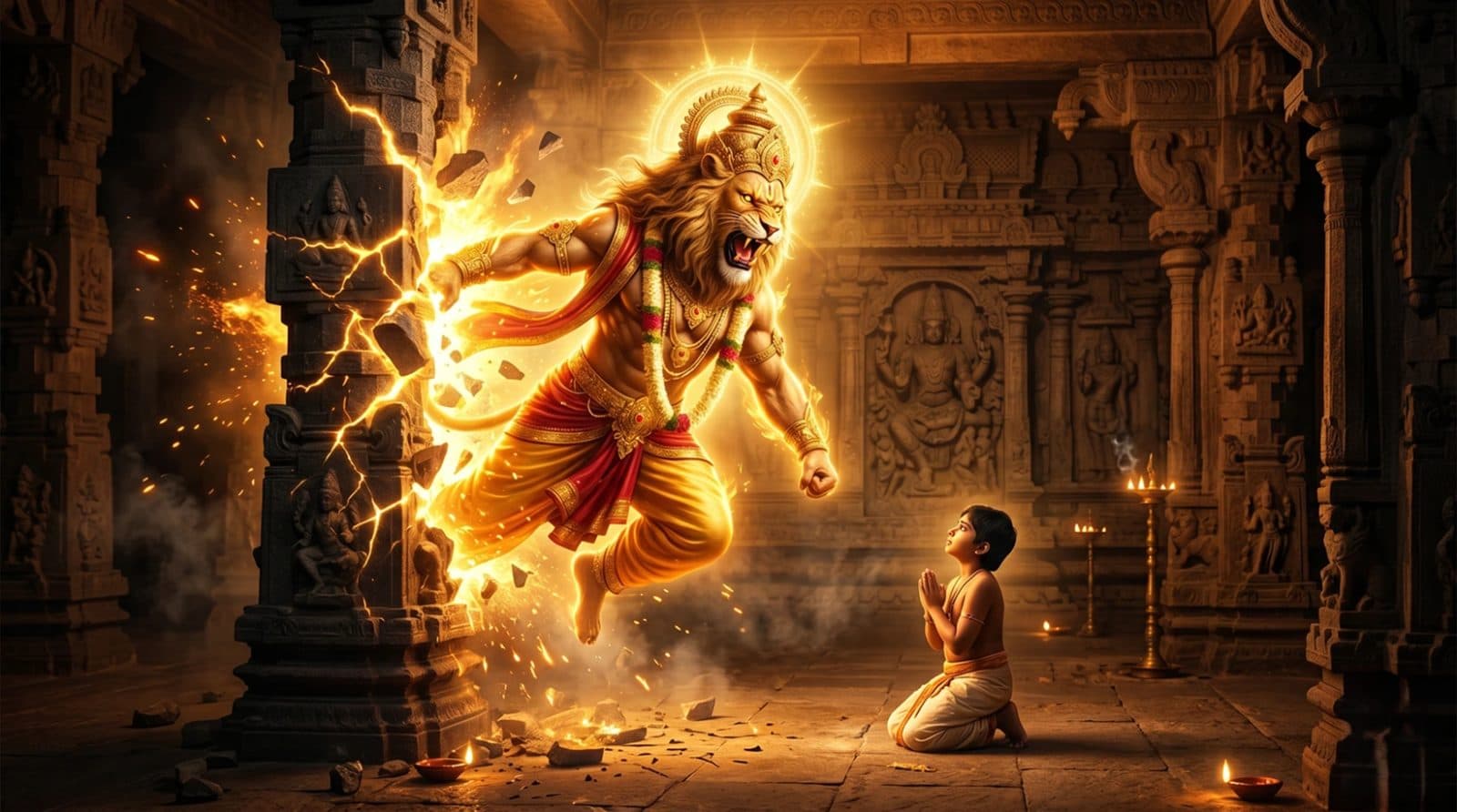
The avatar that transcends categories
Hiranyakashipu’s boon made him unkillable by man or animal, by day or night, indoors or outdoors, by weapon or non-weapon, on earth or in sky. Vishnu appeared as the Man-Lion — neither man nor animal — at the threshold, at dusk, placed him on his lap, and tore him apart with his claws. Every one of the five conditions is met and none is broken.
A pilgrimage to a Narasimha kshetra is a meditation on that: the divine is not bound by the categories a boon can be written in.
The Narasimha invocation
ॐ नमो भगवते नरसिंहाय । नमस्तेजस्तेजसे आविराविर्भव वज्रनख वज्रदंष्ट्र कर्माशयान् रन्धय रन्धय तमो ग्रस ग्रस ॐ स्वाहा ॥
Oṃ namo bhagavate narasiṃhāya | Namas tejas tejase āvirāvirbhava vajranakha vajradaṃṣṭra karmāśayān randhaya randhaya tamo grasa grasa oṃ svāhā ||
Salutations to Lord Narasimha. May his brilliant light manifest. O Narasimha with diamond claws and diamond teeth — pierce, pierce the burden of karma. Swallow the darkness. Om Svaha.
Source: Narasimha Tapaniya Upanishad, Atharvashira recension
The eight kshetras
In the order SevaCart lists them, beginning at Ahobilam. Each entry stands on its text; the photographs are documentary and appear where a temple photograph has been uploaded.
Ahobilam - Nava Narasimha kshetra
Ahobilam, Nandyal district, Andhra Pradesh (230 km from Hyderabad)

Form: Nine forms: Ugra, Kroda, Malola, Stamba, Karanja, Bhargava, Yogananda, Chatravata, Pavana Narasimha
Ahobilam is the supreme Narasimha kshetra - the site where Narasimha actually slew Hiranyakashipu and received Prahlada's worship. Nine distinct Narasimha temples in one sacred forest valley represent nine moods and forms. Upper Ahobilam (8 km trek from Lower Ahobilam) contains the ancient svayambhu murti.
Nine distinct Narasimha temples across a forested valley - the only place in India where all 9 forms are present in one kshetra. Ugra Narasimha (fierce form) at Upper Ahobilam is svayambhu. The Ahobila Matha (Narasimha Vaishnava institution) is headquartered here.
Festival: Narasimha Jayanti (Vaishaka Shukla Chaturdashi, May). Brahmotsavam (10 days).
Visiting: Upper Ahobilam requires an 8-km forest trek - guides mandatory. Best season: October-March.
Simhachalam - Varaha-Narasimha
Simhachalam, Visakhapatnam district, Andhra Pradesh (16 km from Vizag)

Form: Varaha-Narasimha - unique combined form (half-boar, half-lion; only such murti in India)
The murti at Simhachalam is concealed under a thick coating of sandalwood paste throughout the year. The original form (boar-lion combined) is only visible for 12 hours per year on Akshaya Tritiya when the paste is removed for Chandana Yatra. The Chalukya-period stone inscription (1098 CE) is among the oldest in Andhra.
The murti is perpetually covered in sandalwood paste - devotees see the paste-covered form all year. On Akshaya Tritiya, the paste is removed for 12 hours - the unique darshan. Prasad includes sandalwood paste.
Festival: Akshaya Tritiya (Chandana Yatra) - the only day the murti is seen uncovered. Narasimha Jayanti (May).
Visiting: Akshaya Tritiya at Simhachalam draws hundreds of thousands - arrive by 3 AM for the 12-hour darshan window. Book accommodation 3+ months ahead.
Yadagirigutta - Lakshmi Narasimha
Yadagirigutta, Yadadri Bhuvanagiri district, Telangana (70 km from Hyderabad)

Form: Five forms in natural caves: Jwala, Gandha-Bherunda, Ugra, Yoga, Lakshmi Narasimha
The Yadava Rishi performed tapas at this hill. Narasimha appeared in five forms - the last being Lakshmi Narasimha (with Lakshmi seated on his left knee). The Telangana Government undertook a complete temple reconstruction (2016-2023), spending ₹1800+ crore - the new complex is now one of the most magnificent in South India.
Five forms of Narasimha in natural caves at the hill summit. The temple complex (rebuilt 2016-2023) now rivals Tirumala in grandeur. Online slot booking via Yadadri Trust website.
Festival: Narasimha Jayanti (May). Brahmotsavam (Karthika month, 9 days).
Visiting: The new 2023 complex is spectacular - the main gopuram is 126 feet. Online slot booking recommended; darshan time ~45 minutes with booking.
Mangalagiri - Panakala Narasimha
Mangalagiri, Guntur district, Andhra Pradesh (10 km from Amaravati)

Form: Panakala Narasimha - the 'drinking' Narasimha
The deity's mouth is a natural rock fissure. Devotees pour panakam (jaggery sweet-drink) into the fissure - the deity 'drinks' it. Half the panakam poured returns as prasad; the other half disappears. The exact depth of the rock fissure and where the liquid goes has never been determined. Also one of the 108 Divya Desams (Vishnu kshetra).
The deity's 'mouth' is a natural rock fissure - panakam is poured in and the deity drinks it. Half returns as prasad. The perpetual mystery of where the liquid goes. One of the 108 Divya Desams.
Festival: Narasimha Jayanti (May). Brahmotsavam (Karthika month). Ugadi (Telugu New Year) - lakhs of pilgrims.
Visiting: Main temple is on the hill (30 min ascent, elevator available). Panakam offering queue starts at 4 AM on festivals. Also a Divya Desam - combine in 108-Divya Desam circuit.
Sholinghur - Yoga Narasimha
Sholinghur, Ranipet district, Tamil Nadu (80 km north-west of Chennai)

Form: Yoga Narasimha (the meditative, seated form in yogic posture)
After slaying Hiranyakashipu, Narasimha's fury was uncontrollable. Prahlada prayed to him to calm down. Narasimha sat in the yogic posture - cross-legged, meditative, fierce energy now internalized. The hill at Sholinghur has two summits - Upper Hill (Narasimha) and Lower Hill (Hanuman/Anjaneya). Both are visited in sequence as a traditional circuit. Also one of the 108 Divya Desams.
Yoga Narasimha (the only widely worshipped yogic form). Two-hill circuit: upper hill (Narasimha) + lower hill (Hanuman) - both representing fierce protection. A Divya Desam.
Festival: Narasimha Jayanti (May). Vaikunta Ekadashi (December-January) - all-night vigil.
Visiting: Both hills are climbed in sequence - 2-3 hours total. Good base for a Vellore fort visit.
Namakkal - Namakkal Narasimha
Namakkal, Namakkal district, Tamil Nadu (160 km from Chennai)

Form: Standing 18-foot Narasimha (Sthana-Narasimha); same rock also has Ranganatha (reclining Vishnu) below
The rock fort at Namakkal has an ancient cave temple carved into natural rock. Inside is a standing 18-foot Narasimha in 'Sthana' posture. The same rock has a Ranganatha (reclining Vishnu) in the lower cave - the same rock contains both the fierce and the peaceful Vishnu. A Varaha shrine is also present.
18-foot standing Narasimha carved into natural rock. The same rock contains Ranganatha below - fierce and peaceful aspects of Vishnu in one stone. The town's transport industry has Narasimha as its patron deity.
Festival: Narasimha Jayanti (May). Brahmotsavam. Vaikunta Ekadashi.
Visiting: Combine with Namagiri Lakshmi temple (200 m away) - Namagiri is the kula-devata of Ramanujan the mathematician; a fascinating pilgrimage for the scientifically-minded.
Vedadri (Mattapalli) - Lakshmi Narasimha
Vedadri, Nalgonda district, Telangana (on the Krishna river banks, 62 km from Hyderabad)

Form: Lakshmi Narasimha in padmasana (lotus posture) - the gracious, peaceful form
The four Vedas performed tapas at this hill seeking Narasimha's presence. Narasimha appeared as Lakshmi Narasimha. The hill is therefore called 'Veda Giri' / 'Vedadri'. The Krishna river flows at the base of the hill. This temple is a key Sri Vaishnava pilgrimage site.
The 'Vedic' Narasimha - worshipped by the Vedas themselves. Krishna-river-bank location. The murti is in padmasana with Lakshmi - the most peaceful Narasimha form. A Sri Vaishnava pilgrimage.
Festival: Narasimha Jayanti (May). Vaikunta Ekadashi (December-January).
Visiting: The hill is accessible by a flight of steps (800+) or road. Krishna river boat rides available in the mornings. Combine with Nagarjuna Sagar dam (nearby).
Antarvedi - Lakshmi Narasimha on the seashore
Antarvedi, East Godavari district, Andhra Pradesh (Godavari-sea confluence)

Form: Lakshmi Narasimha at the Godavari-Bay of Bengal confluence - the unique seashore form
Antarvedi is where the Godavari river meets the Bay of Bengal. Narasimha manifested here at the command of Prahlada himself - Prahlada wanted a permanent Narasimha kshetra at a sacred river-ocean junction. The convergence of the holy Godavari and the ocean at a Narasimha kshetra is considered extremely potent for moksha and ancestral liberation. The murti faces the sea.
The only major Narasimha temple at a river-ocean confluence. The Godavari pushkar (sacred river festival, every 12 years) makes Antarvedi the focal point for lakhs of pilgrims. Sea-facing Narasimha is rare.
Festival: Godavari Pushkaram (12-year cycle, major). Narasimha Jayanti (May). Karthika Purnima.
Visiting: Antarvedi is accessible by road from Ravulapalem / Amalapuram. The river-delta landscape is beautiful. Best visited outside monsoon (October-February).
Why the count varies
The eight kshetras below are a selection of major Narasimha temples, not a fixed classical circuit. Where a traditional grouping is named in print it is usually the nine Nava Narasimha Kshetras, and Ahobilam alone holds nine shrines of its own. Treat this as a route worth walking rather than a canon to complete.
A related question is whether Puri has its own eight. It does not: neither the temple administration nor the Government of Odisha’s survey records an eight-fold Narasimha grouping there, though Puri does keep sixteen documented Narasimha temples and three guardian octads of Shiva, Shakti and Hanuman.
Sources
- Ahobilam — the nine Narasimha shrines — Wikipedia (encyclopaedic summary, cited for the nine-shrine grouping) (read 31 Aug 2026). Ahobilam in Andhra Pradesh holds nine Narasimha shrines. The pan-India grouping is likewise usually counted as nine (Nava Narasimha Kshetras), not eight.
Where a temple's own publications name a different set, follow the temple. The count here is SevaCart's editorial selection and is presented as one.
Commission at a Narasimha kshetra
Offer a Narasimha seva at a verified kshetra temple.
Narasimha Ashtottara Archana and Ugra Narasimha Homa, performed by KYC-verified archakas.