Matsya · मत्स्य
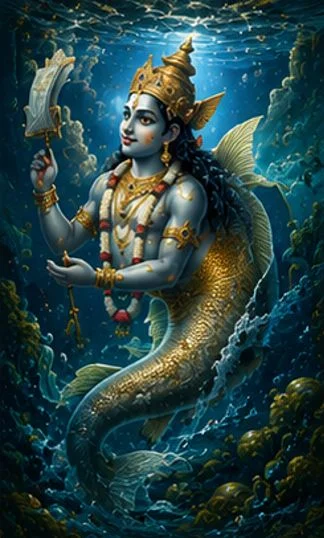
Satya Yuga (~end of preceding kalpa)Form: Fish (matsya) - depicted with the upper body of Vishnu and the lower body of a fish.
The cosmic cause
The asura Hayagriva had stolen the four Vedas from Brahma and hidden them in the cosmic ocean. A great pralaya (deluge) was imminent at the end of the Manvantara.
The story
King Satyavrata (later Vaivasvata Manu) was performing tarpana when a small fish jumped into his palms and begged protection. The fish grew rapidly - first to a bowl, then a tank, then a lake, then the ocean. Recognising Vishnu, Manu offered worship. Vishnu instructed Manu to build a great ark, take with him the 7 rishis, the seeds of all plants, and pairs of all animals. When the great deluge came, Vishnu in fish-form towed the ark to safety, slew Hayagriva, recovered the Vedas, and returned them to Brahma.
Outcome - The Vedas saved. The seeds of life preserved across the pralaya. Manu became the progenitor of the current Manvantara.
Weapon - The fish-form swimming through the cosmic ocean. Sometimes depicted holding the recovered Vedas in four hands.
Temples - Sri Veda Narayana Temple (Vedaranyam, Tamil Nadu), Matsya Narayana Temple (Bangalore), Shankhodara Bet Dwarka.
Teaching - Vishnu protects dharma + the Vedas through any cosmic upheaval. The flood narrative is a global archetype - found in Genesis, Gilgamesh - but the Vedic version emphasises the preservation of revealed knowledge above all.