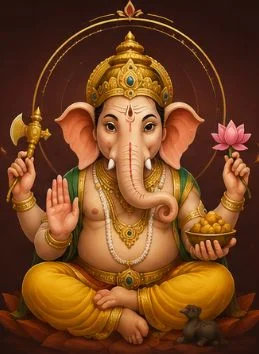
Ashtavinayaka - 8 Self-Manifested Ganesha Temples of Maharashtra
By Sevasannidhi LLP·Updated 22 May 2026Reviewed: Temple order and legends cross-checked against Mudgala Purana and Ganesha Purana; sthala-mahatmya sources
Ashtavinayaka (अष्टविनायक - ashta = eight, vinayaka = Ganesha as the chief remover of obstacles) are the eight svayambhu (self-manifested) Ganesha kshetras of Maharashtra, each considered a jagrut devasthana - a "wakeful" (immediately responsive) shrine. The authority text is the Mudgala Purana (an Upapurana dedicated entirely to Ganesha) and the Ganesha Purana.
Tradition holds that the full Ashtavinayaka circuit must be completed to gain the punya (spiritual merit) of all eight darshans. The circuit is done in order - beginning and ending at Morgaon (Mayureshwar) - the peethadhipa (presiding shrine). By road, the traditional circuit takes 3–4 days from Pune, covering roughly 450 km.
The route in order: Morgaon → Siddhatek → Pali → Mahad → Theur → Lenyadri → Ozar → Ranjangaon → back to Morgaon. Each temple has a distinct form of Ganesha, a unique legend, and a specific spiritual grant.
1
Morgaon
Shri Mayureshwar / Moreshwar
Morgaon village, Pune district, Maharashtra (65 km south-east of Pune)
Legend - First of the Ashtavinayaka and the peethadhipa - the circuit begins and ends here. Ganesha rides a peacock (mayura) here, hence Mayureshwar. The temple predates the Christian era; a sacred kund (tank) on the premises is venerated as especially powerful. Ganesha in this form slew the asura Sindhu at this kshetra.
Grant - Removes all obstacles - Vighnaharta in the supreme sense. The first and last darshan of the circuit.
Festival - Bhadrapada Shukla Chaturthi (Ganesh Chaturthi, Aug-Sep) - the annual Utsav.
2
Siddhatek
Shri Siddhivinayaka
Siddhatek village, on the banks of the Bhima river, Ahmednagar district
Legend - Vishnu acquired his siddhis (spiritual powers) here by worshipping Ganesha before his battles with Madhu and Kaitabha. This is the only Ashtavinayaka temple where Ganesha faces BOTH east and north simultaneously - a rare orientation. The murti is svayambhu (self-manifested).
Grant - Siddhi - spiritual achievement, fulfilment of spiritual powers and liberation.
Festival - Ganesh Chaturthi (Bhadrapada Shukla Chaturthi).
3
Pali
Shri Ballaleshwar
Pali village, Raigad district, Maharashtra (25 km from Khopoli)
Legend - Named after the devotee Ballal, a young boy whose unwavering faith in Ganesha moved the deity to manifest. Ballal's father and the villagers, annoyed by Ballal's constant worship, threw away his Ganesha idol. Ballal prayed intensely; Ganesha appeared and punished the wrongdoers. This is the ONLY Ashtavinayaka named after a human devotee rather than a divine quality.
Grant - Moksha - liberation from the cycle of birth and death.
Festival - Magha Shukla Chaturthi (Tilkund Chaturthi, Jan-Feb).
Legend - A perpetual deepa (lamp) has been burning here without interruption since 1690 CE - over three centuries. The murti is east-facing, in the boon-granting (varada) mudra. The legend tells of a king named Rukmangada who received liberation through Ganesha's grace at this site.
Grant - Varada - boon-giving. The deity grants specific material and spiritual boons to sincere devotees.
Festival - Maghi Ganesh Chaturthi (Magha Shukla Chaturthi, Jan-Feb).
5
Theur
Shri Chintamani
Theur village, Pune district (25 km from Pune on the Pune-Solapur road)
Legend - Brahmadev (Brahma) meditated here to rid himself of worry and anxiety. 'Chintamani' means 'the jewel that removes all anxieties'. The great saint Morya Gosavi (14th c, founder of the Ganapatya sampradaya) worshipped Ganesha intensely at Theur before attaining siddhi. The temple sits on the confluence of the Mula and Mutha rivers.
Grant - Removes anxiety and mental turmoil - Chintamani is invoked for relief from worry, depression, and indecision.
Festival - Bhadrapada Chaturthi (Ganesh Chaturthi, Aug-Sep). Also Magh Shukla Chaturthi.
6
Lenyadri
Shri Girijatmaj
Lenyadri (cave complex), Junnar taluka, Pune district (90 km from Pune)
Legend - Parvati (Girija) performed intense tapas (austerity) in this cave for 12 years to obtain Ganesha as her son. Ganesha was then born here as Girijatmaj - 'born of Girija (Parvati)'. The temple is carved entirely in rock - a cave temple - making it the ONLY cave-shrine among the eight Ashtavinayaka. It is located amid a 30-cave Buddhist complex at Lenyadri.
Grant - Blessings of the mother - Girijatmaj grants fertility, the fulfilment of motherhood, and healing of family bonds.
Festival - Bhadrapada Chaturthi (Ganesh Chaturthi).
7
Ozar
Shri Vighnahar
Ozar village, Junnar taluka, Pune district (8 km from Lenyadri)
Legend - Vighnahar ('remover of obstacles') defeated the demon Vignasura (Vighnasura) here. Vighnasura, who had obtained Brahma's boon to create obstacles for all beings, terrorised gods and sages. Ganesha was invoked and slew the demon at this site, thereby freeing the cosmos from obstacles. The shikhara (temple tower) is gold-tipped; the murti is east-facing.
Grant - Removes vighna (obstacles) - Vighnahar is particularly invoked before beginning new projects, studies, or journeys.
Festival - Bhadrapada Chaturthi. Magh Shukla Chaturthi.
8
Ranjangaon
Shri Mahaganapati
Ranjangaon village, Shirur taluka, Pune district (50 km from Pune on NH-60)
Legend - Shiva worshipped Ganesha at this site before departing to battle and destroy the triple demon-city of Tripurasura. This form of Ganesha - Mahaganapati (Great Ganesha) - is depicted with 10 trunks and 20 arms (Mahottkata form), representing his supremacy and cosmic power. The deity is flanked by Riddhi and Siddhi (his consorts representing prosperity and achievement).
Grant - Universal victory - Mahaganapati grants success in all endeavours, as Shiva himself sought his blessings before battle.
Festival - Bhadrapada Chaturthi. Also Magh Shukla Chaturthi (Tilkund Chaturthi).
Circuit Planning - 3 to 4 Days from Pune
Day 1: Pune → Morgaon (Mayureshwar, 65 km) → Siddhatek (on Bhima river, 50 km) → Pali (Raigad, 120 km). Stay at Pali.
Day 2: Pali → Mahad (Varadavinayaka, 35 km) → Theur (Chintamani, 150 km via Mumbai-Pune expressway). Stay near Pune.
Day 3: Theur → Lenyadri (Girijatmaj, 85 km via Junnar) → Ozar (Vighnahar, 8 km) → Ranjangaon (Mahaganapati, 50 km). Return to Pune.
Completion: Return to Morgaon for the closing darshan (circuit begins and ends here for full merit). Best season: Oct–Feb (post-monsoon; avoid peak Ganesh Chaturthi crowds for smooth circuit).