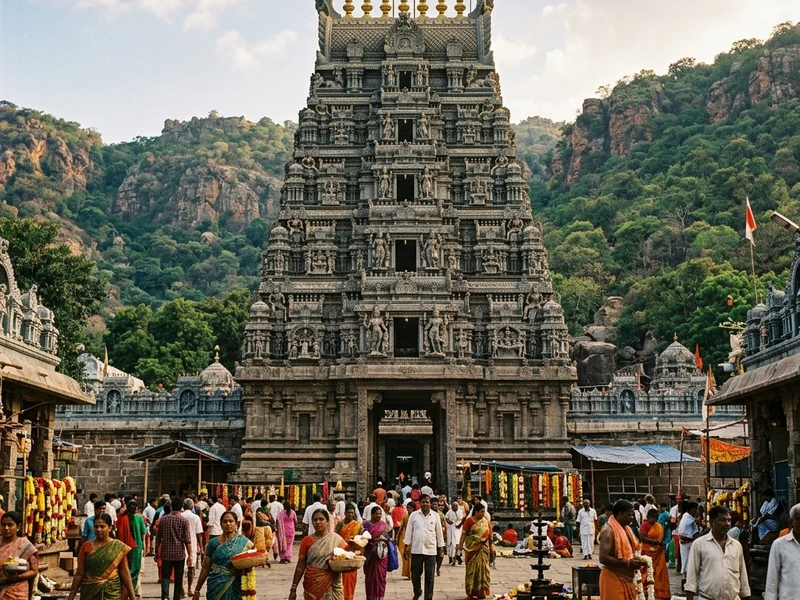
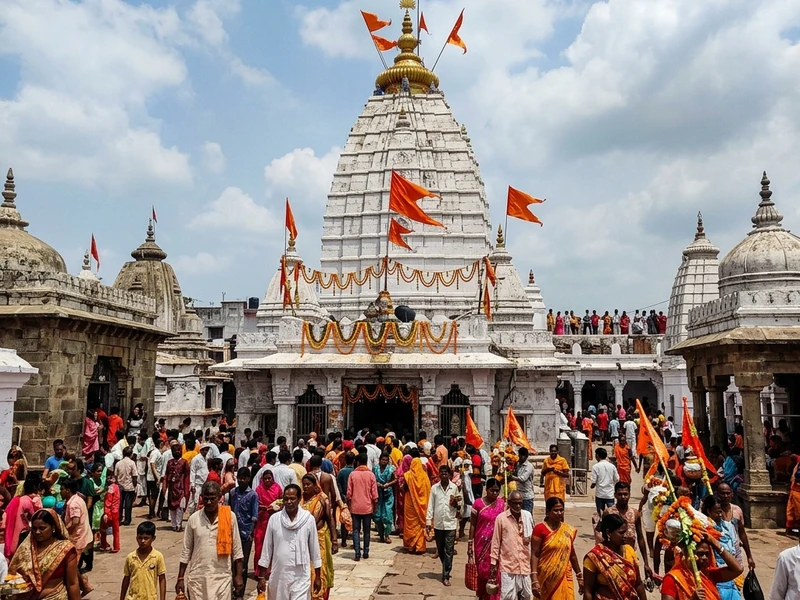
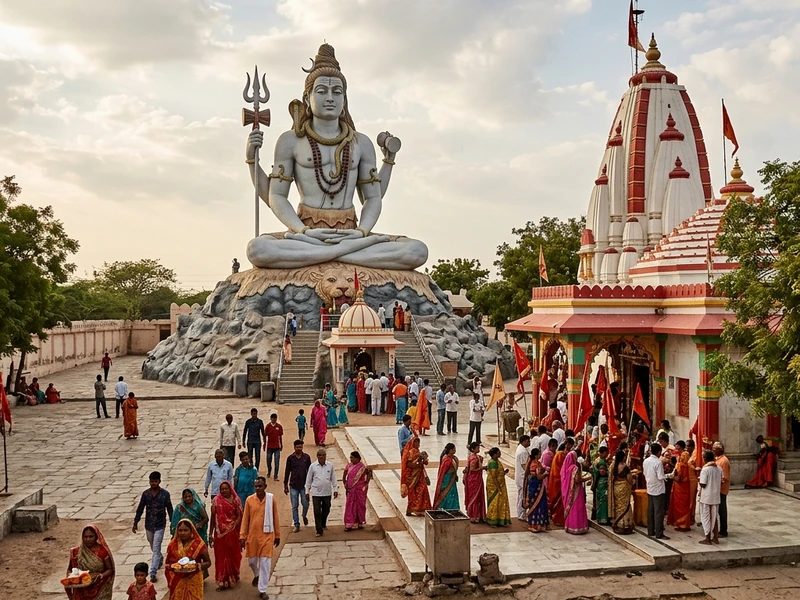
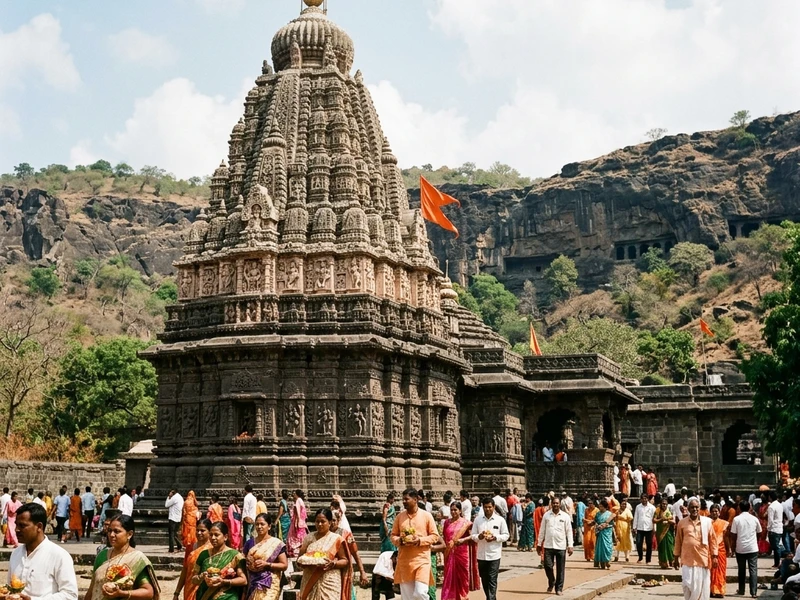
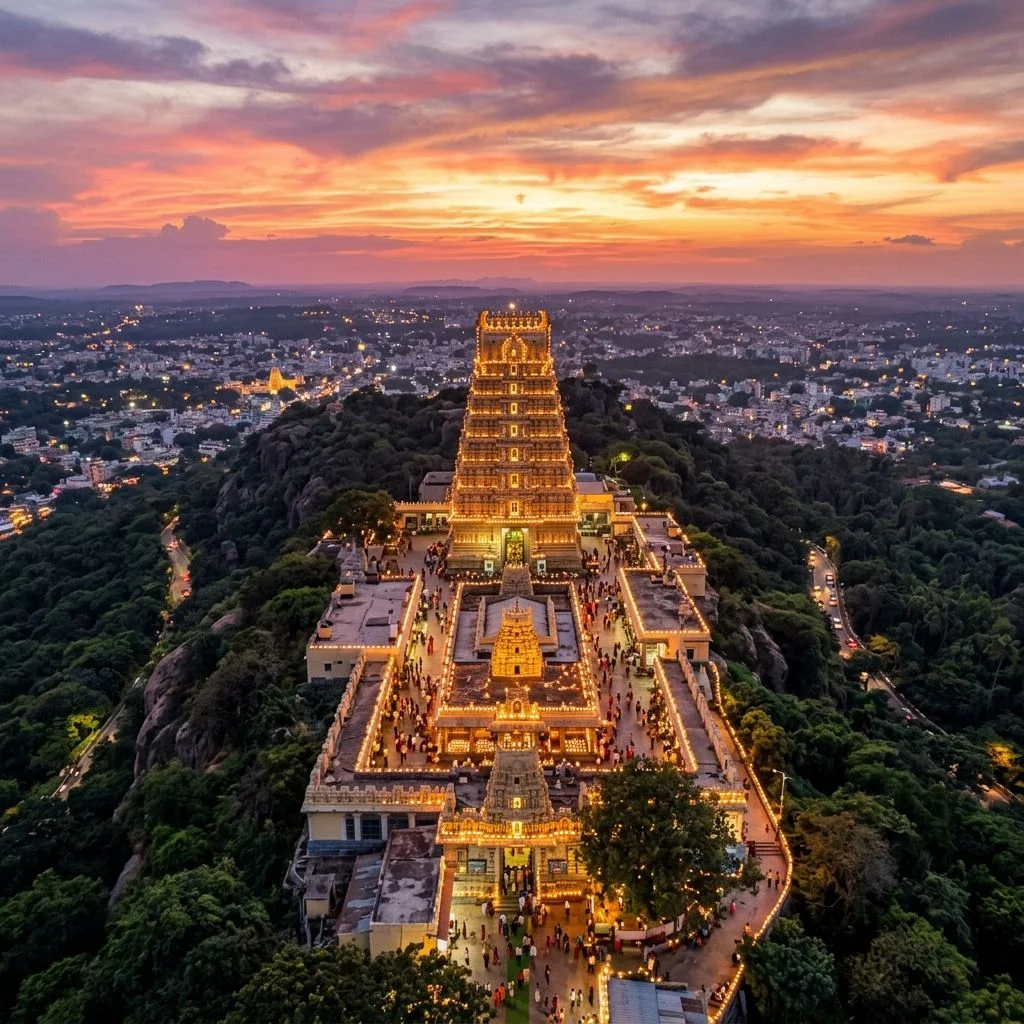
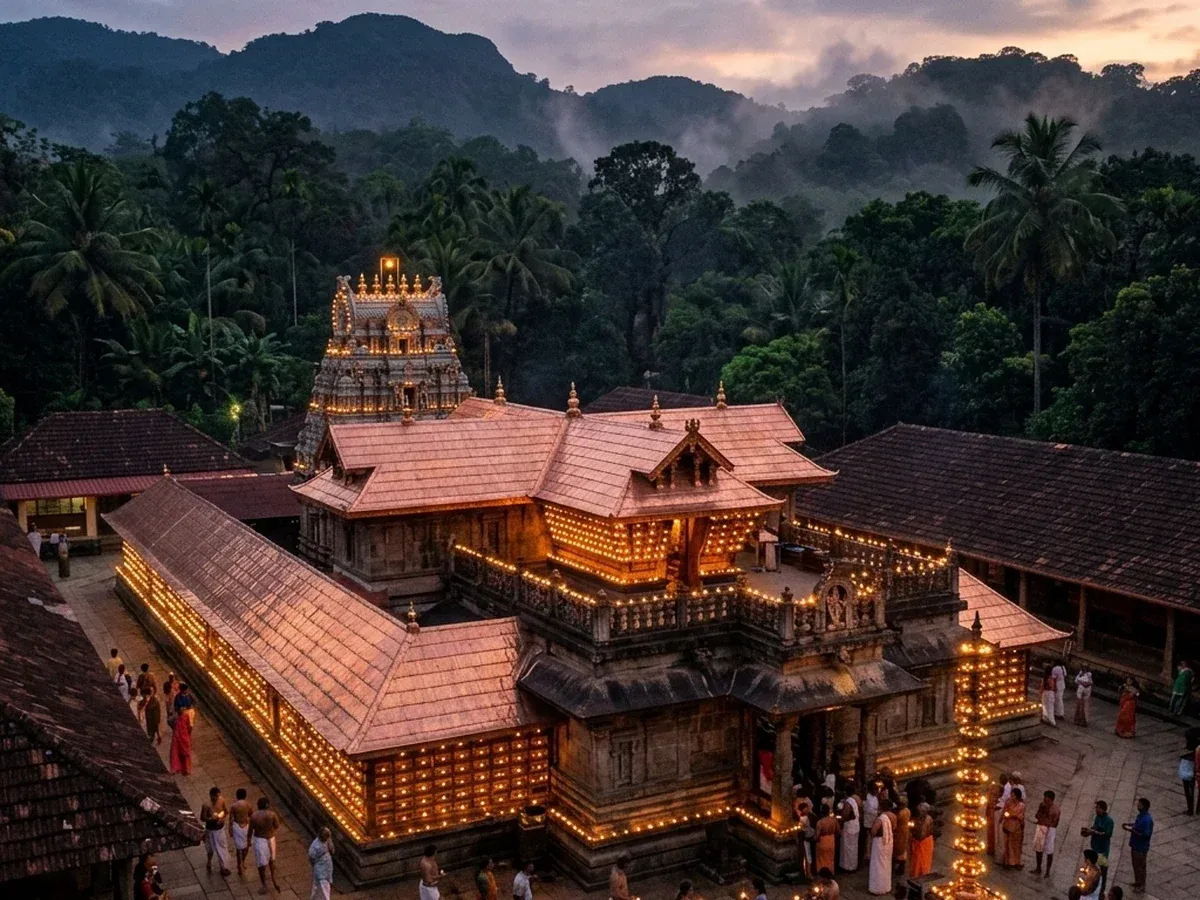
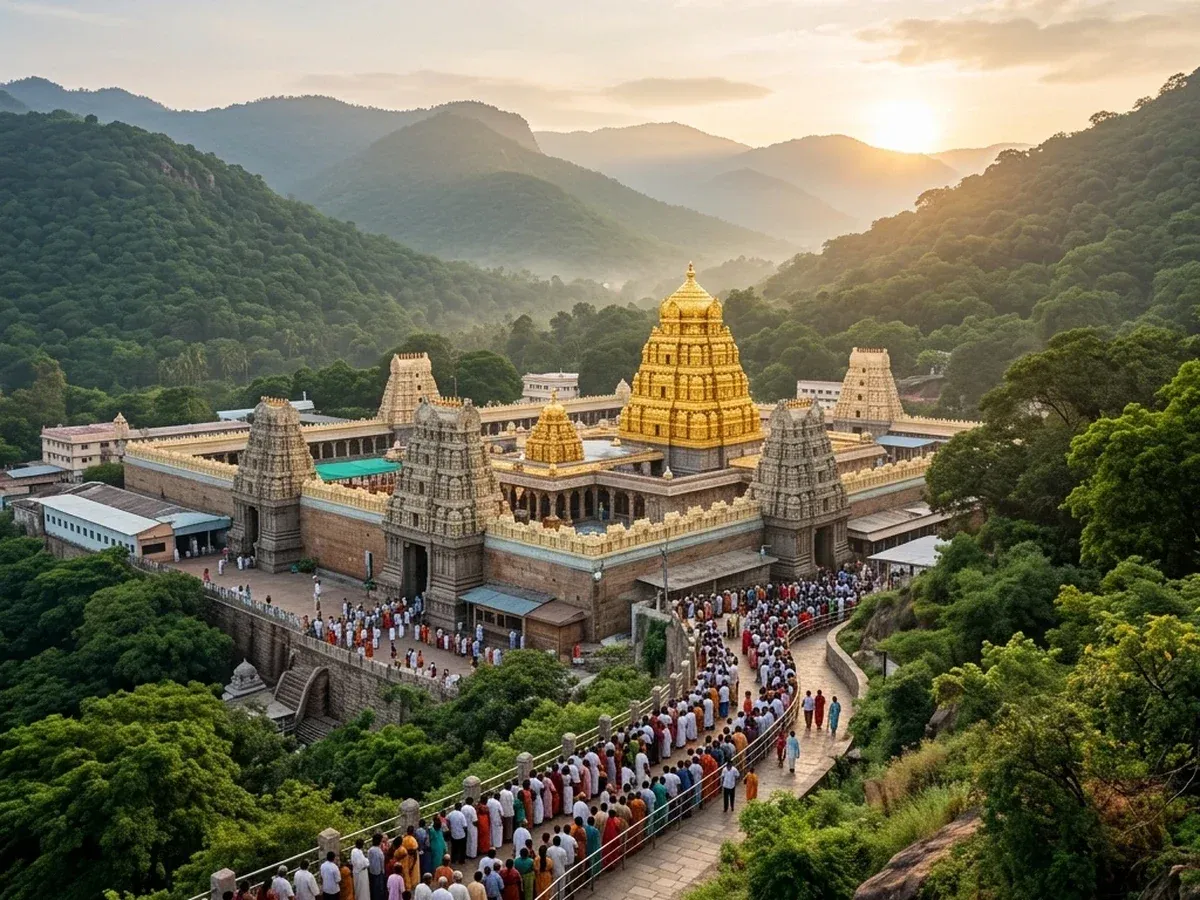
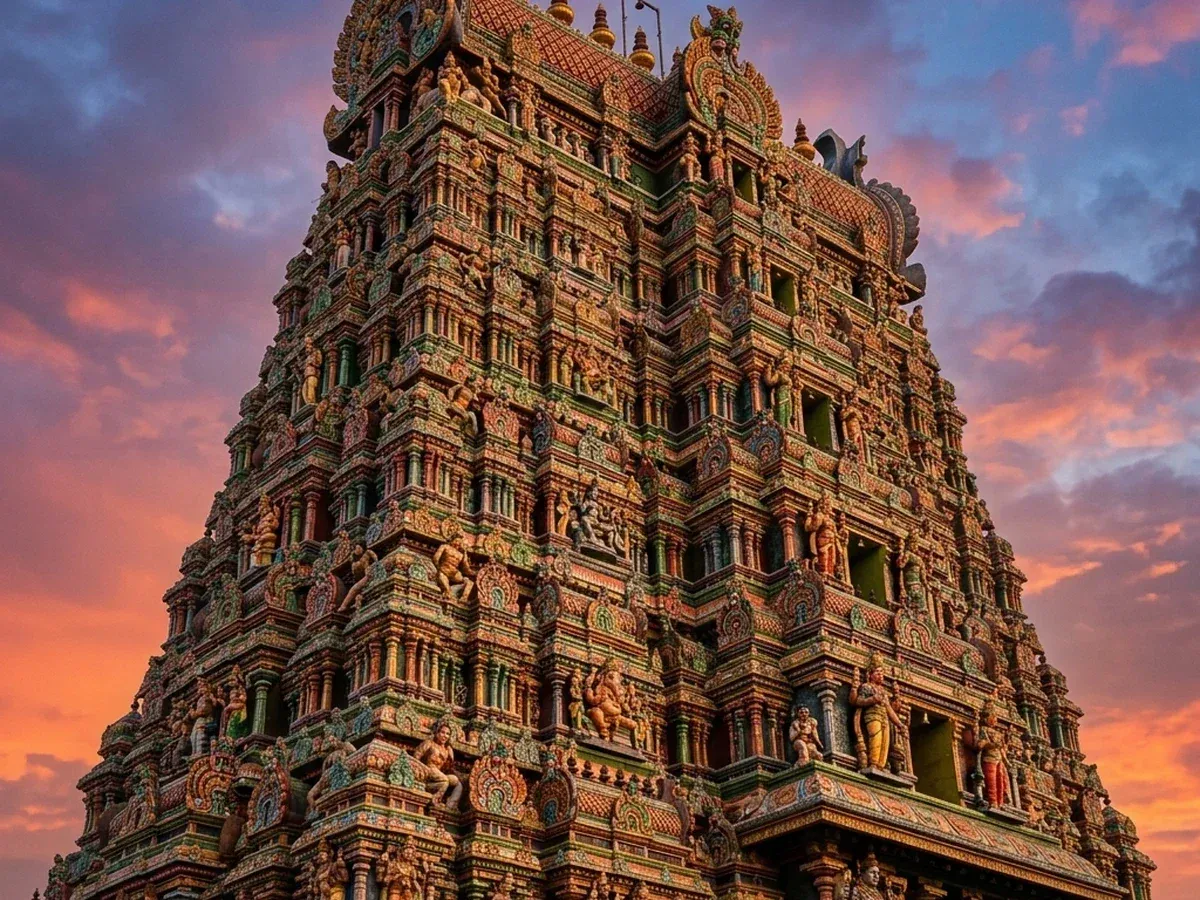
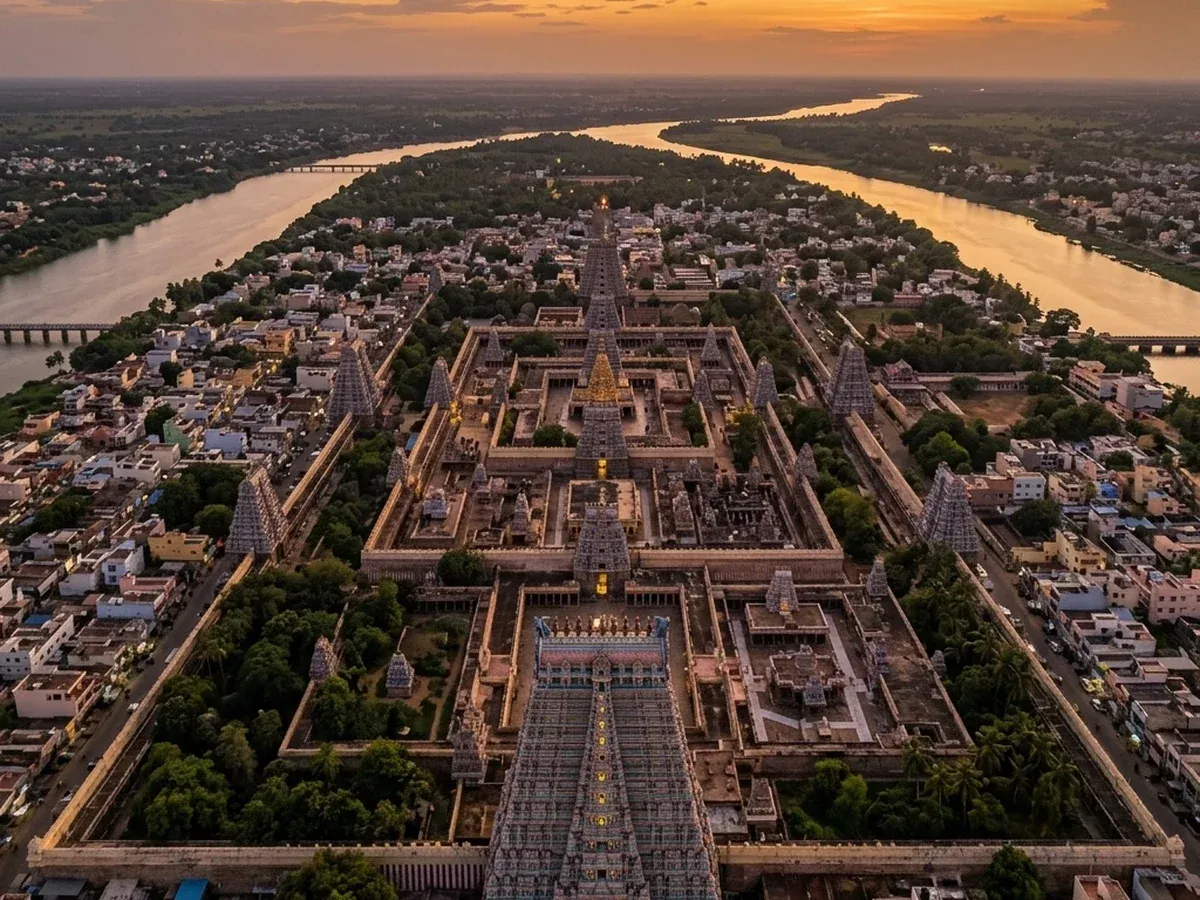
The Char Dham of Adi Shankara, the 12 Jyotirlingas, the 51 Shakti Peethas, the Pancha Bhuta lingas, the 108 Divya Desams - every great temple is a sthala (place) where scripture, history, geography, and divine intent converge. For each temple below: Purana citation, founding legend, why it became famous, the deity's intent (what blessing the deity is famous for granting), the key festival, and a practical visiting tip.
Char Dham - Adi Shankara's Four Corners
Badrinath (north), Dwarka (west), Puri (east), Rameswaram (south) - established by Adi Shankaracharya (788-820 CE) as the 4 cardinal pilgrimage corners. To complete all 4 is the highest gridhastha yatra. Traditional order: North → West → East → South.
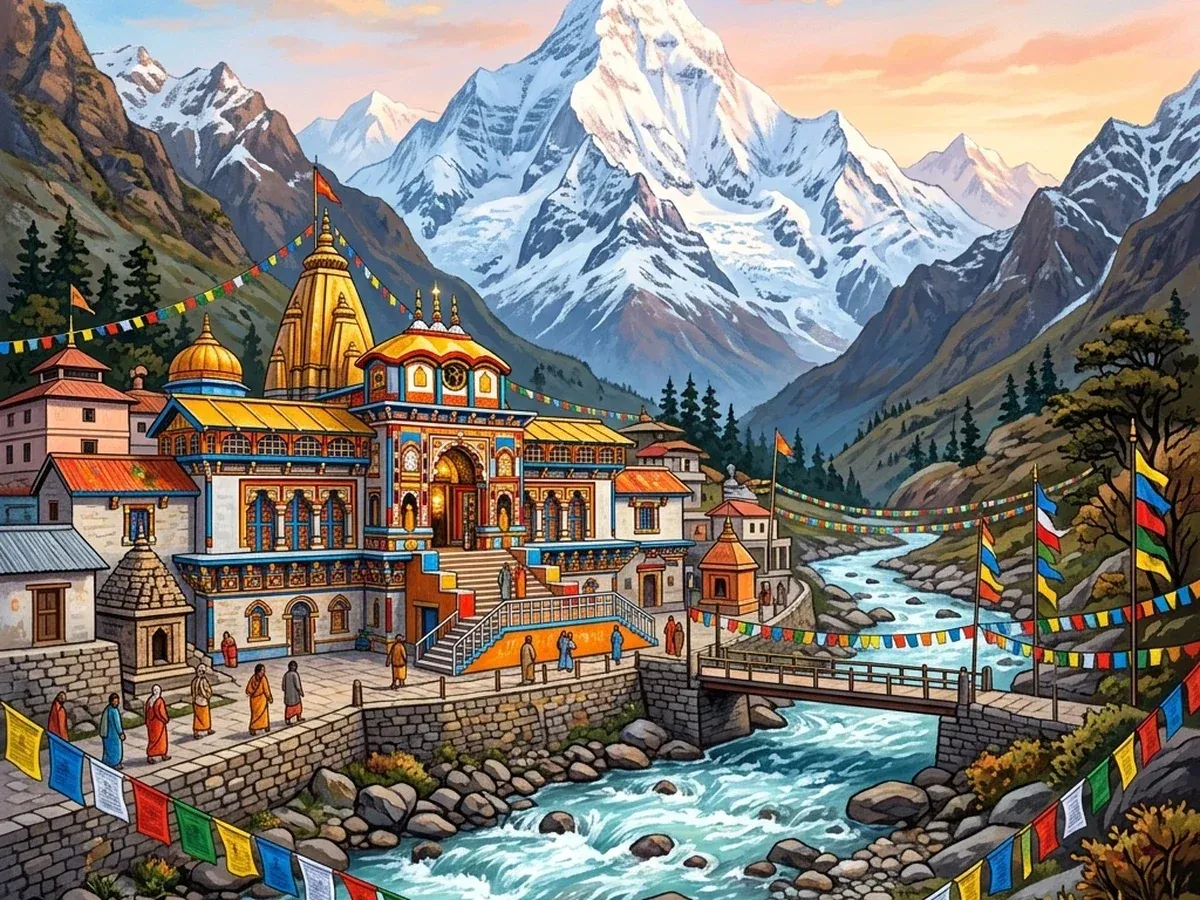
Badrinath· बद्रीनाथ
Chamoli district, Uttarakhand (Garhwal Himalaya, 3,133 m)
Deity - Badrinarayan - Vishnu in tapas-mudra (1 m black-shaligram murti, padmasana)
Legend - Vishnu chose Badari-vana for tapasya. Lakshmi (as the badri-tree, jujube) sheltered him from the snow for thousands of years. Adi Shankara (8th c CE) rediscovered the murti from the Narada-kund of the Alaknanda and re-installed it.
Why famous - Northernmost Char Dham. One of 108 Divya Desams (only Divya Desam in the north). Pilgrim must cross 13 km from Govindghat or drive via Joshimath. The murti is one of 8 self-manifested (svayam-vyakta) Vishnu kshetras.
Deity's intent - Removes accumulated tapa-trayas (3-fold suffering). Grants the fruit of austerity even to those who only visit the kshetra. Liberation (sayujya with Vishnu) for sincere darshan.
Festival - Mata Murti Ka Mela (Sep) - Vishnu's mother. Badri-Kedar utsav (Jun). Opening (Apr-May) + closing (Nov) ceremonies.
Visit tip - Temple closes ~Nov to Apr-May (6 months). Off-season the deity is shifted to Joshimath (Narsingh temple). Check Badrinath-Kedarnath Temple Committee site for current opening date.
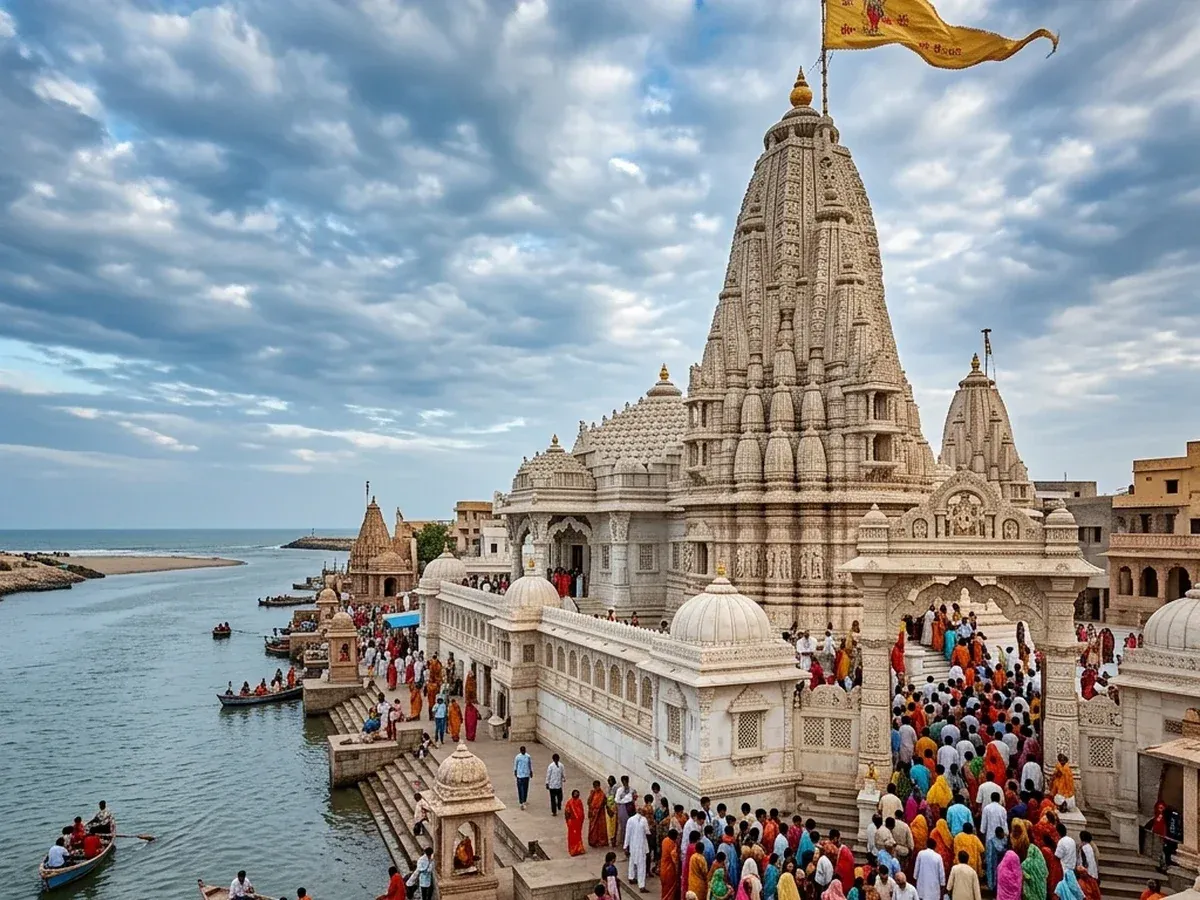
Dwarka· द्वारका
Devbhumi Dwarka district, Gujarat (coast of Arabian Sea, mouth of Gomti)
Deity - Dwarkadhish - Krishna as king (Trivikram form, 4-armed: shankha, chakra, gada, padma)
Scripture -Bhagavata Purana 10.50-52 + 11.30-31 (the city's building + its submergence). Vishnu Purana 5.23. Harivamsha.
Legend - Fleeing Jarasandha's repeated attacks on Mathura, Krishna asked Vishvakarma to build an island-city in the sea. Dwarka rose overnight 12 yojanas off Gujarat coast. After Krishna's mahaprasthan (post-Kurukshetra, end of Dvapara), the sea reclaimed it - Bhagavata 11.31.23.
Why famous - Westernmost Char Dham. One of the 7 Mokshapuris (Sapta-Puri). Marine ASI excavations off Bet-Dwarka in 1979-1983 (S. R. Rao) found submerged ramparts dated c. 1500 BCE consistent with the scriptural account. Main shrine is the 'Jagat Mandir' rebuilt by Vajranabha (Krishna's great-grandson) and again c. 16th c.
Deity's intent - Grants liberation from 4 directions (Dwar-ka = 'gateway'). Krishna gives sayujya-mukti here as he gave to his own kin. Removes the karma-bondage of householder life.
Festival - Janmashtami (Aug-Sep) - biggest. Dwarka-vivah panchami (Nov-Dec) - Rukmini's wedding. Holi + Annakut.
Visit tip - Bet-Dwarka (Krishna's actual residence-island) is a 30-min boat ride away - most pilgrims skip it, do not. Dress code modest. Photography banned inside.
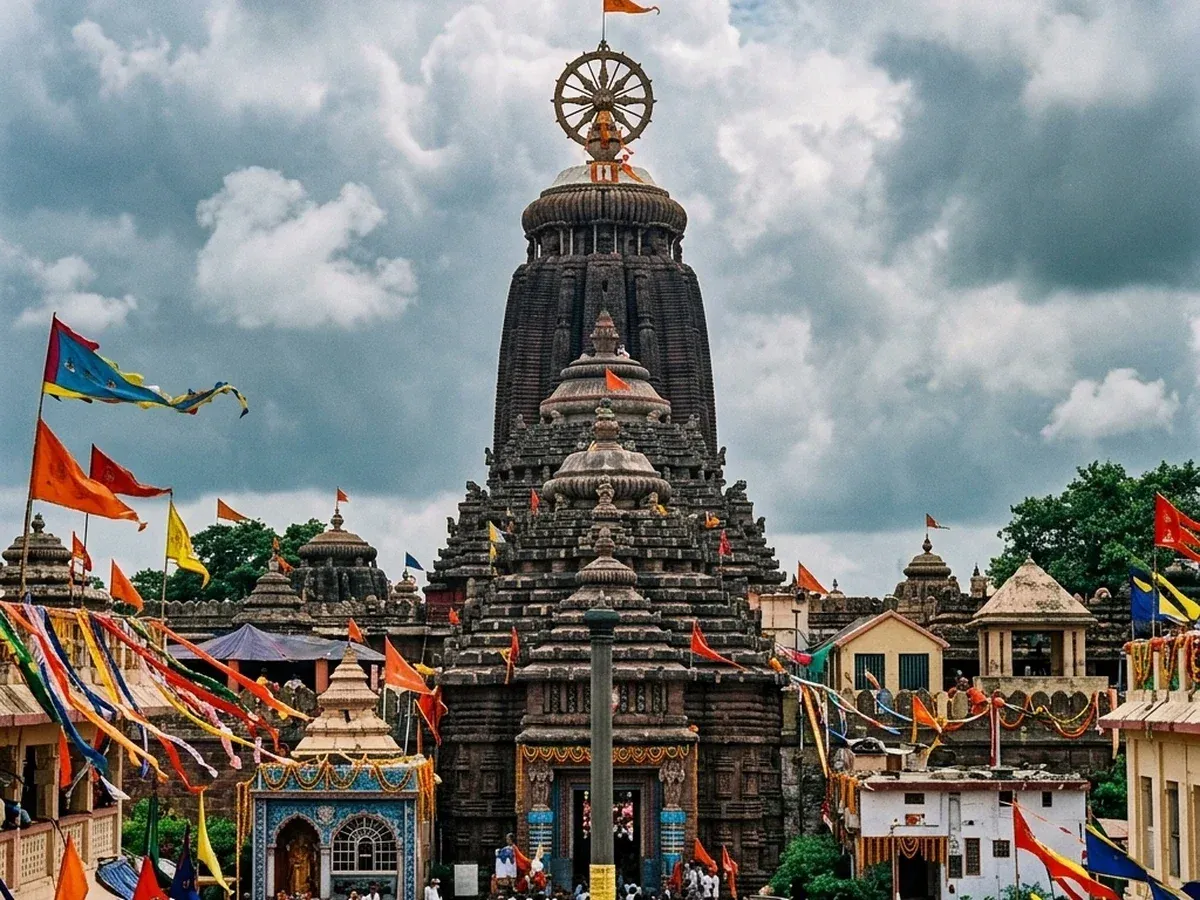
Puri Jagannath· पुरी जगन्नाथ
Puri district, Odisha (coast of Bay of Bengal)
Deity - Trinity - Jagannath (Krishna), Balabhadra (Balarama), Subhadra (sister). Wooden murtis (daru-brahma) - unique in Hinduism, replaced every 12-19 years (Nabakalebara).
Legend - King Indradyumna of Malava saw Nila-Madhava (a blue stone form of Vishnu) on Mount Nila. The stone vanished. Vishnu instructed: 'Find a log on the sea-shore; carve me as Daru-Brahma'. Vishvakarma (in disguise) accepted the carving on the condition he be left undisturbed. The king broke the rule on the 15th day - the murtis were left armless + half-finished. Jagannath declared: 'I shall remain in this form'.
Why famous - One of Char Dham. One of 7 Mokshapuris. Annual Ratha Yatra (Jun-Jul, Ashadha shukla dwitiya) - the 3 deities ride 3 chariots (Nandighosha, Taladhwaja, Devadalan) over 3 km to Gundicha temple; ~1-2 million pilgrims.
Deity's intent - Jagannath = 'Lord of the Universe'. Even an asprishya can pull the chariot-rope and gain liberation. Removes caste-karma. The ONE temple where prasad ('Mahaprasad') is considered ucchishta-free + universally edible.
Festival - Ratha Yatra (Ashadha Shukla 2, Jun-Jul). Snana Yatra (Jyeshtha Purnima - deities take a public bath, then go into 14-day quarantine). Nabakalebara (every 12-19 years when Adhika-Ashadha + specific stars align).
Visit tip - Non-Hindus barred from entering the inner sanctum (controversial but enforced). Mahaprasad is sold in the Ananda Bazar - buy from temple-authorised servitors only. Dress code: no leather, modest.
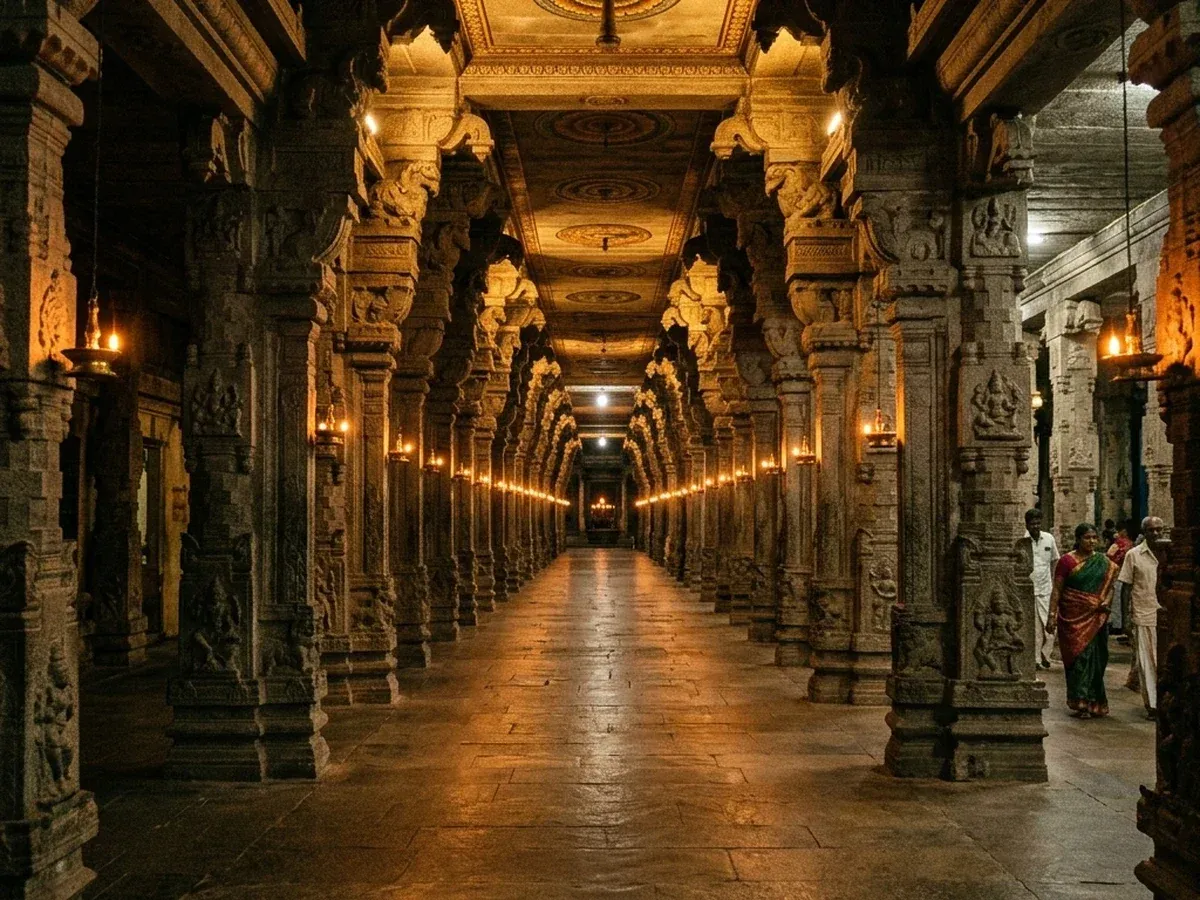
Rameswaram· रामेश्वरम्
Pamban island, Ramanathapuram district, Tamil Nadu (Gulf of Mannar - closest point to Sri Lanka)
Scripture -Valmiki Ramayana - Yuddha Kanda 1.13 (Rama's prayer to Shiva before crossing Setu). Skanda Purana - Brahmottara Khanda + Setu Mahatmya. Also a Jyotirlinga in Shiva Purana - Koti Rudra Samhita 32.
Legend - Returning from Lanka after slaying Ravana (a brahmana), Rama needed to expiate brahma-hatya. He directed Hanuman to bring a Shiva-linga from Kailasa. As Hanuman delayed, Sita made a linga from sea-sand. Rama installed it at the auspicious muhurta - naming it 'Ramanatha' (Shiva who is Rama's lord). When Hanuman arrived with his Kailasa-linga, Rama placed it nearby as 'Vishvalinga' and decreed it be worshipped first.
Why famous - Southernmost Char Dham + a Jyotirlinga (rare double). Longest temple corridor in the world (3rd prakaram, 197 m × 133 m, 1212 pillars). 22 sacred tirthas (theerthams) - pilgrims bathe in all 22 within the complex.
Deity's intent - Removes brahma-hatya (the gravest sin). The kshetra where even Rama atoned - grants forgiveness for the unforgivable. Sea-Setu darshan at Dhanushkodi grants the punya of Setu-bandhana (Rama's bridge).
Festival - Maha Shivaratri (Feb-Mar). Brahmotsavam (Phalguna). Thirukalyanam (Jyeshtha - Shiva-Parvati wedding).
Visit tip - Bring 2 changes of clothes - you will get drenched in the 22-theertha snanam (temple staff pour buckets at each well). Wet clothes are not allowed in the garbhagriha. Dhanushkodi (the abandoned tip) is 17 km further - go.
The 12 Jyotirlingas of Shiva
Jyotirlinga = "linga of light". Per the Koti Rudra Samhita of Shiva Purana (chapters 14-32), there are exactly 12 self-manifested Shiva-lingas across India - Shiva himself swore to remain there until pralaya. Order below is the orthodox sequence - Somnath first, Grishneshwar last.
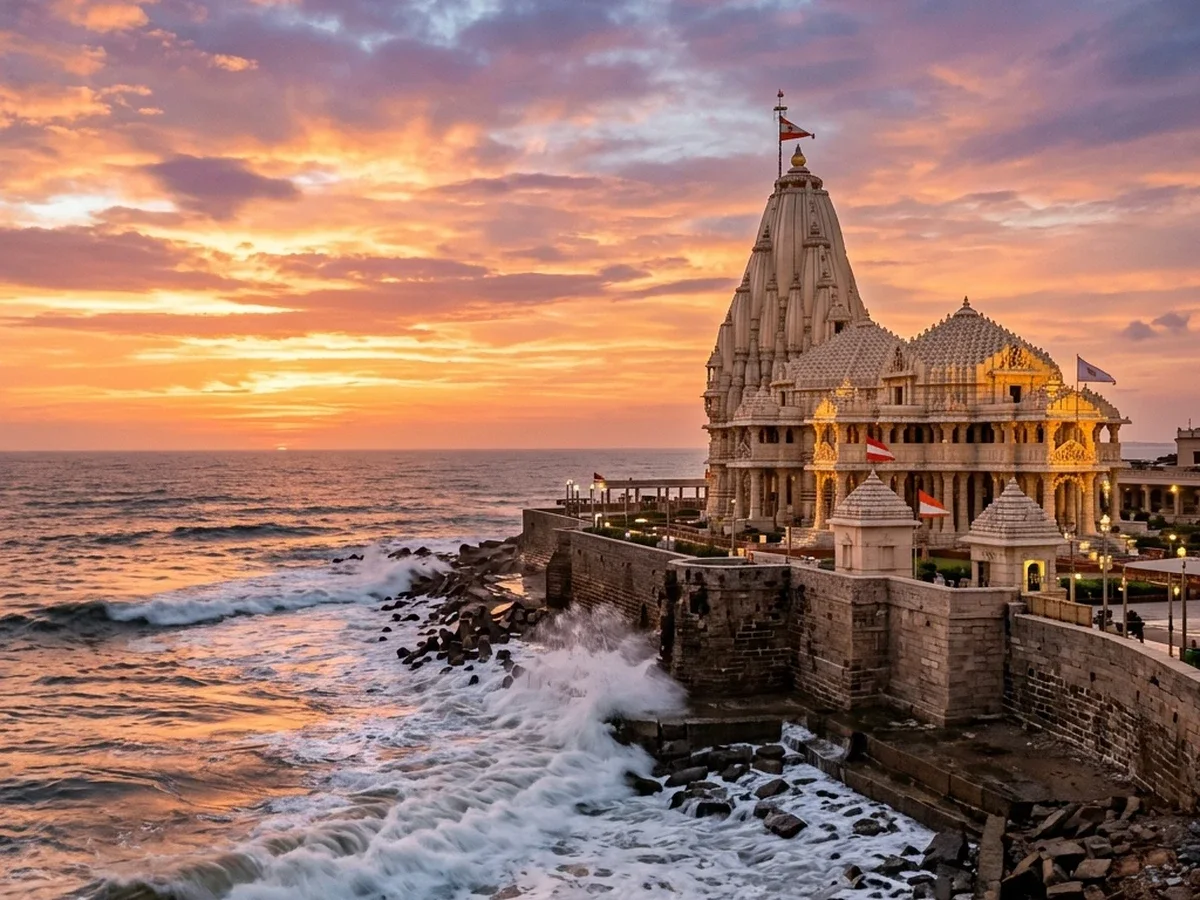
Somnath· सोमनाथ
Gir Somnath district, Gujarat (Veraval, on Arabian Sea coast)
Deity - Somnath Jyotirlinga - Shiva as 'Lord of the Moon'
Legend - Chandra (Moon-god) was cursed by Daksha (his father-in-law) with consumption for favouring Rohini over his other 26 wives (Daksha's daughters). Chandra did tapas to Shiva at Prabhasa. Shiva agreed to wane-and-wax (the bright + dark fortnight). Chandra installed this Jyotirlinga in gratitude - hence 'Soma-natha' (Lord of Soma/Moon).
Why famous - FIRST among the 12 Jyotirlingas. Looted 17+ times - by Mahmud of Ghazni (1024), Alauddin Khilji, Aurangzeb. Rebuilt under Sardar Patel + K. M. Munshi (consecrated 1951). Current temple in Chalukya architectural style. Aligned so a straight line south to Antarctica encounters no land - the 'Tirstambha' pillar.
Deity's intent - Removes diseases of body + mind (Chandra was cured of consumption here). Especially venerated for moon-related afflictions in horoscopes (Chandra dosha).
Festival - Maha Shivaratri (Feb-Mar). Kartik Purnima (Nov) - lamp-floating on the Triveni sangam (Hiranya + Saraswati + Kapila rivers).
Visit tip - Sound-light show 'Jay Somnath' every evening (7:45 pm) narrated by Amitabh Bachchan. Don't miss the Sardar Patel memorial inside the trust complex.
Mallikarjuna (Srisailam)· मल्लिकार्जुन
Nallamala hills, Nandyal district, Andhra Pradesh (banks of the Krishna river)
Deity - Mallikarjuna Jyotirlinga (Shiva) + Bhramaramba Devi (Shakti Peetha - neck of Sati). Rare double - Jyotirlinga + Shakti Peetha in one complex.
Legend - After Kartikeya lost the 'race-around-the-cosmos' to Ganesha (who circled his parents instead), an angered Kartikeya departed for the Kraunch Mountain (Srisailam). Shiva + Parvati came to console him - they took the form of a jasmine-linga (Mallika = jasmine; Arjuna = white) to remain near Kartikeya. Mallikarjuna is Shiva-Parvati combined.
Why famous - 2nd Jyotirlinga + the Bhramaramba Shakti Peetha (one of the 18 Maha-Shakti-Peethas). Set in the Nallamala tiger reserve. ASI dates the present mandapa to c. 7th c (Pulakeshin II era).
Deity's intent - Heals strife between parents + children; harmony in family. Grants the comfort that Kartikeya received here. Doubles as Devi-darshan (rare).
Festival - Maha Shivaratri (Feb-Mar) Brahmotsavam - 11 days. Ugadi.
Visit tip - Sparsha-darshan (touching the linga) is permitted on payment of a small fee - extremely rare among Jyotirlingas. Closest railhead Markapur Road; road through forest closes after dusk.
Mahakaleshwar· महाकालेश्वर
Ujjain, Madhya Pradesh (banks of Shipra river - one of the 7 Mokshapuris + Kumbh Mela kshetras)
Deity - Mahakal - Shiva as 'Lord of Time'. The ONLY south-facing Jyotirlinga (Dakshinamukhi).
Legend - A boy named Shrikar in Avantika was a great Shiva-devotee. When the demon Dushana attacked Avantika threatening to destroy the dharma, Shiva burst out of the earth as Mahakal - reduced Dushana to ash. He stayed at the prayer of the people.
Why famous - 3rd Jyotirlinga. Only south-facing Jyotirlinga (south = direction of Yama, of death). Famous Bhasma-Aarti at 4 AM - the linga is anointed with cremation-ground ashes (uniquely in India). Ujjain is a Kumbh Mela site (Simhastha Kumbh, every 12 years).
Deity's intent - Conquers untimely death (akala-mrityu). Grants mastery over time (kala). The single most powerful Jyotirlinga for averting deaths-by-accident, fatal-illness, premature loss.
Festival - Maha Shivaratri. Sawan Somvar (Mondays of Shravana - month-long procession of Mahakal's silver Sawari through Ujjain). Naga Panchami.
Visit tip - Bhasma-Aarti (4 AM) requires online booking 1-2 days advance (Shri Mahakaleshwar Mandir Prabandh Samiti site). Men: dhoti only, bare-chest. Women: saree. Free queue is 4-6 hrs in Shravana - book a 250 Rs VIP slot if time-poor.
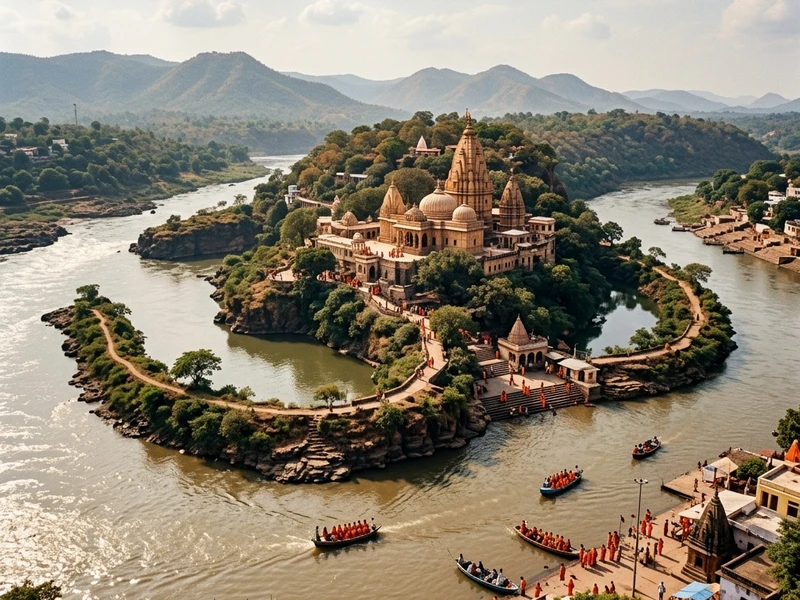
Omkareshwar· ओङ्कारेश्वर
Mandhata island, Khandwa district, Madhya Pradesh (on Narmada river - the island is shaped like the Om / ॐ symbol)
Deity - Omkareshwar (Shiva on the island) + Mamleshwar (Shiva on the south bank). Both are the Jyotirlinga - pilgrimage to both is required.
Legend - King Mandhata (Ikshvaku dynasty) did tapas on this island. Shiva appeared. Separately, devas + asuras worshipped Shiva, who split into two - Omkareshwar (for devas) on the island and Mamleshwar (for asuras, also called Amareshwar/Pranava) on the bank.
Why famous - 4th Jyotirlinga. The Narmada Parikrama (circumambulating the entire 1312 km Narmada) traditionally includes Omkareshwar. The island itself, when viewed from above, traces the Devanagari symbol ॐ - verified by ASI mapping.
Deity's intent - Removes accumulated paap (sin) - the Narmada at Omkareshwar is the only river whose mere darshan (not bath) liberates. Grants self-realisation (the Om is the seed-syllable of Brahman).
Festival - Maha Shivaratri. Kartik Purnima - Narmada Jayanti. Nag Panchami.
Visit tip - You must visit BOTH the island (Omkareshwar) AND the south bank (Mamleshwar) - pilgrims often skip Mamleshwar (incomplete darshan). Bridge or boat. Stay overnight to do the 7-km parikrama of the island at dawn.
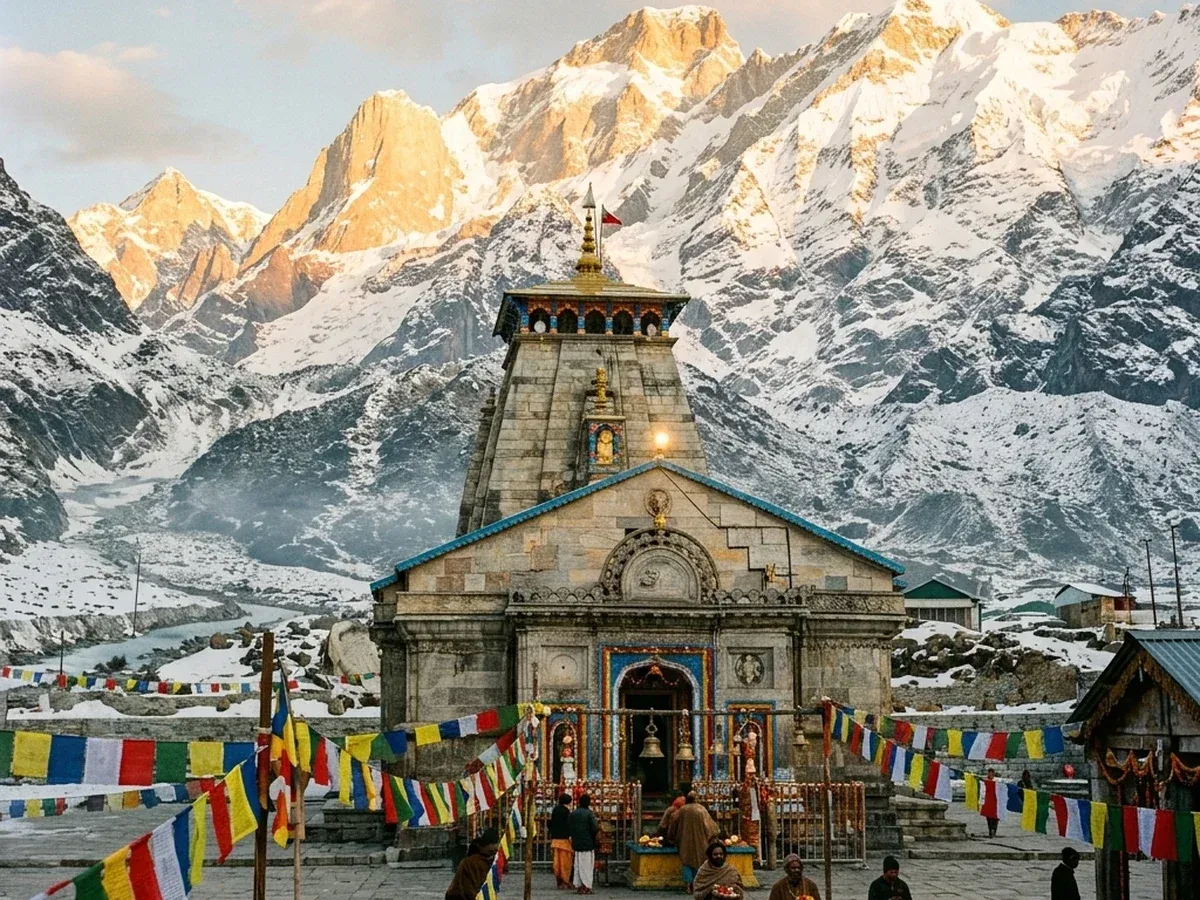
Kedarnath· केदारनाथ
Rudraprayag district, Uttarakhand (Garhwal Himalaya, 3,583 m, source-region of Mandakini)
Deity - Kedarnath Jyotirlinga - Shiva as the conical-back of a buffalo (the only Jyotirlinga in this form)
Legend - After Kurukshetra, the Pandavas sought Shiva to expiate the killing of kinsmen (gotra-vadha) + a teacher (Drona). Shiva, displeased, hid in Kedar as a bull. Bhima recognised him and grabbed the bull's back - the back (prishtha) remained at Kedar; the other 4 parts manifested at the Panch Kedars (Tungnath = arms, Rudranath = face, Madhyamaheshwar = navel, Kalpeshwar = hair).
Why famous - 5th Jyotirlinga + one of Chota Char Dham of Garhwal (Yamunotri, Gangotri, Kedarnath, Badrinath). The 2013 flood spared the temple itself though the surrounding town was devastated - a single boulder (Bhim-shila) deflected the floodwater.
Deity's intent - Atones for the gravest sins - even the killing of one's own kin. Grants liberation to those who undertake the arduous trek as tapas.
Festival - Opening yatra (Apr-May, Akshaya Tritiya). Closing (Nov, Bhai Dooj). Maha Shivaratri.
Visit tip - 16 km trek from Gaurikund (helicopter from Phata 6-min). Closes Nov-Apr (deity shifted to Ukhimath/Omkareshwar temple). Acclimatize 1 night at Sonprayag - altitude sickness is real above 2500 m.
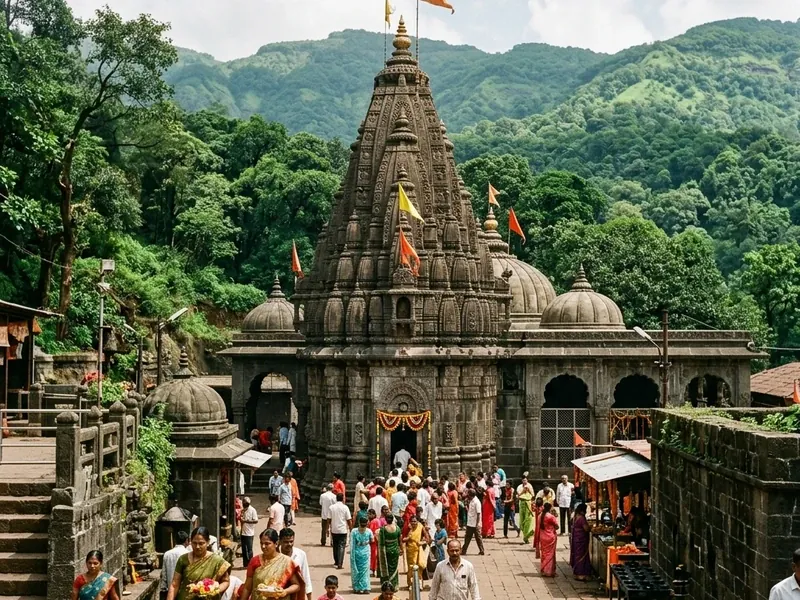
Bhimashankar· भीमशङ्कर
Sahyadri (Western Ghats), Pune district, Maharashtra (source of Bhima river)
Deity - Bhimashankar Jyotirlinga - Shiva who slew Bhima-asura
Scripture -Shiva Purana - Koti Rudra Samhita 20.
Legend - Bhima - son of the rakshasi Karkati + the demon Kumbhakarna (Ravana's brother) - was furious to learn his father had been slain by Rama. He vowed to destroy all Vishnu-bhaktas. He defeated Indra + began tormenting King Sudakshina, a Shiva-devotee. As Sudakshina was about to be killed, Shiva burst out as Bhimashankar + reduced the asura to ash. Shiva's sweat formed the Bhima river.
Why famous - 6th Jyotirlinga. Set in Bhimashankar Wildlife Sanctuary (the Indian Giant Squirrel - Shekhru - Maharashtra's state-animal - is found here). Disputed alternative location at Bhimpur, Odisha (Kashipur) - but Maharashtra is the orthodox claim per Shiva Purana.
Deity's intent - Destroys mountainous obstacles (Bhima = great). Especially for victory over unjust adversaries.
Festival - Maha Shivaratri. Karthik Purnima.
Visit tip - Best by road from Pune (110 km). Monsoon (Jul-Sep) is dazzling but landslide-prone. Carry warm clothes - early-morning fog at 1000 m altitude.
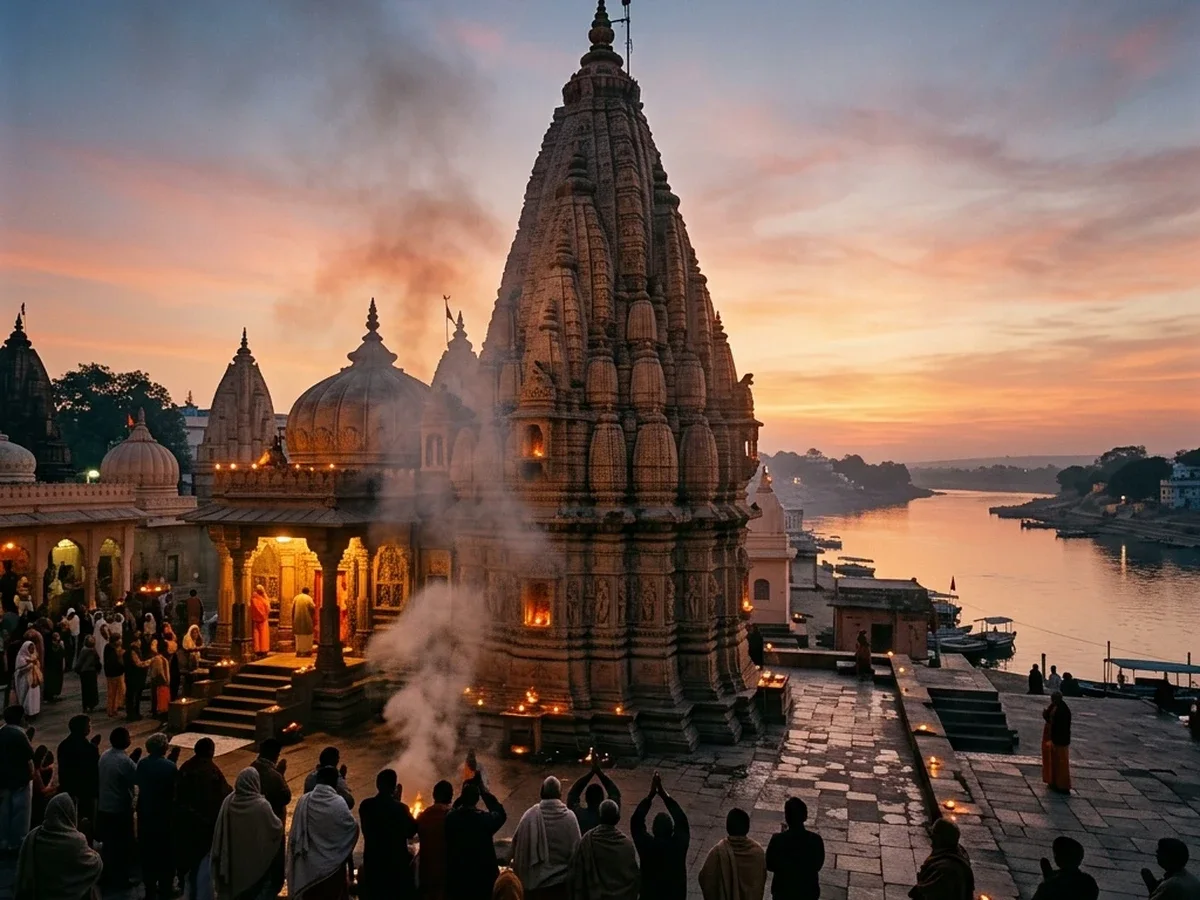
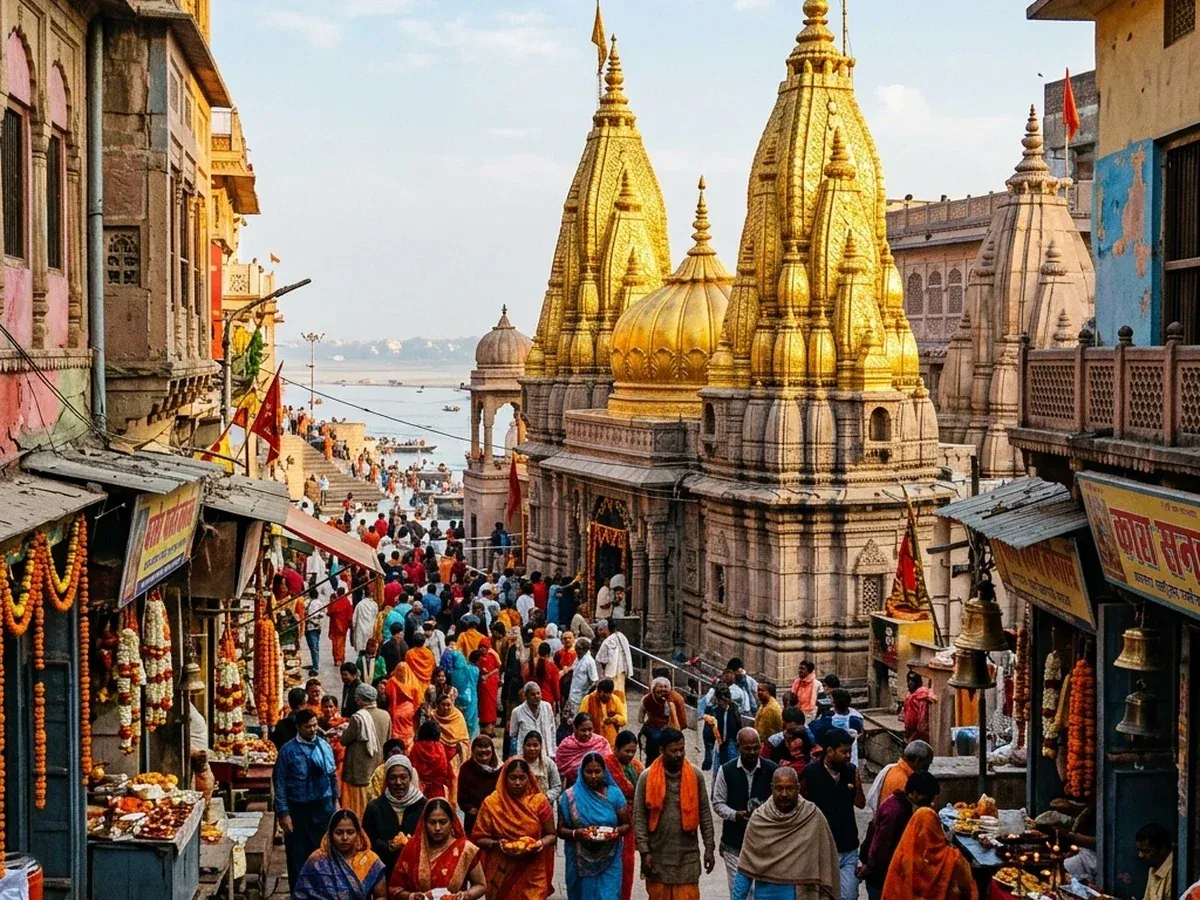
Kashi Vishwanath· काशी विश्वनाथ
Varanasi (Kashi), Uttar Pradesh (on the ghats of the Ganga)
Deity - Vishwanath / Vishveshwara - Shiva as 'Lord of the Universe'. Goddess Annapurna (food-giver) is the consort, in her own adjacent temple.
Legend - Kashi is on the trident (trishul) of Shiva - not on the earth. It is jara-marana-rahita (untouched by old age + death). Shiva declared Kashi 'avimukta' (never abandoned) - even at pralaya, Kashi remains. The linga is self-manifested.
Why famous - 7th Jyotirlinga. The 'centre' Jyotirlinga, the supreme. Kashi is one of 7 Mokshapuris + the most ancient continuously-inhabited city. Vishwanath was demolished 4 times (Qutb-ud-din Aibak 1194, Hussain Shah Sharqi 1447, Akbar's rebuild 1585, Aurangzeb 1669) - the 1780 rebuild by Ahilyabai Holkar is the current temple. The Kashi Vishwanath Corridor (2021) connects temple to Ganga.
Deity's intent - GUARANTEED LIBERATION. Anyone who dies in Kashi (Maranam Mangalam) is whispered the Tarak-mantra (Ram nama) into the right ear by Shiva himself - instant moksha, no rebirth. The supreme Hindu pilgrimage goal.
Festival - Maha Shivaratri. Dev Diwali (Kartik Purnima - million-lamp ghat-lighting). Sawan Somvar processions.
Visit tip - Visit Kal-Bhairava FIRST (he is the Kashi-Kotwal, holds the keys). Sparsha-darshan inside garbhagriha permitted but extreme crowd in Shravana. Don't miss Manikarnika Ghat - the cremation-ghat where Shiva whispers the Tarak.
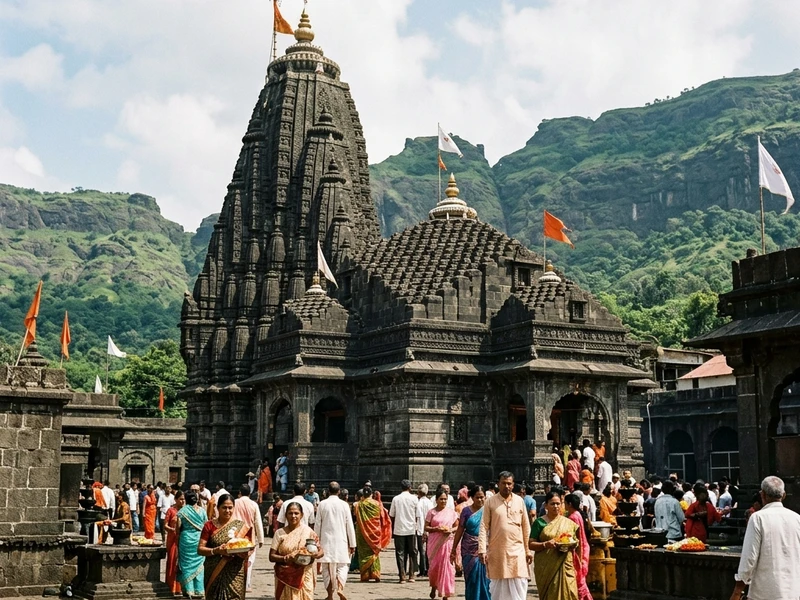
Trimbakeshwar· त्र्यम्बकेश्वर
Nashik district, Maharashtra (source of Godavari river, foothills of Brahmagiri)
Deity - Trimbakeshwar Jyotirlinga - Tri-mukha-linga (3-faced): Brahma, Vishnu, Rudra in one linga. The ONLY 3-faced Jyotirlinga.
Legend - Sage Gautama, falsely accused of killing a cow (it was actually a maya-cow created by jealous brahmanas), did penance to Shiva on Brahmagiri. To wash off the cow-killing sin, he asked Shiva to bring the Ganga south - Shiva released his locks; Godavari (Dakshin Ganga) emerged. Shiva remained as Trimbakeshwar (3-faced - for Brahma, Vishnu, Rudra) at her source.
Why famous - 8th Jyotirlinga + the only 3-faced linga. Source of the Godavari - South India's lifeline (called 'Dakshin Ganga'). The Kumbh Mela is held here every 12 years (Simhastha Kumbh, last Sept 2027). Nila-Parvata + Brahmagiri-Pradakshina is a key tirtha.
Deity's intent - Removes ancestral debts (pitru-rina). The single most powerful Jyotirlinga for performing NarayanaNagbali + Tripindi Shraddha + Kalsarpa Dosha nivaran rituals (eradication of snake-curse).
Festival - Maha Shivaratri. Kumbh Mela (every 12 years - next 2027). Tripindi Shraddha - performed daily for non-festival days.
Visit tip - Book a panda (priest) for KalSarpa-Dosha or NaraynaNagbali only via the Sansthan office - touts overcharge wildly (Rs. 500 actual; touts ask Rs. 25000+). Brahmagiri Pradakshina is 12 km - start 4 AM.
Vaidyanath (Baidyanath Dham)· वैद्यनाथ
Deoghar district, Jharkhand (orthodox claim per Shiva Purana). Disputed alternative - Parli Vaijnath, Beed, Maharashtra.
Deity - Vaidyanath - Shiva as 'Physician of the cosmos'. Linga installed by Ravana himself.
Scripture -Shiva Purana - Koti Rudra Samhita 23.
Legend - Ravana did tapas at Kailasa, cutting his own 9 heads as offerings. As he was about to sever the 10th, Shiva - pleased and impressed - appeared, restored his heads + granted him a Jyotirlinga to take back to Lanka. Condition: 'Do not place it on the ground en route'. Vishnu (worried this would make Ravana invincible) sent Varuna to make Ravana need to urinate. Ravana handed the linga to a cowherd-boy (Vishnu in disguise) - who placed it on the earth at Deoghar. The linga immobilized. Ravana, defeated, pressed his thumb into it - Deoghar means 'House of God'.
Why famous - 9th Jyotirlinga. Combined Jyotirlinga + Shakti Peetha (Sati's heart fell here per Pithanirnaya - hence one of 51 Shakti Peethas as Jaya Durga). The annual Shravani Mela (Jul-Aug) draws ~10 million pilgrims who walk 108 km from Sultanganj-Ganga carrying gangajal kanwars.
Deity's intent - Heals chronic + incurable illnesses (Vaidya = physician). Pilgrims come specifically for healing of cancer, mental illness, persistent disease. Considered the supreme 'medical' Jyotirlinga.
Festival - Shravani Mela (Jul-Aug - month-long kanwar yatra). Maha Shivaratri.
Visit tip - Pilgrims must first take Gangajal from Sultanganj (Bihar) and walk barefoot 108 km in saffron - the kanwar yatra. If time-short, do the short kanwar (5 km from Jasidih). Aurangzeb-era inscriptions visible on the panchsool.
Nageshwar· नागेश्वर
Devbhumi Dwarka district, Gujarat (12 km from Dwarka, on the Arabian Sea coast)
Deity - Nageshwar Jyotirlinga - Shiva as 'Lord of the Serpents'
Scripture -Shiva Purana - Koti Rudra Samhita 24.
Legend - A great Shiva-devotee, the merchant Supriya, was captured along with his family by the demon Daruka. In captivity, Supriya continued chanting 'Om Namah Shivaya' + persuaded fellow-prisoners. Daruka tried to kill him; Shiva burst from the earth as Nageshwar, granted Supriya a Pashupatastra (weapon), and Supriya destroyed the demon. Shiva remained as Nageshwar - protector against serpents + poisons.
Why famous - 10th Jyotirlinga. Set within view of the Arabian Sea - only sea-side Jyotirlinga (with Somnath, also coastal). 25-m statue of Shiva in dhyana-mudra in the temple courtyard. Often visited on the same Dwarka pilgrimage circuit.
Deity's intent - Protects from snake-bites, poisons (vish), and toxic relationships. Removes effects of black-magic + Naga-dosha in horoscopes.
Festival - Maha Shivaratri. Naga Panchami (Shravana - special snake-puja).
Visit tip - Pair with Dwarka (12 km) + Bet-Dwarka. Sparsha-darshan permitted at certain hours.
Rameswaram (also a Jyotirlinga)· रामेश्वरम्
Pamban island, Ramanathapuram district, Tamil Nadu (see Char Dham above)
Deity - Ramanathaswamy Jyotirlinga - Shiva as 'Lord of Rama' (same as Char Dham entry)
Legend - Ghushma, the 2nd wife of brahmana Sudharma, was a great Shiva-devotee. She daily made 101 clay-lingas, worshipped them, and dropped them in a pond. Sudeha (the 1st wife), envious, killed Ghushma's son in his sleep + dumped the body in the pond. Ghushma, unshaken, continued her puja. When she went to immerse the lingas the next day - her son emerged ALIVE from the pond. Shiva appeared. Ghushma asked only that her sin-fully-sister be forgiven. Shiva remained as Ghrishneshwar (named for Ghushma).
Why famous - 12th and LAST Jyotirlinga. Smallest of the 12 in physical size but completes the pilgrimage. Adjacent to Ellora caves (Kailasa-Temple, Cave 16 - 8th c Rashtrakuta) - pilgrims combine both.
Deity's intent - Removes envy + petty malice (jealousy from family). Grants restoration of lost children, lost loved ones. Forgiveness for those who wronged us.
Festival - Maha Shivaratri.
Visit tip - Combine with Ellora caves (5-min walk) + Daulatabad fort (15 km) + Bibi-Ka-Maqbara. Men must remove shirt for sparsha-darshan.
Shakti Peethas - The Goddess Falls
When Sati immolated herself at Daksha's yajna, Shiva carried her corpse in tandava-grief. Vishnu cut the corpse with his Sudarshana chakra into 51 pieces (some traditions: 52, 64, or 108). Each fell on earth as a Shakti Peetha - the most powerful Devi sites. Below: the top 18-20 of the canonical 51 (with Hinglaj in Pakistan as the westernmost).
Kamakhya· कामाख्या
Nilachal hill, Guwahati, Assam (overlooking the Brahmaputra)
Deity - Kamakhya - the yoni (generative organ) of Sati. NO image of the goddess - only a natural rock-cleft with a spring that turns red each year.
Scripture -Kalika Purana (the supreme tantric source for Kamakhya). Yogini Tantra. Devi Bhagavata Purana 7.30.
Legend - Sati's yoni fell on Nilachal when Vishnu's chakra dismembered her corpse. The site became the most powerful tantric peetha. Naraka - son of Vishnu (Varaha) + Bhudevi - became Kamakhya's first king; ruled Kamarupa from here.
Why famous - Yoni-peetha - the SOURCE of all Shakti, considered THE most powerful of the 51. Tantric supreme. Annual Ambubachi Mela (Jun, Ashadha) - the goddess is believed to menstruate; temple closes 3 days, prasad is a piece of red cloth from the menstruation. Wholly unique in Hinduism.
Deity's intent - Grants the ultimate desire (kama). All tantric siddhis. Restores fertility, removes feminine afflictions (PCOS, infertility, menstrual irregularity). Activates the kundalini at root.
Visit tip - During Ambubachi the temple closes 3 days then reopens - crowds extreme. Bali (animal-sacrifice) is still practiced - vegetarians may find this jarring. Climb 100 steps OR drive up.
Vaishno Devi· वैष्णो देवी
Trikuta hills, Reasi district, Jammu & Kashmir (5300 ft, 13 km trek from Katra)
Deity - Vaishno Devi - the combined form of Maha-Kali, Maha-Lakshmi, Maha-Saraswati. THREE PINDIS (natural rock-formations) in a sanctum cave - no anthropomorphic image.
Scripture -Devi Bhagavata Purana - though the primary source is the local Vaishno-Devi-mahatmya. The 3-tridevi combination is per Devi Mahatmya 5.
Legend - Vaishnavi, a girl born in southern India, was a great Vishnu-devotee. She did tapas in the Trikuta cave for 9 months while the asura Bhairon Nath (a tantric who pursued her) waited outside. Vaishnavi entered the cave; Bhairon found her, was beheaded by her sword, his head flying to a nearby peak (Bhairon temple, 2 km further). His last prayer redeemed him - Vaishnavi blessed him: 'My pilgrimage is incomplete without darshan of Bhairon'.
Why famous - One of the most-visited Hindu shrines (~8 million pilgrims/year). Trek of 13 km from Katra to the bhavan; another 2 km to Bhairon temple. Cave is the ORIGINAL sanctum - a narrow tunnel with the 3 pindis at the end. New cave opened in 1977 for crowds.
Deity's intent - Vaishnavi's pure-Sattvic shakti grants 4 ashramas of dharma: fulfilment of right-desire, dharma, artha, kama, and eventual moksha. Vegetarian-only - no animal-sacrifice.
Festival - Navratri (Mar-Apr Chaitra + Sep-Oct Sharad). Diwali. Birthday of the goddess (Ashwin Shukla Pratipada).
Visit tip - Online RFID yatra-parchi mandatory (free). Ardhkuwari + Bhairon temple are CRITICAL - most pilgrims skip Bhairon, making yatra technically incomplete. Pony / helicopter to Sanjichat available.
Kalighat· कालीघाट
Kalighat, Kolkata, West Bengal (on the Adi Ganga / Tolly's Nala - original Ganga course)
Deity - Kalika - Kali in a stone face with 3 red enamel eyes, gold tongue, 4 silver arms. Sati's right-toes fell here.
Legend - Sati's right small-toe (some say all 4 toes of right foot) fell at this site. The name 'Calcutta' is itself derived from 'Kalikata' - Kali's habitation. The current temple is c. 1809 (rebuilt over a much older shrine).
Why famous - One of the 51 Shakti Peethas + one of the 4 Adi-Shakti Peethas (with Bimala-Puri, Tara-Tarapith, Dakshina-Kalighat - per Bengal-Tantra). Ramakrishna Paramahamsa worshipped at Dakshineshwar Kali (across the river) - same Kali-bhakti tradition. Annual blood-sacrifice on Kali Pooja.
Deity's intent - Removes mahapaap (mortal sins). Grants protection from black-magic + abhichara. Kali consumes negative karma directly.
Festival - Kali Pooja (Oct-Nov, Kartik Amavasya - same night as Diwali). Snana Yatra. Charak Pooja (Apr).
Visit tip - Crowd is intense; queue 2-4 hours on amavasya. Goat-sacrifice still happens daily (carcasses sold as prasad). Combine with Dakshineshwar (Ramakrishna's temple, 30 km north).
Tarapith· तारापीठ
Birbhum district, West Bengal (on the Dwarka river)
Deity - Tara - the 2nd of the Dasha-Mahavidyas, a fierce blue-skinned form. Sati's eye-balls fell here (per one tradition).
Legend - Sage Vasishtha (per local tradition) installed the deity. The site became a Tantric seat (siddha-pith). Most famously associated with Bamakhepa (1837-1911) - the 'mad saint' who lived at the cremation-ground here, the original Aghori-saint of Bengal, mentor of generations of Tantric sadhakas.
Why famous - One of the 51 Shakti Peethas. The supreme Tara-peetha in India. Adjacent cremation-ground (Maha-shmashana) is open + active - sadhakas practice shava-sadhana here. Bamakhepa's samadhi is steps from the temple.
Deity's intent - Tara grants 'Tarini' (one-who-saves) - instant rescue from desperate situations. Grants powers of speech (vak-siddhi), removal of obstacles in spiritual practice.
Visit tip - Tantric site - not a 'pleasant family pilgrimage'. Cremation ground is uncomfortable for the uninitiated. Bamakhepa's samadhi is the inner pilgrimage. Bali (sacrifice) is daily.
Legend - Sati's tongue fell at Jwalamukhi. The flames have burned UNINTERRUPTED for millennia (the site is over a natural-gas fissure - geologically a non-volcanic gas vent). When Akbar (1500s) tried to extinguish the flames with diverted water, the flames re-emerged elsewhere.
Why famous - One of 51 Shakti Peethas. Unique - the deity is fire itself, no image. The 9 flames are named after the 9 Durgas (Mahakali, Annapurna, Chandi, Hinglaj, Vindhyavasini, Maha-Lakshmi, Saraswati, Ambika, Anjana). Akbar's failed extinguishment is recorded.
Deity's intent - Burns away all impurities - the goddess as transformative fire (tapa). Grants instant fulfilment of vows offered into the flames.
Festival - Navratri (both Chaitra + Sharad). Jwala Jayanti.
Visit tip - Combine with Chamunda Devi (60 km) + Bajreshwari (Kangra fort, 30 km) + Chintapurni (95 km) - the Himachal Devi-circuit. All 4 Peethas in 2-3 days.
Naina Devi· नैना देवी
Bilaspur district, Himachal Pradesh (on Naina-Devi hill, 1100 m, overlooking Govind Sagar)
Deity - Naina Devi - Sati's eyes (naina) fell here. Stone-image of the goddess with eye-emphasis.
Scripture -Pithanirnaya. Local Naina-Devi mahatmya.
Legend - When Sati's eyes fell, the goddess manifested. Discovered by a cowherd Naina (or by Guru Gobind Singh who is said to have done puja here before the Battle of Anandpur). The Sikh-Hindu syncretism is notable - Guru Gobind Singh is said to have invoked Shakti here.
Why famous - One of 51 Shakti Peethas + part of the Himachal Devi-circuit. 5-km trolley/cable-car from base. Bhakra Dam visible from temple.
Legend - Per Devi Mahatmya, the goddess took the form of Chamunda to slay the asuras Chanda + Munda (commanders of Shumbha). She then defeated Mahishasura (the buffalo-demon) on Chamundi hill. Mahisha's statue stands at the foot of the hill.
Why famous - One of 18 Maha-Shakti-Peethas. Kuladevi of the Mysuru Wadiyars (since 14th c). Annual Mysuru Dasara (Vijayadashami) - government-sponsored, 10-day royal celebration with elephant procession; Chamundeshwari is the centre.
Visit tip - 1008 steps up Chamundi Hill or drive. The Nandi (Shiva's bull) at step 800 is one of the largest monolithic Nandis in India (4.8 m). Combine with Mysore Palace.
Bhadrakali (Itkhori)· भद्रकाली
Itkhori village, Chatra district, Jharkhand (on the Mahane river)
Deity - Bhadrakali - fierce form of Devi. Sati's anus / lower-back (some sources) fell here.
Scripture -Pithanirnaya. Local mahatmya.
Legend - Sati's body-part fell here; goddess manifested as Bhadrakali. The site also has Buddhist + Jain stupas (the Mahane river-bank) - a rare tri-dharmic pilgrimage. Buddha is said to have visited.
Why famous - One of the 51 Shakti Peethas. Sangam of Hindu, Buddhist, Jain. The 1000-piece Bhadrakali sahasra-shivalinga (a single basalt-stone with 1008 carved miniature lingas) is unique. Recently excavated archaeological site.
Deity's intent - Bhadrakali = 'Auspicious Kali'. Grants Bhadra (auspiciousness) - turns sin into punya, danger into safety. Restores karma-balance.
Festival - Navratri. Bhadra Purnima (Bhadrapada Purnima).
Visit tip - Remote location (5 hr from Ranchi). Combine with Hazaribagh tiger reserve. Most pilgrims unaware - uncrowded.
Bhramaramba (Srisailam)· भ्रमराम्बा
Srisailam, Nallamala hills, Andhra Pradesh (same complex as Mallikarjuna Jyotirlinga)
Deity - Bhramaramba - Devi as 'mother of bees'. Sati's neck fell here.
Legend - An asura Arunasura received the boon: 'cannot be killed by any 2-legged or 4-legged being'. Devi took the form of Bhramari (6-legged bee-swarm) - millions of black-bees attacked + killed him. She remained as Bhramaramba on Srisailam.
Why famous - One of 18 Maha-Shakti-Peethas + RARE pairing with a Jyotirlinga (Mallikarjuna) in one complex. Considered the supreme combined darshan in India (Linga + Yoni).
Legend - Devi Mahalakshmi chose Karaveer (Kolhapur) as her permanent residence - she 'left' Vaikuntha to bless earth here. The original temple is c. 7th c (Chalukya); reconstructed c. 9th c (Shilahara). Twice a year (Jan 31 + Nov 9, approximately), sun-rays fall directly on the deity's face at sunset - Kiranotsav.
Why famous - One of 18 Maha-Shakti-Peethas. The South-Indian + Maharashtrian Lakshmi-peetha (rare - most Shakti-peethas are Kali/Durga). Kiranotsav (sun-on-face phenomenon) is engineered - temple precisely aligned.
Legend - Sage Kardama's widow Anubhuti did tapas on Yamunachal; the asura Kukur attacked her. Devi appeared as Bhavani - slew Kukur. She remained on the hill. Famously, Shivaji Maharaj (Chhatrapati Shivaji, 1630-1680) was a devotee - Bhavani is the Bhonsale kuladevi. The sword 'Bhavani Talwar' was given to him by the goddess herself (legend).
Why famous - One of 18 Maha-Shakti-Peethas. Kuladevi of Shivaji + the Marathas. Bhavani Talwar (kept at Tuljapur, also in London - disputed). Unique 'Manik-Prabhu Daivat' tradition.
Deity's intent - Grants kshatriya-shakti - courage in just war, victory over corruption. The 'sword-mother'. Protects the dharma-warriors.
Festival - Navaratri (Sharad + Chaitra - 9 days of decorations). Shivaji Jayanti.
Visit tip - Sparsha-darshan permitted. The original Manik Chowk (where Shivaji received the Talwar) is shown. Marathi-speaking guides essential.
Mookambika· मूकाम्बिका
Kollur, Udupi district, Karnataka (on Sauparnika river, foothills of Kodachadri)
Deity - Mookambika - Devi who silenced Mookasura. Jyotirlinga + 3-line gold-line on the linga (Brahma + Vishnu + Maheshwara).
Legend - An asura named Kumhasura did tapas to Brahma. About to receive the boon of immortality, he was struck dumb (mooka) by Devi at the request of the devas. He still attacked the gods, in his dumb form - hence 'Mookasura'. Devi slew him + remained at Kollur. Adi Shankara, during his digvijaya, sought to take Devi back with him to Sringeri - she agreed on condition he not turn back; he did at Kollur, so she remained.
Why famous - Combined Devi (above) + a swayambhu linga (below) in one shrine - Ardha-nareeshwara-type. The supreme Devi-shrine of coastal Karnataka. Saraswati's seat (devotees do akshara-abhyasa here - children's first letter writing).
Deity's intent - Restores speech (Mookambika = silencer-of-Mooka → grants Vak). The supreme deity for children with speech-delay, autism, deaf-mutism. Also Vidya (knowledge) - students do their first writing here.
Festival - Navaratri (Sharad). Vidyarambham (Vijayadashami - first letter ceremony for children).
Visit tip - Vidyarambham slot must be booked. Kodachadri trek (40 km) is the Adi Shankara meditation cave. Sauparnika river-bath is a tirtha.
Vindhyavasini· विन्ध्यवासिनी
Vindhyachal, Mirzapur district, Uttar Pradesh (on the banks of the Ganga, Vindhya hills)
Deity - Vindhyavasini - 'She who dwells on the Vindhyas'. Manifests in 3 simultaneous forms - Vindhyavasini (south), Ashtabhuja (west, 8-armed), Kalikhoh (east, in a cave) - pilgrims do trikona-parikrama of all 3.
Scripture -Devi Mahatmya (Markandeya Purana) - Chapter 11 (when Devi promises to take birth as Yashoda's daughter, switched with infant Krishna). Bhagavata 10.4. Devi Bhagavata.
Legend - When Kamsa killed the children of Devaki, Vishnu had Yogamaya (the daughter of Yashoda born the same night as Krishna) switched with Krishna. Kamsa tried to kill her - she flew up as a goddess + declared 'Your slayer is born elsewhere; I shall reside on the Vindhyas'. She became Vindhyavasini. The unique 3-form (Mahakali + Mahalakshmi + Mahasaraswati) is per Devi Mahatmya 11.
Why famous - One of 51 Shakti Peethas. The ONLY peetha where Devi resides in 3 simultaneous physical-temple forms in a triangle (trikona) - pilgrims do 'trikona-parikrama' (5 km circuit).
Deity's intent - Switches misfortune to fortune (as she switched with Krishna). Yogamaya - the power of cosmic-illusion to one's advantage. Protects children.
Visit tip - Do the trikona-parikrama at dawn - the 3 temples form a 5-km triangle. Sub-zero in winter - carry warm clothes. Closest railhead: Mirzapur.
Hinglaj Mata· हिंगलाज माता
Hingol National Park, Lasbela district, Balochistan, PAKISTAN (on the Hingol river, 12 km from Arabian Sea)
Deity - Hinglaj Devi - Sati's brahmarandhra (top-of-head / fontanelle) fell here. Natural rock-shrine in a cave.
Scripture -Pithanirnaya. Devi Bhagavata.
Legend - Sati's brahmarandhra (the crown chakra opening) fell on the Hingol river-bank. The site became the WESTERNMOST Shakti Peetha. Even after partition (1947), the temple is maintained by the Pakistani Hindu community + a small Muslim community calls her 'Nani Mandir' / 'Bibi Nani'.
Why famous - Westernmost of 51 Shakti Peethas. Despite being in Pakistan, ~250,000+ pilgrims (mostly Pakistani Hindus + Indian pilgrims with visa) attend the annual Hinglaj Yatra every year - making it the largest Hindu pilgrimage in Pakistan. The cave-shrine itself is unique.
Festival - Hinglaj Yatra (Apr - Chaitra Navaratri to Vaisakh).
Visit tip - Requires Pakistan visa - apply 6+ months ahead via Pakistan High Commission. Most international pilgrims go in organised groups. The 250-km road from Karachi is now paved (was rough until 2010).
Manasa Devi (Haridwar)· मनसा देवी
Bilwa Parvat, Haridwar, Uttarakhand (overlooking Har-ki-Pauri ghat on the Ganga)
Deity - Manasa Devi - daughter of sage Kashyapa, sister of the Nagas (serpent-deities), wife of sage Jaratkaru. 3-headed, 5-armed form.
Legend - Manasa was created from Kashyapa's mind (manas) to control the Nagas - she became their queen-protector. She married Jaratkaru + bore Astika - the rishi who saved the Nagas from Janamejaya's snake-sacrifice. She is invoked against snake-bite.
Why famous - One of 51 Shakti Peethas (per some lists). Haridwar's top hill-shrine, reached by 2-cable-car (or 1.5 km climb). Wish-fulfilling tree (mannat-tree) inside complex - devotees tie red-threads.
Deity's intent - Wish-fulfilment ('manasa' = wish). Protection from snake-bites. Removes Kalsarpa-dosha when paired with Trimbakeshwar.
Visit tip - Cable-car ('Udan Khatola') is a 1.5-min ride. Combine with Chandi Devi (Neel Parvat, opposite hill, also Shakti Peetha) + Maya Devi (Haridwar's original Peetha - Sati's nabhi-heart-eye fell here, less crowded).
Chintapurni· छिन्नमस्तिका / चिन्तपूर्णी
Una district, Himachal Pradesh (Chhinnamastika peeth - Sati's head fell here)
Deity - Chhinnamasta / Chintapurni - Devi who severed her own head. Pindi-form (head-stone) in shrine.
Scripture -Devi Bhagavata. Markandeya Purana. Chhinnamasta Tantra (the Mahavidya).
Legend - Once, Devi was bathing with her 2 yoginis (Dakini + Varnini) in the Mandakini. After bath, the yoginis became hungry + asked for food. Devi instantly severed her own head - 3 streams of blood gushed: one fed Dakini, one Varnini, the third Devi drank herself. The severed head spoke + blessed them. The body remained at this location.
Why famous - One of 51 Shakti Peethas + one of the Dasha-Mahavidyas (Chhinnamasta - see /wisdom/dasha-mahavidyas). The shrine of the supreme self-sacrificing form.
Deity's intent - Removes worries (chinta-purni = filler-of-worry-gap). Grants whatever is mentally requested. The deity who 'gives her head' will give anything.
Legend - Pitambar / Bagala = 'crane-faced'. Stops the speech + action of one's enemies. Born at Saurashtra (per one tradition) from the lake of turmeric-water. The Datia temple was built by Bir Singh Deo (Bundela king, c. 1610) on Devi's direct command in a dream.
Why famous - Not on the standard 51-list but considered a Maha-Vidya pith + 'shatru-stambhana' supreme. Bir Singh Deo's temple is the most famous; small temple at Bankhandi, Kangra, HP also revered.
Legend - Once Shiva, in a philosophical mood, told Parvati: 'Food is maya, illusion. Why eat?' Parvati was angered + disappeared. The world starved. Shiva himself begged for food. Parvati appeared as Annapurna at Kashi + fed Shiva from her own hand - Shiva ate humbly + acknowledged: 'Food is Brahman (annam brahma)'. She remained at Kashi.
Why famous - Within Kashi Vishwanath complex - every Vishwanath-pilgrim also visits Annapurna. Annual Annakut (Dec-Jan, Margashirsha Purnima) is the most famous food-offering in Kashi.
Deity's intent - Removes food-scarcity (anna-daridrya). Once Annapurna is invoked, the household never lacks food. Domestic prosperity, never-empty kitchen.
Festival - Annakut (Margashirsha Purnima). Annapurna Jayanti (same day). Navratri.
Visit tip - Buy a single grain of the gold-coin prasadam (a tiny token-coin given by the temple, distributed Annakut day only) - believed to ensure annapurna's blessing on your kitchen for the year.
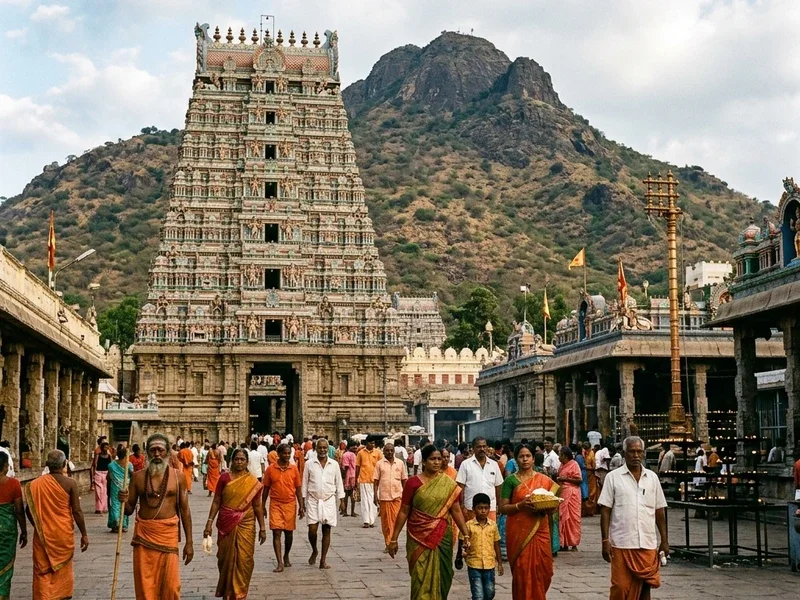
South India - Divya Desams, Pancha Bhuta, Pancha Sabha
South Indian temple-craft is a civilisation in itself. Below: Tirupati (richest temple), Meenakshi-Sundareshwarar (most-visited TN temple), Brihadeeshwara (Chola masterpiece, UNESCO), Srirangam (largest functioning complex), Padmanabhaswamy (wealthiest hidden treasure), Sabarimala, Guruvayur, and the 5 Pancha-Bhuta-Lingas (5 elemental Shaiva sthalas - ether, water, fire, wind, earth).
Legend - In Kaliyuga, Mahalakshmi (consort of Vishnu) left Vaikuntha in a dispute (Bhrigu-prahara - Bhrigu kicking Vishnu's chest). Vishnu came down to find her on the Venkatachala hill. Lakshmi remained at Kolhapur; Vishnu took a hill-shrine + borrowed money from Kubera for his wedding to Padmavati (the local princess, an avatar of Lakshmi). Until that debt is repaid, devotees offer money - hence the wealthiest temple. The marriage is celebrated annually.
Why famous - Wealthiest religious institution in the world (~Rs. 1,500+ crore annual income, gold reserves ~9 tonnes). One of 108 Divya Desams. ~50,000+ pilgrims per day, ~100,000 on holidays. Head-tonsure tradition - ~600 tonnes of hair collected annually. The deity NEVER opens his eyes fully (the Naga-bandhana - his gaze is unbearable).
Deity's intent - Repays karmic-debt + grants wealth (since devotee's gift goes to clearing Vishnu's debt to Kubera). The deity of liberation in Kaliyuga (Bhavishyottara: 'In Kaliyuga, only Venkatesha grants moksha').
Festival - Brahmotsavam (Sep, Bhadrapada - 9 days, 7 vahana processions). Vaikuntha Ekadashi (Dec-Jan). Garuda Seva (most important).
Visit tip - TTD seva online booking 3+ months ahead. Free darshan (Sarvadarshanam) queue 6-18 hours; Rs. 300 'special' is the practical choice. Free meals at Annadanam complex. NO black clothing inside.
Meenakshi Sundareshwarar· मीनाक्षी सुन्दरेश्वर
Madurai, Tamil Nadu (banks of Vaigai river)
Deity - Meenakshi (fish-eyed goddess - Parvati incarnate as Pandya princess) + Sundareshwarar (Shiva). Unique - the Devi is primary, not consort.
Scripture -Tiruvilaiyadal Puranam (Tamil Shaiva text by Paranjyoti Munivar, 16th c). Skanda Purana - Halasya Mahatmya.
Legend - Childless Pandyan king Malayadhwaja did putra-kameshthi yajna; from the fire emerged a 3-year-old girl with 3 breasts - she would lose the 3rd breast when she met her destined husband. She conquered the 8 quarters; at Kailasa she met Shiva - her 3rd breast vanished. Shiva came to Madurai + married her as Sundareshwarar. The 14 gopurams of the temple commemorate this wedding.
Why famous - 14 gopurams (4 outermost are 50-m). 33,000+ stone-carvings. Hall of 1000 pillars (each carved differently). One of the largest temple complexes in India (14 acres). Tamil Nadu's #1 temple in tourist visits.
Deity's intent - Meenakshi grants what she herself received - a perfect spouse. Supreme deity for marriage + marital harmony (3rd-breast-disappears = false-ego dissolves when right partner found).
Festival - Meenakshi Thirukalyanam (Chitra month, Apr-May - the wedding re-enactment - 12 days, the most opulent kalyanam in India). Navratri.
Visit tip - Allow 4 hours minimum. Cameras allowed in outer prakaram only. East tower (Ashta Shakti Mandapam) at sunrise is the photo-spot.
Brihadeeshwara (Big Temple)· बृहदीश्वर
Thanjavur, Tamil Nadu (banks of Cauvery)
Deity - Brihadeeshwara / Peruvudaiyar - Shiva as 'The Great Lord'. 3.7-m linga in 4-m square sanctum.
Scripture -Inscriptions of Rajaraja Chola I (1010 CE consecration) on the temple walls. Skanda Purana - local mahatmya.
Legend - Built by Rajaraja Chola I (985-1014 CE) at the peak of Chola power - consecrated 1010 CE on his 25th-regnal year. Designed by chief-architect Kunjara Mallan Raja Raja Perunthachan. The shikhara (66 m / 216 ft) was the tallest in the world for 600+ years.
Why famous - UNESCO World Heritage (1987) - one of the 'Great Living Chola Temples'. The shadow of the main shikhara never falls on the ground at noon - engineering masterpiece. The single Vimana-stone (80 tonnes) at the top - how it was raised remains debated. 1000th anniversary celebrated 2010.
Deity's intent - Confers Chola-class regal-grandeur. Granted Rajaraja Chola his empire (the inscriptions are essentially his autobiography). For those undertaking grand projects.
Festival - Maha Shivaratri. Sadayam (Rajaraja's birth-star, Magha). Brahmotsavam.
Visit tip - UNESCO-managed, well-maintained. Inner sanctum access free. Combine with Airavateshwara (Darasuram, 40 km) + Gangaikondacholapuram (70 km) - the other 2 Chola Great Temples.
Srirangam (Ranganathaswamy)· श्रीरङ्ग
Srirangam island, Tiruchirappalli, Tamil Nadu (Cauvery + Kollidam delta)
Deity - Ranganatha - Vishnu reclining on Adisesha. 6-m granite murti, eastward-facing (only Vishnu temple where deity faces East and South - south-facing rare).
Scripture -Srirangam Mahatmya. Brahmanda Purana. Garuda Purana. Most importantly - the entire Tamil-Prabandham (Divya Prabandham, 4000 verses) composed by 12 Alvars (5th-9th c) - Srirangam is celebrated more than any other Divya Desam (247 verses).
Legend - Vibhishana (Ravana's brother, made king of Lanka by Rama) took a Vishnu murti to install in Lanka - on condition 'do not put it down en route'. He camped at Srirangam to bathe in the Cauvery; the murti would not move thereafter. Vibhishana, weeping, was told: 'I shall remain here, facing south, looking towards you in Lanka, blessing you'. Hence south-orientation.
Why famous - LARGEST functional Hindu temple complex in the world - 156 acres, 7 concentric prakarams, 21 gopurams (the largest, Rajagopuram, is 73 m - completed only 1987 by an old vaishnava centenarian acharya). Foremost of 108 Divya Desams. Ramanujacharya's main seat (his samadhi-murti is here, mummified, on view).
Deity's intent - Removes the karma-knots of countless births (Sri Vaishnava 'sharanagati' - surrender - succeeds here easiest). The peak Vaishnava goal - sannidhi-darshan at Srirangam = direct Vaikuntha.
Festival - Vaikuntha Ekadashi (Dec-Jan) - 21-day Pagal Pathu + Rapathu utsav with 21 days of Divya Prabandham recitation. Brahmotsavam (Panguni).
Visit tip - Vaikuntha Ekadashi (Vaikuntha Dvara opens for 1 day only) sees 1-2 million pilgrims - book hotels 6 months prior. Inner sanctum: non-Hindus admitted to outer 4 prakarams only. Ramanujacharya's murti darshan is uniquely moving.
Padmanabhaswamy· पद्मनाभस्वामी
East Fort, Thiruvananthapuram, Kerala
Deity - Padmanabha - Vishnu in Anantashayana (reclining on Adi-Sesha, with Brahma emerging on a lotus from his navel - padma + nabha). 18-ft murti - visible only through 3 doors as 3 separate sections (head, navel-lotus, feet).
Legend - Sage Divakara Muni did tapas to Vishnu, asking for a child-form to nurse. Vishnu came as a mischievous child who would not return Vishnu's chakra to the sage. The sage cursed: 'Disappear!'. The boy entered the Iluppa tree, which fell - revealing Vishnu in Anantashayana, 18 ft long. The sage saw the form was too long for one darshan - Vishnu allowed darshan in 3 sections through 3 doors. The Travancore royals (Marthanda Varma, 1750) dedicated the entire kingdom to Padmanabha - they ruled only as 'Padmanabhadasa'.
Why famous - Considered the wealthiest hidden treasure in the world. 6 of the 8 vaults were opened in 2011 - Rs. 1+ lakh crore (~$22 billion+) in gold, gems, idols revealed. Vault B remains unopened. UNESCO consideration. Strictly dress-coded.
Deity's intent - Grants the wealth of Travancore - sustained generational prosperity. The 'royal' Vishnu - devotee becomes a king.
Festival - Painkuni utsav (Mar-Apr - 10 days, Aarat at sea). Alpasi (Oct-Nov).
Visit tip - STRICT dress code - Men: dhoti, bare-chested (mundu, no shirt). Women: saree or mundu-set. No salwar, jeans, leggings. Cameras + cell-phones strictly banned. Foreigners + non-Hindus barred from inner sanctum.
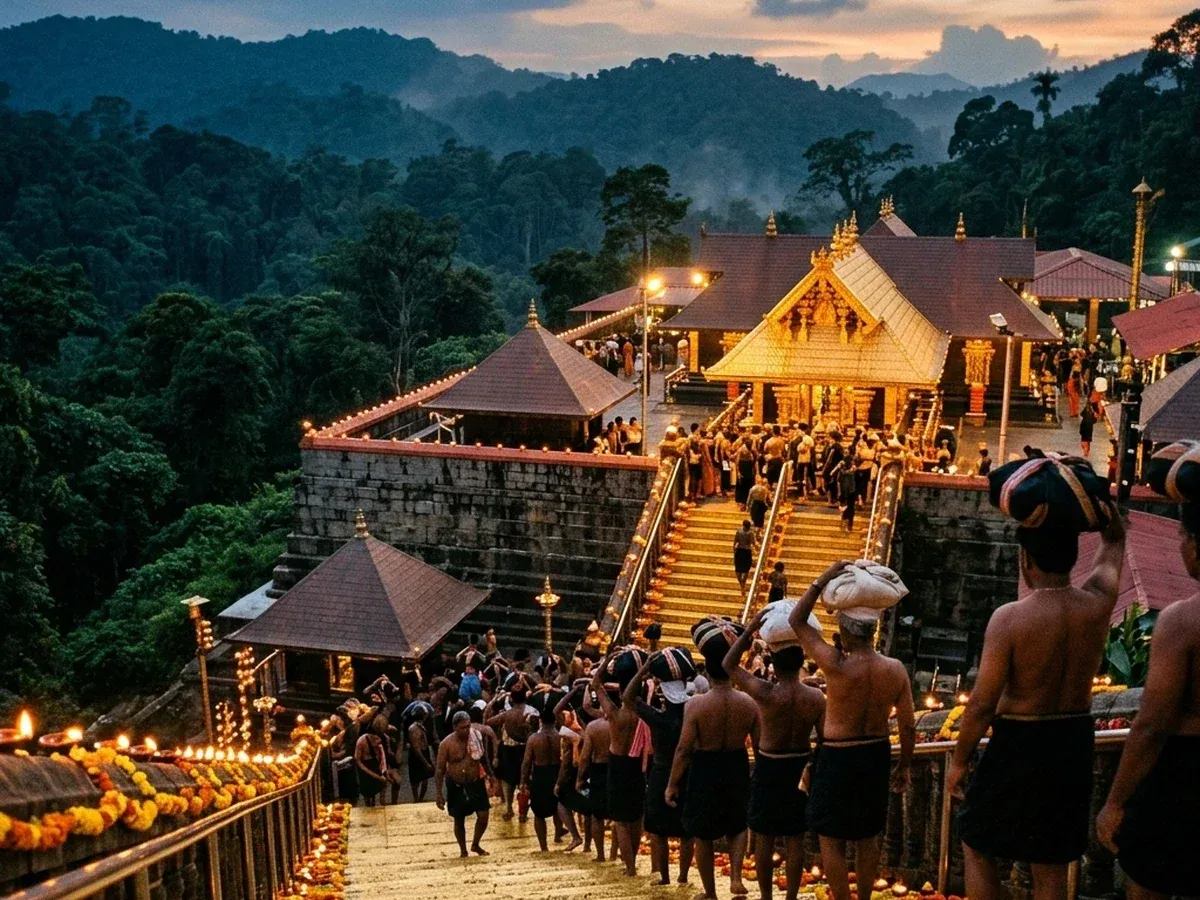
Sabarimala Ayyappa· शबरीमला अय्यप्पा
Periyar Tiger Reserve, Pathanamthitta district, Kerala (1535 m, deep forest)
Deity - Ayyappa / Hariharaputra - son of Hari (Vishnu, as Mohini) + Hara (Shiva). Yoga-mudra murti, knee-bound posture (yoga-patta).
Scripture -Bhutanatha Upakhyana. Brahmanda Purana - Mahishi Bhanjana. Kerala local mahatmyas.
Legend - Mahishi (sister of Mahishasura) received the boon that she could only be killed by a son of Hari + Hara. Shiva embraced Vishnu's Mohini-form; Ayyappa was born. King Rajashekara of Pandalam found the infant in the forest + raised him. Ayyappa returned to the forest at 18, slew Mahishi atop the 18 hills of Sabarimala, + remained there in yoga.
Why famous - ~50 million pilgrim-visits per year (largest annual gathering globally outside Kumbh). 18 sacred steps (Pathinettam Padi) - each step represents 1 aspect of yoga. 41-day vrata (Mandala Vrata) - strict celibacy, no leather, black/blue clothing, no shaving, before darshan.
Deity's intent - Cuts the chord of all attachments. The supreme Yogi-Vishnu-Shiva. Strength to undertake brahmacharya. Grants moksha through dharma-action.
Festival - Mandala Pooja (Nov-Dec - 41 days). Makaravilakku (Jan 14, Makara Sankranti - 'mystery light' on Ponnambalamedu hill).
Visit tip - Women aged 10-50 (menstrual age) historically not permitted - disputed; 2018 SC ruling allowed; tradition continues to be enforced. Wear black/blue mundu. Must complete 41-day vrata (1 meal, no leather, no shave, abstain). Trek 5 km from Pamba.
Guruvayur· गुरुवायूर्
Thrissur district, Kerala
Deity - Guruvayurappan - 4-armed Vishnu / Krishna (shankha + chakra + gada + padma). Original murti is c. Dvapara - given to Krishna by Vishnu, who gave it to Uddhava, who at Krishna's mahaprasthan passed it to Guru (Brihaspati) + Vayu (Wind-god) - they installed it here, hence Guru-Vayur-Appan.
Scripture -Narayaneeyam (Bhagavata distillation in 1036 verses by Melpathur Narayana Bhattathiri, 1586-87 CE, who wrote it AT Guruvayur after being cured of paralysis).
Legend - Krishna at his mahaprasthan instructed Uddhava to take the household-murti of Vishnu (worshipped by Vasudev + Devaki, then Krishna himself) + entrust it to Brihaspati. The Pralaya flooded Dwarka; the murti floated. Brihaspati + Vayu retrieved it + installed it at the present site on Guruvayur, in tret-Tretayuga.
Why famous - 'Bhuloka Vaikuntha' - the heaven on earth. Narayaneeyam recital cured Bhattathiri's paralysis (story documented). Strict Kerala-Brahmin-only entry. Tantra by Tantri Sarvavijayam family. Famous Pancha-Janya conch + Krishna's flute imprints visible on the murti.
Deity's intent - Cures chronic illness - most famously paralysis + skin-diseases (Bhattathiri's verified case). Tulabharam (weighing one's body in any commodity - banana, jaggery, gold - and offering to the temple) - for vow-fulfilment.
Visit tip - Strict dress code: Men dhoti bare-chest, Women only saree. Non-Hindus barred. Wedding-bookings at the temple are years-out (most-sought wedding-venue in Kerala). The Krishna-Nada elephant (now retired) is famous.
Chidambaram (Akasha-linga, Ether)· चिदम्बरम्
Cuddalore district, Tamil Nadu
Deity - Nataraja - Shiva as cosmic dancer. The 'lingam' is INVISIBLE (akasha = ether/space) - only a yantra in empty space behind a curtain ('Chidambara Rahasya' - 'the Chidambara secret').
Legend - Sages of Daruka-vana practiced misguided rituals + arrogance. Shiva, disguised, came with Vishnu (as Mohini) to humble them. The sages sent serpents + a tiger + a deer - Shiva wore them. They sent the dwarf Muyalaka (apasmara - ignorance) - Shiva trampled him + began the Cosmic Dance (Anandatandava). This dance is forever frozen here as Nataraja.
Why famous - One of Pancha Bhuta Sthala - represents AKASHA (ether). One of the Pancha Sabhas - Kanaka Sabha (golden hall, where the dance happens). Source-image for ALL Nataraja bronzes worldwide. Dikshitar priest-community is unique.
Deity's intent - Reveals the empty-space (Brahman) behind appearance. Grants direct realisation of the void as fullness. The deity of cosmic-dance - for dancers + performers.
Visit tip - Chidambara Rahasya (the empty-yantra darshan) happens only at certain hours - ask Dikshitar priests. The 4 gopurams have all 108 Bharatanatyam karanas (poses) carved.
Tiruchirappalli district, Tamil Nadu (adjacent to Srirangam)
Deity - Jambukeshwarar - Shiva as water-linga. The sanctum has water seeping continuously around the linga (verified - small underground spring).
Scripture -Skanda Purana. Periya Puranam.
Legend - Once Parvati, in a moment of pride, was sent by Shiva to earth as Akilandeshwari ('Mistress of the universe'). She did tapas in the form of a cow (Akhilam = whole, andam = universe). She moulded a linga from Cauvery-clay under a Jambu (rose-apple) tree. The spider + elephant + tortoise also worshipped (Sthala-Vrukshyam) - hence the name 'Tiru-Anai-kaval' ('place worshipped by elephant').
Why famous - One of Pancha Bhuta Sthala - JALA (water). Akilandeshwari (Parvati) here is the supreme - Adi Shankara famously installed earrings (tatanka) on her to subdue her fierce form.
Legend - Brahma + Vishnu disputed who was supreme. Shiva appeared as an infinite pillar of fire - challenged them: 'Find my top + bottom'. Vishnu (as boar Varaha) dug down; Brahma (as swan) flew up - neither could find an end. Brahma lied + said he had found the top. Vishnu admitted defeat. Shiva: 'You who admitted truth will be worshipped less' (Brahma is not worshipped). The flame-pillar cooled into the Arunachala hill.
Why famous - One of Pancha Bhuta Sthala - AGNI. Annual KARTHIGAI DEEPAM (Nov-Dec) - a 7-m-tall ghee-lamp lit atop the hill, visible from 30 km, burns 7 nights - the largest open-air lamp in India. Ramana Maharshi (1879-1950) lived here 53 years; his ashram is at the foot.
Deity's intent - BURNS karma-impurities directly (agni-pradakshina). The 14-km giri-pradakshina (around Arunachala hill) is itself liberation. The deity of self-enquiry - Ramana's lineage.
Festival - Karthigai Deepam (Nov-Dec, Kartik Krittika star - peak). Maha Shivaratri. Chitra Pournami (Apr - full-moon giri-pradakshina, ~1 million pilgrims).
Visit tip - Do giri-pradakshina on a Full-Moon night - 14 km barefoot on the hill-road. 4-5 hours, ideally start 6 PM. Ramana Ashram is 2 km, samadhi-darshan is essential. Don't climb the hill (forbidden).
Sri Kalahasti (Vayu-linga, Wind)· श्रीकालहस्ती
Tirupati district, Andhra Pradesh (banks of Swarnamukhi river, 36 km from Tirupati)
Deity - Sri Kalahastiswara - Shiva as VAYU (air) linga. The sanctum-lamp flickers continuously (perceptibly to a steady wind that has no obvious source).
Scripture -Skanda Purana - Kalahasti Mahatmya.
Legend - Sri (spider), Kala (cobra), Hasti (elephant) each worshipped the linga in their own way - the spider weaving a web of devotion, the cobra placing flowers on its hood, the elephant pouring Swarnamukhi water. They quarrelled (each thinking they alone worshipped); Shiva united them into the name Sri-Kala-Hasti.
Why famous - One of Pancha Bhuta Sthala - VAYU. The sanctum-lamp flickering is a UNIQUE phenomenon - visible to all pilgrims. The supreme RAHU-KETU dosha + Kalsarpa Dosha removal temple of South India (more potent than Trimbakeshwar per south-tradition).
Deity's intent - Removes Rahu + Ketu doshas (the 2 shadow-planets - chronic problems, malefic-influences in horoscope). The supreme remedial-temple for nakshatra-doshas.
Festival - Maha Shivaratri (12-day). Brahmotsavam.
Visit tip - Combine with Tirupati (36 km) - most pilgrims do Tirupati → Sri Kalahasti the same trip. Rahu-Ketu pooja (1.5 hrs, Rs. 800 official) - book at the temple office only. Do NOT pay touts at the gate.
Deity - Ekambareshwara - Shiva as the PRITHVI (earth) linga. Sanctum-linga is made of compacted earth/sand - never abhisheka with water (it would dissolve); honey + perfume only.
Scripture -Skanda Purana - Kamakshi Vilasa. Local Kanchi-Mahatmya.
Legend - Parvati (banished by Shiva for closing his eyes playfully) did tapas under a Mango tree (ekamra) on the banks of Vegavathi. To test her, Shiva sent a flood - Parvati embraced the sand-linga to save it. She moulded it with her own hands. Shiva, pleased, gave her the linga + married her here. Hence Ekamra-nathar / Ekambareshwara ('Lord of the One-Mango Tree').
Why famous - One of Pancha Bhuta Sthala - PRITHVI. ALSO one of 108 Divya Desams (paired with the Varadaraja Perumal temple, Kanchi). Adi Shankara installed the Sri Yantra in Kamakshi temple here (next-door) - see Sri-Yantra deep. 3500+ year old Mango tree (sthala-vruksha - believed original).
Deity's intent - Grounds the wavering mind (prithvi = stability). Removes mental-restlessness, anxiety-disorders. Especially for those whose horoscopes are deficient in earth-element.
Festival - Panguni Uthiram (Mar-Apr). Maha Shivaratri.
Visit tip - Kanchipuram has 1000+ temples - Ekambareswarar + Kamakshi + Varadaraja are the top 3 (do all in 1 day). Original 3500-yr Mango tree shown with permission.
Other Major Temples - Himalaya, Orissa, Delhi, Vrindavan
Amarnath (ice-linga in Himalaya), Pashupatinath (Nepal), Muktinath (108 dhara), Krishna Janmabhoomi, Ram Janmabhoomi (consecrated 2024), Vrindavan ISKCON, Akshardham (Guinness-Record largest comprehensive Hindu temple), Lingaraj (Kalinga style), Konark Sun Temple, Modhera, Khajuraho (Chandela).
Amarnath· अमरनाथ
Anantnag district, Jammu & Kashmir (3,888 m, deep Himalaya)
Deity - Amarnath - Shiva as a self-forming ICE LINGA (waxes + wanes with the moon, peaks at Shravan Purnima)
Legend - Shiva took Parvati to Amarnath cave to whisper the secret of immortality (Amar Katha) - the 'how-to-never-die' wisdom. He left his Nandi at Pahalgam, his moon-crescent at Chandanwari, his serpent at Sheshnag, his elephant-head son Ganesha at Mahaganesh hill, his 5 elements at Panjtarni - entering the cave alone with Parvati. Two doves overheard the Amar-Katha - they live on in the cave (Amar-pakshi) seen by pilgrims even today.
Why famous - Self-forming ice-linga (geological phenomenon: water seeping + freezing). Annual Amarnath Yatra (Jul-Aug, Shravan) - ~3 million pilgrims trek 32 km from Pahalgam or 14 km from Baltal. Discovered by a shepherd Buta Malik (Muslim) in 1850s - Malik-family still gets a share of donations.
Deity's intent - Grants AMAR (deathlessness). The supreme darshan of mortality-conqueror Shiva. Removes fear-of-death.
Festival - Shravan Purnima (Raksha Bandhan - peak of ice-linga formation). Yatra Jun-Aug.
Visit tip - REGISTER online with Shri Amarnath Shrine Board (SASB) months ahead. Medical certificate (heart + lung fitness) mandatory. Helicopter from Baltal-Panchtarni shortens 14 km. Altitude sickness real - acclimatize.
Pashupatinath· पशुपतिनाथ
Kathmandu, NEPAL (banks of Bagmati river)
Deity - Pashupatinath - Shiva as 'Lord of all beings' (pashu = soul, pati = master). 5-faced linga - Sadyojata (W), Vamadeva (N), Aghora (S), Tatpurusha (E), Ishana (top/zenith).
Scripture -Pashupata Sutra (Lakulisha, c. 200 CE - earliest Shaiva text). Skanda Purana. Nepalimahatmya.
Legend - Shiva, weary of devas, took the form of an antelope (rishabha) + grazed in the Mrigasthali forest (now Pashupati). The devas tracked him + grabbed his horn - it broke into 4 pieces. The body (kapot-form) became Pashupatinath; head went to Kedarnath; legs to Tungnath; chest to Madhyamaheshwar; arms to Rudranath; etc - the Panch Kedars (see Kedarnath above).
Why famous - UNESCO World Heritage (1979). One of 12 Jyotirlinga-aligned 'Maha-Kshetra' (per Nepali tradition). Only Nepali-Brahmin (Bhatt) priests allowed inside. Cremation-ghat (Arya Ghat) on the Bagmati - most-sacred cremation site for Nepali Hindus.
Deity's intent - Liberates all 'pashus' (souls) bound by 'pasha' (karma-noose). Grants moksha to those cremated on the Bagmati ghat. Supreme bond-breaker.
Festival - Maha Shivaratri (Feb-Mar - ~700,000 sadhus + pilgrims; ~1 million on peak day). Teej (Aug-Sep - women fast).
Visit tip - Non-Hindus barred from inner sanctum but can view from across the Bagmati. Mahashivaratri = camping-pilgrimage atmosphere. Combine with Boudhanath Stupa (5 km).
Muktinath· मुक्तिनाथ
Mustang district, NEPAL (3,710 m, in the rain-shadow of Annapurna massif)
Deity - Muktinath - Vishnu as 'Liberation-giver'. One of 108 Divya Desams (the only Divya Desam outside India). Murti is golden, ~1 m.
Scripture -Brahmanda Purana - Mukti Kshetra Mahatmya. The shrine is also the source-spring of Shaligram-shilas (black ammonite-fossils on the Kali Gandaki river - considered svayam-vyakta Vishnus).
Legend - Brahma's 4 sons (Sanaka, Sanatana, Sanandana, Sanatkumara) did tapas at this kshetra; Vishnu appeared + granted them liberation. Saligram-shilas (fossil-ammonites of Mesozoic cephalopods) on the Kali Gandaki riverbed are the only natural svayam-vyakta Vishnu murtis - devout Vaishnavas worship them; they form here exclusively.
Why famous - 108 dhara (water-spouts shaped like bull-faces) flowing around the temple - pilgrim bathes under all 108 (fits ice-cold Himalayan water - January-temperatures below freezing). Jwala Mai shrine adjacent has 3 natural flames burning over water - fire-on-water phenomenon.
Deity's intent - MUKTI (liberation) directly - name says it. The 108 dhara remove the 108 karma-knots of 108 past births. The fire-on-water = the unity of opposites = moksha.
Festival - Janai Purnima (Aug - pilgrim peak). Vijayadashami (Sep-Oct).
Visit tip - Fly to Pokhara then Jomsom (15-min flight). 7-km jeep to Ranipauwa village; 1.5-km climb. Altitude 3700 m - acclimatize. Pick a Shaligram only with explicit local permission (illegal export).
Srirangapatna, Mandya district, Karnataka (on a Cauvery island, 18 km from Mysuru)
Deity - Ranganatha - reclining Vishnu, 5-m murti. One of the 5 Ranganatha-kshetras (Adi-Ranga at Srirangapatna, Madhya-Ranga at Shivanasamudra, Antya-Ranga at Srirangam, etc).
Scripture -Brahmanda Purana. Skanda Purana.
Legend - Sage Gautama installed the deity. The Cauvery encircles the temple-island. Tipu Sultan (1750-1799) - surprisingly - patronised this temple (despite his other policies); his palace was inside the fort.
Why famous - ADI-RANGA - the first Ranganatha-kshetra (Srirangam is Antya-Ranga / final). Hoysala-Vijayanagara architecture. Site of Tipu Sultan's death (the fort fell to British in 1799; his body was found near the temple).
Deity's intent - Beginning-of-Vaishnava-yatra - Adi-Ranga grants the first awakening of bhakti.
Festival - Vaikuntha Ekadashi. Brahmotsavam (Apr).
Visit tip - Combine with Mysuru Palace (18 km) + Daria Daulat Bagh (Tipu's summer palace, 1 km) + Tipu's tomb. Half-day enough.
Krishna Janmabhoomi (Mathura)· कृष्ण जन्मभूमि
Mathura, Uttar Pradesh (on the Yamuna)
Deity - Bal Krishna - infant Krishna in the original prison-cell of Kamsa (where Devaki gave birth, Bhadrapada Krishna Ashtami, midnight, c. 3228 BCE per tradition).
Legend - Devaki + Vasudeva were imprisoned by Kamsa (Devaki's brother). 7 children killed; the 8th - Krishna - was born at midnight in the prison. Vasudeva carried him across the Yamuna to Gokul + exchanged him with Yashoda's newborn daughter (Yogamaya). The 'Garbha Griha' beneath the current temple is the supposed original cell.
Why famous - One of 7 Mokshapuris. Disputed structure - the Shahi Idgah mosque (built 1670 by Aurangzeb after demolishing the earlier temple) is adjacent; legal dispute ongoing in courts as of 2026. Current temple is a 1965 rebuild on the surrounding land.
Deity's intent - Grants the bhakti-rasa of Krishna directly - devotees report instant tears + childlike-emotion. The womb of bhakti.
Festival - Janmashtami (Bhadrapada Krishna Ashtami, Aug-Sep - midnight birth celebration, ~1 million pilgrims).
Visit tip - Strict security check (mosque adjacent). Combine with Vrindavan (15 km) + Govardhan (25 km) + Barsana (40 km, Radha's birthplace) - the Braj parikrama is a 252-km circuit. Most pilgrims do shortened 7-temple version.
Ram Janmabhoomi (Ayodhya)· राम जन्मभूमि
Ayodhya, UP (on the Sarayu river)
Deity - Ram Lalla - infant Rama (5-yr-old form), 51-inch black stone murti, consecrated 22 January 2024 by PM Modi + Pandit Lakshmikant Dixit.
Legend - Rama, son of King Dasharatha + Queen Kaushalya, was born in Ayodhya at noon on Chaitra Shukla Navami (c. 5114 BCE per traditional reckoning, though academic debate). The current temple is built atop the disputed site of the Babri Masjid (built 1528 by Mir Baqi, demolished 6 Dec 1992; Supreme Court 9 Nov 2019 ruling awarded site for temple).
Why famous - One of 7 Mokshapuris (the oldest - Treta-yuga). Consecrated 22 January 2024 - the largest religious event in Hindu history of the 21st century. ~10 million pilgrims attended the consecration period. Surya-Tilak (sun-ray on Rama's forehead on Rama Navami noon) is an engineered feature using mirrors.
Deity's intent - Restores dharma (Rama is dharma incarnate). Grants the rule of just-conduct in one's life. Mass-bhakti awakening.
Legend - Krishna's childhood - the rasa-leela with the gopis, Govardhan-uplifting, Kaliya-mardana - all happened in Vrindavan + nearby (Govardhan, Mathura, Gokula). Vrindavan was 'rediscovered' in 16th c by Chaitanya Mahaprabhu + the 6 Goswamis (Rupa, Sanatana, Jiva, Raghunath Das, Raghunath Bhatta, Gopal Bhatta). ISKCON's Krishna-Balaram temple (1975) is on the spot where Krishna + Balarama played as children - established by AC Bhaktivedanta Swami Prabhupada.
Why famous - Centre of the global ISKCON movement (founded 1966, NY by Prabhupada). Prabhupada's samadhi-mandir on the same campus. Open to all (no caste-restriction). Daily 7 aratis + kirtan.
Deity's intent - Grants Krishna-prema (love of Krishna) - the purpose of human life per Chaitanya's teaching. Easy + universal - even foreigners with no Sanskrit attain bhakti here.
Festival - Janmashtami. Radhashtami. Gaur Purnima (Chaitanya's birthday, Mar). Govardhan Pooja.
Visit tip - Lectures + kirtan in English. Free prasadam (lunch). Combine with the 84 kos parikrama (252 km Braj circuit) OR shorter 7-temple circuit. Banke Bihari temple (1 km) is the most powerful single-darshan in Vrindavan.
Akshardham (Delhi)· अक्षरधाम
Noida-link, East Delhi (on Yamuna)
Deity - Bhagwan Swaminarayan (1781-1830, founder of BAPS Swaminarayan sampradaya) - 3-m gold-leafed murti in dhyana mudra.
Legend - Bhagwan Swaminarayan was born Ghanshyam Pande (1781, Chhapaiya); renunciated at 11; established the Swaminarayan Sampradaya. The temple at Akshardham Delhi was built by BAPS in 2000-2005 (5 years, 11,000 artisans) - Guinness Record (Nov 2007) for 'Largest comprehensive Hindu temple'.
Why famous - Largest comprehensive Hindu temple in the world (per Guinness). 234 carved pillars, 9 ornate domes, 20,000+ deities + sages depicted. Pink-sandstone + marble. Multimedia 'Sahaj Anand' show. 'Neelkanth Yatra' IMAX. Boat ride 'Sanskruti Vihar' through 10,000 years of Vedic history.
Deity's intent - Modern presentation of Sanatana Dharma - for those who find traditional temples opaque. Universal-access (all welcome).
Festival - Janmashtami. Diwali. Annakut.
Visit tip - Closed Mondays. Security extremely strict (no phones, bags, cameras). Allow 4-5 hours. Sahaj Anand show + Mystic India boat ride book ahead. Also Akshardham Gandhinagar (older, 1992) - equally impressive.
Lingaraj· लिङ्गराज
Bhubaneswar, Odisha
Deity - Lingaraj - Shiva as 'King of Lingas'. Self-manifested 8-ft swayambhu linga in granite, half-Shiva half-Vishnu (Hari-Hara).
Legend - Bhubaneswar = 'Lord of the World' (Tri-bhuvaneshwara). Lingaraj is the supreme. The Hari-Hara character - half-Vishnu, half-Shiva - is unique among major lingas. Built 11th c by Somavamshi king Jajati Keshari (per inscriptions).
Why famous - Kalinga architectural style - supreme example. 55-m vimana (one of tallest in India). 3 prakarams. Strict Hindu-only entry (non-Hindus can view from raised platform outside east-wall).
Deity's intent - King-of-Kings darshan. The Linga of supreme sovereignty + harmony of dvaita (Hari + Hara).
Festival - Maha Shivaratri. Rukuna Rath Yatra (Apr - chariot festival, smaller cousin of Puri's).
Visit tip - Non-Hindus: ASI raised platform (east boundary) gives complete view. Bhubaneswar has 700+ ancient temples - combine with Mukteshwar, Rajarani, Brahmeshwar, Parashurameshwar, Vaital Deul (the rare tantric Chamunda temple).
Konark Sun Temple· कोणार्क सूर्य मन्दिर
Konark, Puri district, Odisha (on Bay of Bengal coast)
Deity - Surya - Sun-god, in a 30-m stone-chariot pulled by 7 horses (the days of week) on 12 wheels (the months) - each wheel is also a sundial (functional to the minute).
Legend - Built 1238-1264 CE by King Narasimhadeva I of Eastern Ganga dynasty to celebrate his victory over the Tughluq invaders. Designed as the actual chariot of the Sun god - 24 wheels + 7 horses, all hand-carved granite. The main shikhara (76 m / 250 ft) collapsed in c. 1837 (storms / Portuguese sabotage / structural failure - debated). The jagamohana (assembly-hall, 39 m) survives.
Why famous - UNESCO World Heritage (1984). Architectural marvel - wheels work as sundials accurate to within 1 minute. The erotic carvings (Khajuraho-like but on a temple-chariot) are unique. The 'Konark dance festival' (Dec) is the premier Indian classical dance event.
Deity's intent - Sun-blessing - health, vitality, success, vision. Surya was worshipped here for cure of leprosy + skin-diseases (Samba, Krishna's son, was cured here - per Bhavishya).
Festival - Magha Saptami (Feb - Surya's birthday). Konark Dance Festival (Dec).
Visit tip - ASI-managed; no active puja inside (deactivated by Aurangzeb in 1677). Sunrise + sunset shows the wheels in dynamic light. Combine with Puri (35 km) + Chilika Lake (60 km).
Sun Temple Modhera· मोढेरा सूर्य मन्दिर
Mehsana district, Gujarat (banks of Pushpavati river)
Deity - Surya - Sun-god. Original murti looted/lost; current structure is purely ASI-preserved.
Legend - Built 1026-1027 CE by Solanki (Chaulukya) king Bhima I. Inscription dated Vikram Samvat 1083 (1026 CE) gives precise date. Looted by Mahmud of Ghazni's successor (Allauddin Khilji 1298).
Why famous - ASI-protected. The Kund (stepwell) - Surya-Kund / Rama-Kund - is one of the largest, deepest stepped-tanks in Gujarat (a Solanki architecture peak). On the Tropic of Cancer - solstice + equinox light enters the garbhagriha precisely.
Deity's intent - Historical-cultural significance, not active worship. Architectural inspiration; royal Surya-bhakti.
Festival - Modhera Dance Festival (Jan - ASI hosts).
Visit tip - Open all year. Combine with Patan (Rani-ki-Vav, UNESCO, 35 km) + Ambaji (50 km, Shakti Peetha).
Khajuraho· खजुराहो
Chhatarpur district, Madhya Pradesh (Bundelkhand)
Deity - Multiple - 23 of original 85 temples survive (9 active worship). Kandariya Mahadeva (largest, 31 m) is the most famous Shiva-temple; Lakshmana, Vishvanatha, Chaturbhuja are others.
Scripture -Inscriptions of Chandela dynasty (10th-12th c CE) - built under Yashovarman + Dhanga + Vidyadhara.
Legend - Founded by the Chandela dynasty (a Rajput line). Chandravarman (the legendary founder) was said to be the son of Hemavati (a beautiful brahmin widow) and the Moon-god - Chandela = 'lunar dynasty'. The 85 temples built 950-1050 CE represent the peak of Nagara architecture in central India.
Why famous - UNESCO World Heritage (1986). FAMOUS for erotic sculptures (~10% of carvings; 90% are dharmic / celestial). The erotic-mithuna sculptures depict tantric kama-shastra principles - kama as 1 of the 4 purusharthas - not 'pornography' but a complete recognition of life's stages. ASI's restoration ongoing.
Deity's intent - Recognition of kama (desire) as a legitimate path within dharma. Temple-darshan paired with the understanding: 'on the outside, the world; in the garbhagriha, the bare-Brahman.' The erotic-outer becoming the empty-inner = the journey.
Festival - Khajuraho Dance Festival (Feb - premier Indian classical dance event). Maha Shivaratri (Kandariya).
Visit tip - Best at sunrise. Hire ASI-approved guide (Rs. 500) - most pilgrims miss the symbolic meanings without guidance. Daily light-and-sound show (English 6:30 PM). Combine with Panna Tiger Reserve (40 km).
Pilgrimage Planning Notes
Quick reference for organising yatras - Char Dham circuits, Jyotirlinga sequences, Shakti Peetha groupings, Pancha Bhuta day-trips, and a universal practical kit.
Char Dham circuit (Adi Shankara's 4)
Badrinath + Dwarka + Puri + Rameswaram - 4 corners of India. Traditional order: NORTH → WEST → EAST → SOUTH. Total ~15-21 days by train + road. Modern adaptation: fly to each city (~7 days).
Chota Char Dham (Garhwal)
Yamunotri + Gangotri + Kedarnath + Badrinath - all in Uttarakhand. ONLY open May to November (snow-bound winters). 10-12 day yatra. Helicopter packages from Dehradun ~Rs. 70,000-1,50,000.
12 Jyotirlinga yatra
Complete circuit 30-45 days. Modern fast-track: 14 days by road + rail. Order varies - orthodox is to start with Somnath (1st) and end with Grishneshwar (12th). IRCTC packages from Rs. 80,000+.
51 Shakti Peetha yatra
Spread across India + Bangladesh + Pakistan + Nepal + Tibet + Sri Lanka. Complete circuit 90+ days; most pilgrims do the top 18 Maha-Shakti-Peethas (in India) over 30 days.
Pancha Bhuta yatra (Tamil Nadu + AP)
Ekambareshwarar (Kanchipuram) + Tiruvanaikaval (Trichy) + Tiruvannamalai + Sri Kalahasti (AP) + Chidambaram - all reachable in 5-7 days by road from Chennai.
South Indian Divya Desam circuit
108 Divya Desams of Vishnu (Alvar tradition). Foremost are Srirangam, Tirupati, Padmanabhaswamy, Guruvayur - covered in 7-10 days. Complete 108: 60-90 days.
Carry: photocopy of ID, Rs. 5000 cash (UPI works mostly), 1 plain white dhoti / saree (strict dress codes in Padmanabha + Guruvayur + Sabarimala), small cloth-bag for prasad, sturdy walking shoes (most southern temples require leaving them at the gate), printed darshan-booking (online), an unfilled Shaligram-cloth for samadhi/yagya offerings, water-bottle (most temples DON'T sell water inside).
Encyclopaedia of Hindu Iconography (4 vols) - T. A. Gopinatha Rao (Madras, 1914-1916 (reprint Motilal 1985))
Temples of South India - Sthapati K. Ganapati Sthapati commentary - K. Ganapati Sthapati (Aris) (Vastu Vedic Trust, 2000)
Glory of Indian Temples - architecture + cosmology - Stella Kramrisch (Motilal Banarsidass, 1976 (reprint of 1946 original))
Archaeological Survey of India (ASI) - temple-dating + UNESCO submissions for Khajuraho, Konark, Great Living Chola Temples, Pattadakal - ASI New Delhi (ongoing (1861-present))
Disclaimer - Information compiled from public scriptural sources (Puranas, sthala mahatmyas) and devotional tradition. Temple timings, dress codes, and access rules change - verify with the official temple website before pilgrimage. SevaCart is not affiliated with any individual temple administration. Some temples (Padmanabhaswamy, Sabarimala, Guruvayur) have specific access restrictions; consult the temple's own guidelines.