🪔 Daily practice
Anushthana - the householder day
A practical guide to a Hindu householder's daily ritual day - Brahmamuhurta to bedtime. No fluff. Each section tells you what to actually do, and why. Adapt to your lineage, your time, your body - but the structure is the same across sampradayas.
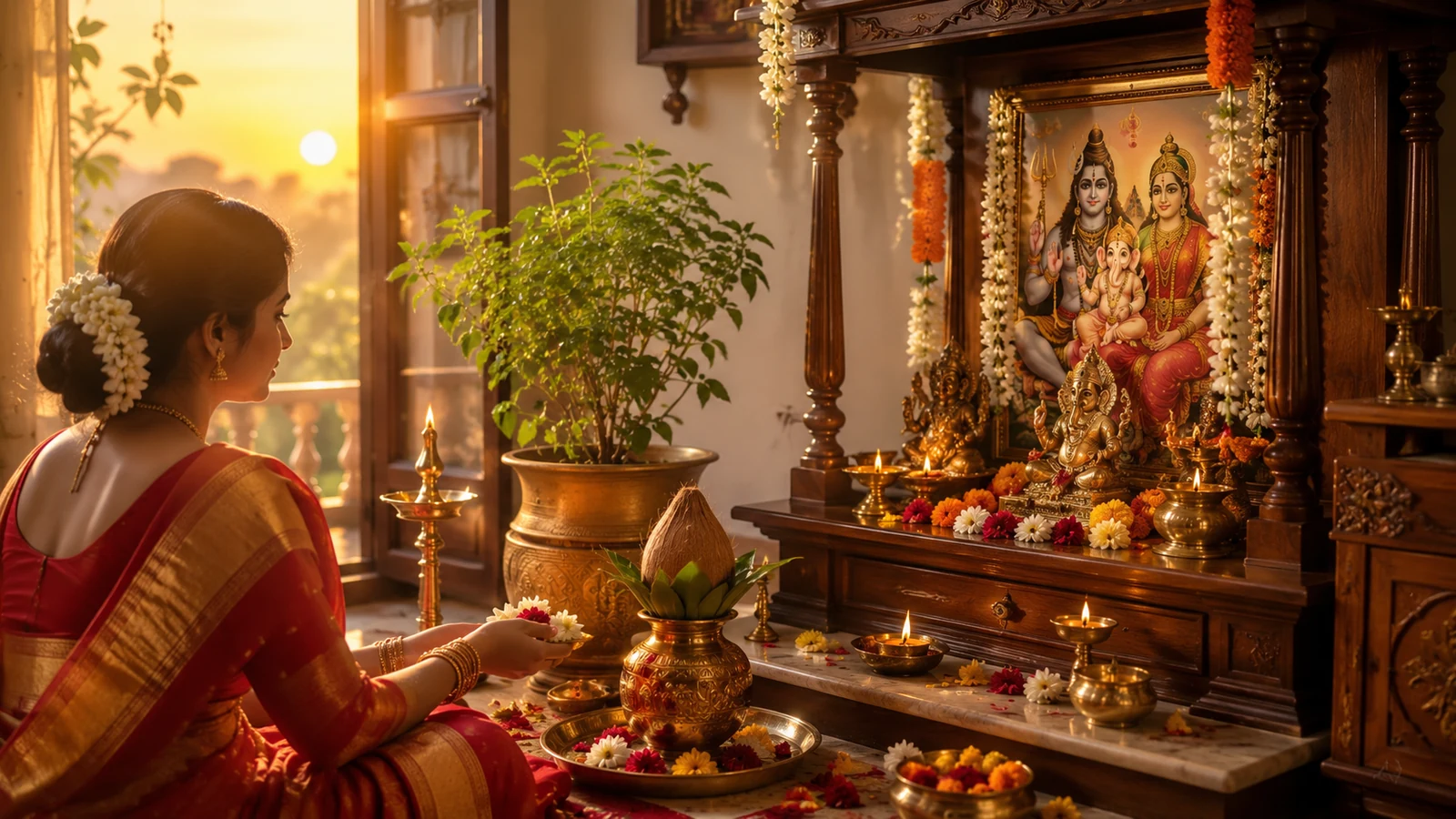
Brahmamuhurta - the hour before dawn
The 96 minutes before sunrise. Sattvic, undisturbed, the mind not yet entangled in the day. The single most valuable hour of practice in the householder's day.
- Wake at 4:30–5:00 AM. Before opening eyes, fold palms on chest and silently chant: karāgre vasate lakṣmīḥ, kara-madhye sarasvatī, kara-mūle tu govindaḥ, prabhāte kara-darśanam - "Lakshmi at the fingertips, Saraswati in the palm, Govinda at the wrist; at dawn I look upon my hands."
- Touch the earth. samudra-vasane devi parvata-stana-maṇḍale, viṣṇu-patni namas-tubhyaṃ pāda-sparśaṃ kṣamasva me - "O Earth, ocean-clad, mountain-breasted, consort of Vishnu, forgive the touch of my feet."
- Bath, brushing, ablutions. Cold water if you can. Then dry, clean clothes - preferably new or freshly washed.
- Apply tilaka / vibhuti / kumkum as your sampradaya requires. The forehead is the seat of intention.
Sandhya Vandana - the threefold daily salutation
The single most distinctive Vedic practice of the brahmana householder. Three times: at sunrise (prātaḥ), midday (mādhyāhnika), sunset (sāyaṃ). Each takes 10–20 minutes when learned.
The basic structure (same at all three sandhyas):
- Achamana - three sips of water, naming Keshava, Narayana, Madhava.
- Pranayama - three rounds of alternate-nostril breath while mentally chanting the 24-syllable Gayatri.
- Sankalpa - date, place, intent: "Today, on this tithi, in this place, I perform this sandhya for the pleasure of the Supreme."
- Marjana - sprinkling water on the head, three times, with three Vedic mantras of purification.
- Argya pradana - three offerings of water to Surya, scooped in cupped palms and let fall.
- Gayatri Japa - minimum 10 rounds of the 24-syllable Gayatri. Ideally 108 with a tulsi or rudraksha mala.
- Surya Upasthana - standing salutation to the sun.
- Devata Tarpana - water-offering to the devas, rishis, and pitrus.
- Shanti - the closing peace-mantra: oṃ śāntiḥ śāntiḥ śāntiḥ.
If 20 minutes feels long: start with just achamana + 10 rounds of Gayatri facing the sun. Build from there. A short consistent practice beats a long inconsistent one.
Sankalpa - how to set sacred intent
A sankalpa precedes every ritual. It anchors a moment of practice in cosmic time and personal will. The full Vedic sankalpa names the kalpa, manvantara, yuga, samvatsara, season, lunar fortnight, tithi, vara, nakshatra - then your name and gotra - then the action and its purpose.
A short modern sankalpa template:
mama upātta-samasta-duritakṣaya-dvārā
śrī parameśvara-prītyarthaṃ
adya śubha-tithau, śubha-nakṣatre,
[devatā-nāma]-prīty-arthaṃ
[ritual-name] kariṣye.

- "For the destruction of all my acquired sins,
for the pleasure of the Supreme,
on this auspicious tithi and nakshatra,
for the pleasure of [name of deity],
I shall perform [the ritual]."
Japa - using the mala
- 108 beads - the standard count. Plus the meru (the larger 109th bead), which marks the head and is never crossed.
- Hold in the right hand, between the thumb and the middle finger. Index finger never touches the beads - it represents the ego, kept apart.
- One bead per chant. When you reach the meru, do not cross it. Reverse direction and start the next round.
- Tulsi mala for Vishnu / Krishna / Rama. Rudraksha for Shiva / Devi / Ganesha. Sphatika (crystal) is universal.
- Posture: spine straight, eyes half-closed, breath natural. Sit on a kusha / wool mat - never directly on the floor for serious japa.
- Time: Brahmamuhurta is best. Otherwise any time the mind is settled.
Pradosham + Ekadashi - the two weekly fasts
Pradosham falls on the 13th tithi of every fortnight, in the 1.5 hours before sunset. The Lord of Pradosham is Shiva - Mahadeva is said to dance the Sandhya-Tandava during these moments. A Pradosham practice:
- Bath in the evening before sunset.
- Light a single lamp before a Shiva image or linga.
- Recite the Shiva Panchakshara - oṃ namaḥ śivāya - for 108 rounds.
- Read or chant the Lingashtakam if time permits.
Ekadashi falls on the 11th tithi of every fortnight. Sacred to Vishnu. Devotees observe a partial or full fast (depending on age, health, capacity), spend the day in remembrance of Vishnu, and break the fast the next morning at sunrise. Mahaekadashis: Vaikuntha (Margasirsa shukla), Nirjala (Jyestha shukla), Devshayani (Ashadha shukla), Devuthani (Kartika shukla).
Prarthana - praying with the body
A prayer is not just words. The body is part of the offering.
- Namaskara - palms joined at the heart. The default opening of every prayer.
- Sashtanga namaskara - full prostration with eight limbs touching the ground. The deepest bow. Performed before the deity, the guru, and elders.
- Pradakshina - circumambulation. Always clockwise (the deity is to your right). Three times for Vishnu, four for Devi, five for Ganesha, six for Subramanya, seven for Surya, half for Shiva.
- Mauna - silence. The natural language of prayer. End every session with a minute of silence.
Closing the day
Before sleep:
- One round of Gayatri or your ishta-mantra.
- The night-before-sleep verse: kara-caraṇa-kṛtaṃ vā kāya-jaṃ karma-jaṃ vā, śravaṇa-nayana-jaṃ vā mānasaṃ vāparādham, vihitam-avihitaṃ vā sarvam-etat kṣamasva, jaya jaya karuṇābdhe śrī mahādeva-śambho - "Whatever fault I committed today through hand, foot, body, action, ear, eye or mind - known or unknown, prescribed or proscribed - forgive it all. Glory to the ocean of compassion, Sri Mahadeva-Shambhu."
- Right side down. Smriti of the ishta-devata. Sleep.
Adapt to your time and lineage. The form of the practice differs across sampradayas; the spirit is the same - daily, ordered, embodied remembrance of the sacred.
My day - today’s practice for your place · Panchang - today’s tithi, nakshatra and timings