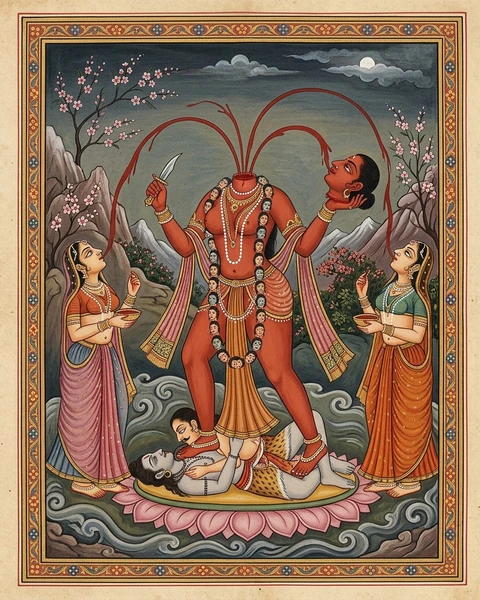
The seed (bija) cluster of Chinnamasta - the bijas of Lakshmi (Śrīṃ), Maya (Hrīṃ), desire (Klīṃ) and speech (Aiṃ) gathered with the dissolution-bija Hūṃ and sealed with Phaṭ. Repeated as japa for the cutting-away of ego and the awakening of the inner power.
The widely-published mantra of Chinnamasta in her form as Vajravairochaniya - invoking the radiant, adamantine ("vajra") power that severs ignorance. Traditionally received from a guru.
The widely-published shorter mantra of Chinnamasta in her form as Prachanda Chandika - the fierce, blazing Chandika - formed of the bijas of speech (Aiṃ), Maya (Hrīṃ) and desire (Klīṃ) with the salutation to her. Recited for courage and the cutting-through of inner obstacles.
The Gayatri of Chinnamasta, following the standard "vidmahe / dhimahi / prachodayat" pattern; meditated upon for the fierce grace (as Vajravairochani / Prachanda Chandika) that severs the ego.
ॐ वैरोचन्यै विद्महे छिन्नमस्तायै धीमहि।
तन्नो देवी प्रचोदयात्॥
The classical Dhyana verse of Chinnamasta - standing in the warrior pratyalidha posture, self-luminous, holding her own severed head and a sword, the threefold life-stream nourishing herself and her two attendants Dakini and Varnini; the supreme image of self-sacrifice and the unity of life and death. Recited before her worship.
The opening names of the Chinnamasta Ashtottara-shatanama-stotram (108 names), a litany of the self-offering Goddess recited for inner courage and the severing of ego.
चण्डिका चण्डरूपा च चामुण्डा चक्रधारिणी।
छिन्नमस्ता च वाराही वैरोचनी वरप्रदा॥