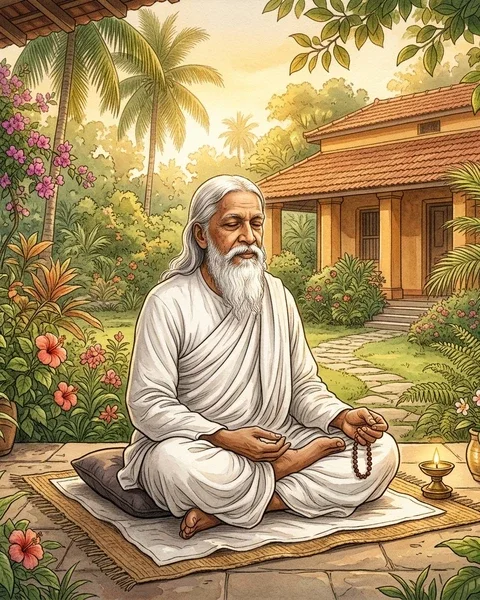
The 19th + 20th centuries saw a remarkable spiritual renaissance. Sri Ramakrishna + Vivekananda re-asserted Sanatana Dharma globally. Ramana Maharshi revived Advaita through direct experience. Sri Aurobindo synthesised yoga + evolution. Yogananda + Sivananda exported Kriya + Hatha yoga to the West. 11 marquee saints below - each with their life-story, core teaching, and a motivational lesson their life teaches you. Distinct from the older Bhakti saints (Alvars, Nayanmars, Varkari, Sants - 6th to 18th century).
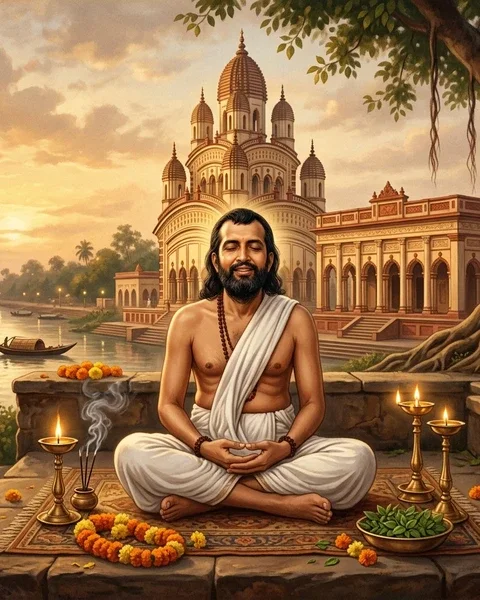
Biography - Born to a poor brahmana family in rural Bengal. Became priest of the Kali temple at Dakshineshwar at 20. Had direct vision of Kali after extreme tapas. Subsequently practised + realised every form - Shakta, Vaishnava, Advaita, Christian, Islamic - concluding that all paths lead to the same Reality. Lived in samadhi for days at a time. Trained Narendranath Datta (Vivekananda) as his chief disciple.
Teaching - God-realisation through any sincere path. "As many faiths, so many paths." Direct vision of God is the goal - not theological speculation. Renounce kanchana (gold) and kamini (lust) as the two main obstacles. Bhakti is the most natural mode for the Kali Yuga householder.
Signature work - The Gospel of Sri Ramakrishna (Sri Sri Ramakrishna Kathamrita) - recorded by Mahendranath Gupta (M). 1,200+ pages of conversations 1882-86.
Legacy - Founded the Ramakrishna Order through Vivekananda (1897). Today: 200+ centres of the Ramakrishna Math + Mission worldwide. Belur Math (Howrah) is the headquarters.
"As many faiths, so many paths."
Yato mat, tato path - every sincere mat (faith) is a path to the same goal.
What their life teaches you
He did not argue that all religions are one - he walked each path himself and proved it on his own body. Before you debate what is true, test it in your own life. Lived experience silences every doubt that argument cannot.
Swami Vivekananda
Narendranath Datta
Lifespan: 1863-1902
Region: Calcutta → Chicago → Belur
Tradition: Advaita Vedanta + Karma + Bhakti yoga
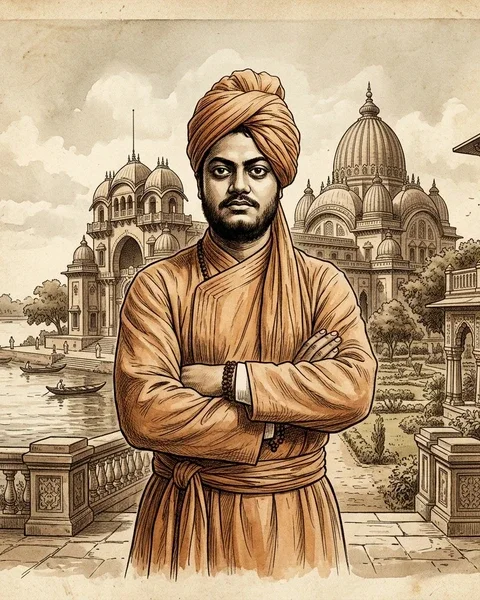
Biography - Born into the educated Calcutta brahmo bhadralok. Met Ramakrishna at 18 and became his chief disciple. After his guru's death, walked across India as parivrajaka (wandering monk) for 5 years. Delivered the historic address at Parliament of World's Religions, Chicago (Sept 11, 1893) - beginning "Sisters and Brothers of America" - that introduced Vedanta to the West.
Teaching - Practical Vedanta - bring philosophy down to the village. Service to man = service to God. Sankalpa to "rouse India" as her contribution to the world. Each soul is potentially divine - realise this within yourself.
Signature work - Raja Yoga (commentary on Patanjali Yoga Sutras), Karma Yoga, Bhakti Yoga, Jnana Yoga - the 4-volume yoga teaching. Plus the Complete Works (9 volumes of his speeches + letters).
Legacy - Founded the Ramakrishna Math (monastic order) + Ramakrishna Mission (service org) in 1897. Vivekananda Memorial Rock at Kanyakumari. National Youth Day in India (January 12 - his birthday).
"Arise! Awake! Stop not till the goal is reached."
Uttishthata jagrata prapya varan nibodhata - from the Katha Upanishad. The supreme exhortation to spiritual effort.
What their life teaches you
He was penniless, grief-struck after losing his guru, and unknown abroad - yet he shook the world in one speech. Your circumstances are not your ceiling. "Each soul is potentially divine" means the limit you feel is a thought, not a fact - so arise, and act as the strength you already are.
Sri Ramana Maharshi
Venkataraman Iyer
Lifespan: 1879-1950
Region: Tiruchuli → Arunachala (Tiruvannamalai, Tamil Nadu)
Tradition: Advaita Vedanta (direct path of self-inquiry)
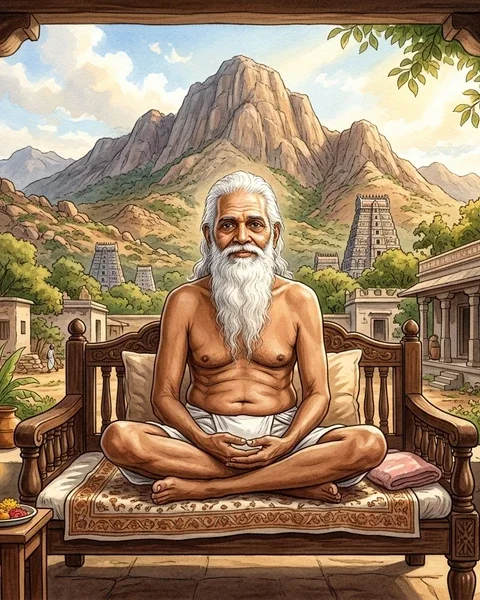
Biography - At age 16, while studying in school, suddenly underwent a "death experience" - an overwhelming fear of death + spontaneous realisation that the body dies but the I-feeling persists. Left home weeks later. Walked to Arunachala (his chosen Self-form) and never left. Lived in the hill caves for 23 years; then in the ashrama at its foot. Maintained mostly silence; taught through silent presence + a few key questions: "Who am I?" and "Who is it that asks this question?"
Teaching - Atma-vichara (self-inquiry). The only essential question is "Who am I?". The answer is not a thought but a direct realisation of the Self that asks. Surrender (sharanagati) and self-inquiry are the two paths - both lead to the same end.
Signature work - Talks with Sri Ramana Maharshi (Munagala Venkataramiah). Self-Inquiry (Vichara-sangraham). Spiritual Instruction (Upadesha Sara - 30 verses).
Legacy - Sri Ramanasramam at the foot of Arunachala. International disciples - Paul Brunton, Arthur Osborne, Robert Adams, Annamalai Swami, Lakshmana Swami. Recognised as a jivanmukta + perhaps the foremost 20th-century Advaitin.
"Who am I?"
Naan yaar - the supreme question. Hold to it relentlessly. The mind that asks dissolves into the Self that is.
What their life teaches you
A teenager met his greatest terror - the fear of death - and instead of fleeing, asked "who is it that dies?" The fear dissolved into freedom. The thing you most avoid, faced directly and questioned honestly, can become the very doorway to your peace.
Sri Aurobindo
Aurobindo Ghose
Lifespan: 1872-1950
Region: Calcutta → Pondicherry (French India)
Tradition: Integral Yoga (synthesis of all yogas)
Biography - Born in Calcutta, schooled in England (Cambridge). Returned to India + became a freedom fighter in the Bengal underground (Alipore Bomb Case). In jail (1908) had a vision of Krishna + Vivekananda; turned from politics to yoga. Settled at Pondicherry (1910), under French rule. With his collaborator The Mother (Mirra Alfassa), founded the Sri Aurobindo Ashram + later Auroville.
Teaching - Integral Yoga - combining all yogas with an evolutionary aim. The next step of human evolution is to bring down "Supermind" - a level of consciousness beyond mind - into the body. Earthly life is to be divinised, not escaped.
Signature work - The Life Divine (philosophical magnum opus, 1100+ pages). Savitri (epic poem of 24,000 lines - his spiritual testament). The Synthesis of Yoga. Essays on the Gita. Letters on Yoga.
Legacy - Sri Aurobindo Ashram (Pondicherry). Auroville - an international community established 1968 by The Mother as a "city of human unity". Auroville now has 3000+ residents from 60+ countries.
"All life is yoga."
Sarvam jeevanam yogah - the entire range of human life is the field of yoga, not a renunciation away from it.
What their life teaches you
The British locked him in Alipore jail to break a revolutionary - and the cell became the place he met Krishna and was reborn as a yogi. No setback is the end of the story. The walls that confine your body can be exactly where your spirit finds its freedom.
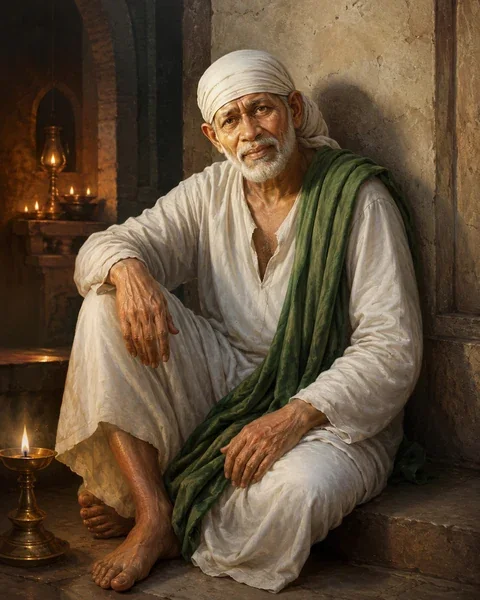
Shirdi Sai Baba
Sai Baba of Shirdi
Lifespan: ~1838-1918
Region: Shirdi (Ahmednagar, Maharashtra)
Tradition: Beyond categorisation - Hindu + Muslim mystic
Biography - Origins unknown. Appeared as a 16-year-old yogi in Shirdi village ~1854. Lived there for 60+ years. Wore a long kafni (Sufi robe), kept a sacred fire (dhuni) burning continuously, attracted disciples from both Hindus and Muslims. Believed by Hindus to be an avatar of Dattatreya / Shiva, by Muslims to be a Sufi pir.
Teaching - Faith (Sraddha) + Patience (Saburi). Live by these two. "Sab ka malik ek" - "the master of all is one". Sectarian boundaries dissolve in true faith.
Signature work - Did not write. Teachings preserved in the Sri Sai Satcharitra (Hemadpant, 1922) - 53 chapters covering Baba's life + miracles + teachings.
Legacy - Shirdi Saibaba Temple (one of the wealthiest temples in India). Thousands of Sai Baba temples worldwide. Sathya Sai Baba (1926-2011) claimed to be his reincarnation, though the two traditions are distinct.
"Sraddha + Saburi"
Faith + Patience. The two qualities Baba demanded of every disciple.
What their life teaches you
He owned nothing, belonged to no sect, and asked of every seeker only two things: keep faith, and keep patience. When life feels stalled, the answer is rarely more striving - it is Shraddha and Saburi. Hold steady; trust the unfolding; the rest arranges itself.
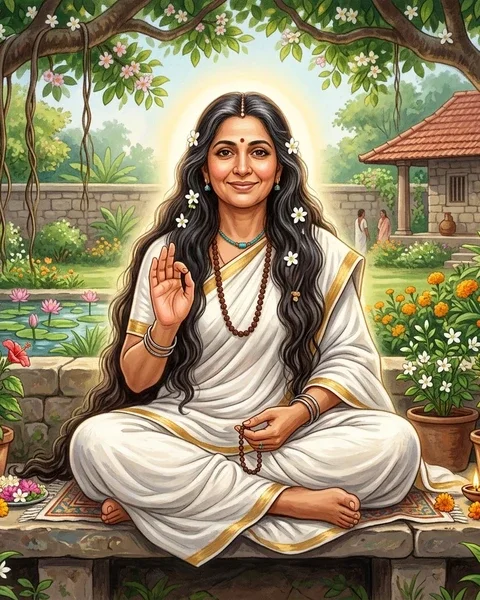
Mata Anandamayi
Sri Anandamayi Ma
Lifespan: 1896-1982
Region: Born East Bengal → Kashi + travelled India
Biography - Born to a brahmana family in Kheora village (now Bangladesh). Married at 13 but the marriage was unconsummated (she was already in samadhi). Spontaneous yogic kriyas + visions from childhood. Recognised as a jivanmukta. Travelled India teaching for 60+ years. Indira Gandhi was a devoted disciple.
Teaching - "Father, you are everywhere - yet I see you nowhere." The cosmic mother behind all manifestation. No formal teaching - taught by presence + answering questions. Loving devotion is the easiest path for women + householders.
Signature work - No written works. "Matri Vani" (Mother's Voice) and "Words of Sri Anandamayi Ma" are collections of her conversations recorded by disciples.
Legacy - Sri Anandamayi Sangha - 25+ ashrams across India. Buried at Kankhal (Haridwar) where her samadhi-mandir stands. Indian government issued commemorative stamp in 1987.
"Whatever you do - eat, sleep, work - do as service to Bhagavan."
Sarvam Bhagavadarpanam - surrender every action as offering to God.
What their life teaches you
She had no monastery hours and no special seat - she turned cooking, walking and answering visitors into worship itself. You do not need free time or a perfect setting to live spiritually. Offer the ordinary act in front of you to the Divine, and the whole day becomes sacred.
Paramahamsa Yogananda
Mukunda Lal Ghosh
Lifespan: 1893-1952
Region: Born Gorakhpur → Los Angeles (USA)
Tradition: Kriya Yoga (lineage from Lahiri Mahasaya + Sri Yukteswar Giri)
Biography - Born in Gorakhpur. Initiated into Kriya Yoga by Swami Sri Yukteswar Giri at 17. In 1920, travelled to Boston for the Congress of Religious Liberals. Settled in the USA, founded the Self-Realization Fellowship (SRF) in Los Angeles 1925. Lived in California for the next 32 years, teaching Kriya Yoga to thousands of Americans + visiting Indians.
Teaching - Kriya Yoga - a specific pranayama-meditation technique that uses breath-control to accelerate spiritual evolution. "Self-Realization" through direct experience - not belief. East-West synthesis: Yoga + Christianity's essential teaching.
Signature work - Autobiography of a Yogi (1946) - the most-read modern spiritual autobiography. Has been continuously in print since publication; sold 4+ million copies in 50+ languages. Steve Jobs distributed copies at his memorial.
Legacy - Self-Realization Fellowship (USA) + Yogoda Satsanga Society (India) - both his organisations. SRF temples in 60+ countries. Mukti at Forest Lawn Memorial Park, LA - body remained incorrupt for 21 days (mortuary director's notarised letter).
"Wherever you go - there you are."
Inner search must precede outer pilgrimage. The Self is always with you.
What their life teaches you
One young monk sailed alone to a foreign land where almost no one had heard of yoga - and his single book has since turned millions inward. You do not need permission, numbers, or resources to begin. Sincerity travels further than any advantage; start where you stand.
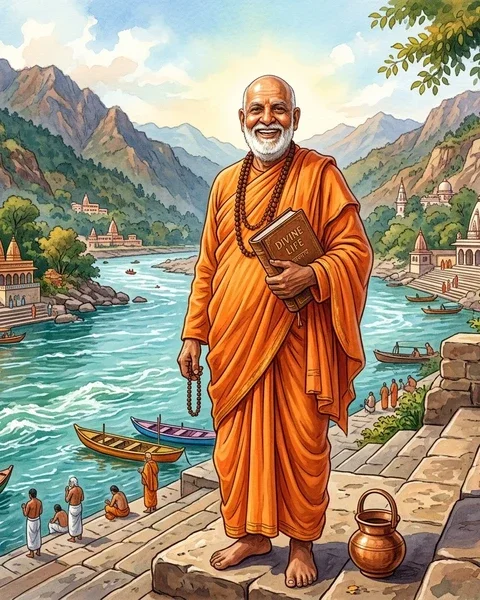
Swami Sivananda
Kuppuswamy (birth name)
Lifespan: 1887-1963
Region: Tamil Nadu (Pattamadai) → Rishikesh (Uttarakhand)
Biography - Trained as a doctor in Tamil Nadu. Practised medicine in Malaysia for 10 years. Took sannyasa in 1924 at Rishikesh. Founded the Divine Life Society (1936) + Yoga-Vedanta Forest Academy + Sivananda Ashram at Rishikesh. Wrote 296 books - covering Vedanta, yoga, bhakti, Ayurveda, ethics. Sometimes wrote 50+ books per year.
Teaching - Serve, Love, Give, Purify, Meditate, Realize (the famous six-word formula). "An ounce of practice is worth a ton of theory." Integral spiritual practice combining all four yogas.
Signature work - Bliss Divine + Sadhana + Concentration and Meditation + Practice of Karma Yoga + Practice of Bhakti Yoga + Hatha Yoga (introduced the modern asana-sequence). Total: 296 books.
Legacy - Divine Life Society (HQ Rishikesh) + Sivananda Yoga Vedanta Centres worldwide (founded by his disciple Swami Vishnudevananda). Major disciples: Swami Chinmayananda, Swami Satyananda (Bihar School of Yoga), Swami Krishnananda, Swami Venkatesananda.
"Serve, Love, Give, Purify, Meditate, Realize."
Six steps. Each builds on the previous. Service is the foundation; realisation is the fruit.
What their life teaches you
A successful doctor gave up his practice not to retire from service but to serve at a higher level - and summed the whole path in six verbs you can start today. Stop waiting until you "understand enough". An ounce of practice this morning outweighs a library you never open.
Swami Chinmayananda
Balakrishnan Menon (birth name)
Lifespan: 1916-1993
Region: Kerala → Rishikesh → Mumbai (worldwide Jnana Yajnas)
Tradition: Advaita Vedanta (Gita + Upanishad teaching for the masses)
Biography - Began as a sharp, sceptical journalist who travelled to Rishikesh intending to expose sadhus as frauds. Instead he was won over by Swami Sivananda, took sannyasa, and studied Vedanta for years in the Himalayas under the formidable Swami Tapovan Maharaj. He then did the unthinkable for his time - taught the Upanishads and the Bhagavad Gita in plain English to ordinary householders through public "Jnana Yajnas".
Teaching - Vedanta is not for forest-dwelling renunciates alone - every working person can and should study the Gita and Upanishads. Knowledge (jnana) must be practical and lived. "Plan your life, do not drift." Convert dry scripture into daily clarity.
Signature work - Hundreds of Gita + Upanishad commentaries and talks. The Holy Geeta (verse-by-verse Bhagavad Gita commentary) is his best known. Founded a vast library of accessible Vedanta study material.
Legacy - Chinmaya Mission - 300+ centres worldwide, schools (CHYK youth wing), Chinmaya International Foundation. Co-founded the Vishva Hindu Parishad (1964). His commentaries remain a standard entry-point to Vedanta in English.
"Plan out your life. Do not drift."
A life lived by design - with purpose and study - not surrendered to circumstance and habit.
What their life teaches you
He set out to debunk the sages and was converted by the very truth he came to mock. Honest doubt is not the enemy of faith - pursued sincerely, scepticism itself can carry you all the way to the truth. Ask your hardest questions; do not fear where they lead.
Tradition: Bhakti - supreme devotion to Hanuman + Ram
Biography - A wandering Hanuman-devotee who became one of the most loved gurus of the 20th century, yet left almost no formal teaching. He established the Kainchi Dham ashram in the Kumaon hills and countless Hanuman temples. He shunned fame, often sent disciples away, and taught entirely through love, humour and small acts of grace rather than lectures.
Teaching - "Love everyone, serve everyone, feed everyone, remember God." Sub-ek (all is one). The fastest path is selfless service joined with constant remembrance of the Divine name - especially through Hanuman, the perfect servant-devotee.
Signature work - Wrote nothing himself. His life + teaching reached the world through disciples' books - most famously Ram Dass's "Be Here Now" and "Miracle of Love".
Legacy - Kainchi Dham (a major pilgrimage site today). Western disciples carried his influence far: Ram Dass (spiritual teacher), Larry Brilliant (helped lead WHO smallpox eradication), Krishna Das (kirtan). Steve Jobs and Mark Zuckerberg have spoken of visiting his ashram.
The whole path compressed into four daily acts - service and remembrance, available to anyone, anywhere.
What their life teaches you
The most beloved guru of his age gave no grand philosophy - just four verbs: love, serve, feed, remember. The highest spiritual life is not the most complicated one. Begin with simple kindness to whoever is in front of you, and let that be your sadhana.
Trailanga Swami
Telang Swami · "the walking Shiva of Varanasi"
Lifespan: died 1887 (said to have lived to a great age)
Region: Andhra → Varanasi (Kashi)
Tradition: Advaita / Dattatreya-margi yogi
Biography - A renowned yogi who, after his mother's death, left home for decades of intense tapas before settling in Varanasi for the last stretch of his life. He lived in radical simplicity on the ghats of the Ganga and was famed for profound silence and deep, continuous samadhi. Sri Ramakrishna met him and revered him as a living embodiment of Shiva in Kashi.
Teaching - Taught almost entirely through silence and presence rather than words. The body is a temporary instrument; the Self alone is real. Mastery of the body and breath is meant to free the spirit, never to display power.
Signature work - Left no scripture. He is remembered through the accounts of those who met him - including references in the Autobiography of a Yogi and the Ramakrishna tradition.
Legacy - Remembered as one of the great yogis of 19th-century Kashi. His samadhi in Varanasi is still honoured. A standing reminder of the heights of contemplative attainment within living memory.
"The Self alone is real; the body is a passing guest."
Identify with the deathless witness within, not with the body that comes and goes.
What their life teaches you
A celebrated yogi chose silence over spectacle and the bare ghats over comfort. Whatever powers or gifts you cultivate are tools, not trophies - held lightly, they serve; clung to and shown off, they imprison. Mastery is meant to free you, not to impress anyone.
Living tradition - Each of these saints founded an institution that continues today: Ramakrishna Math (Belur), Ramanasramam (Tiruvannamalai), Sri Aurobindo Ashram (Pondicherry), Self-Realization Fellowship (LA), Divine Life Society (Rishikesh), Shirdi Saibaba Sansthan, Sri Anandamayi Sangha. SevaCart connects to these ashramas for darshan-offerings, memorial-day offerings, and seva-commissions. See also Bhakti saints (older, 6th-18th century), and Acharyas (philosophical founders).