Sanatana Dharma is not the work of one founder. It is a continuous conversation across two and a half thousand years, carried by teachers (acharyas) who took the same Vedic source-material and drew very different conclusions. Each one's view is internally consistent and worth reading on its own terms - even where they sharply disagree. Below are the nine most consequential teachers of the post-Vedic era, with their schools, key works, and where to read more.
By Sevasannidhi LLP·Updated 19 May 2026
अद्वैत वेदान्त
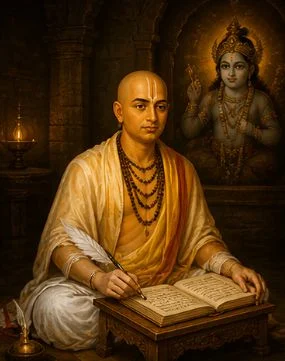
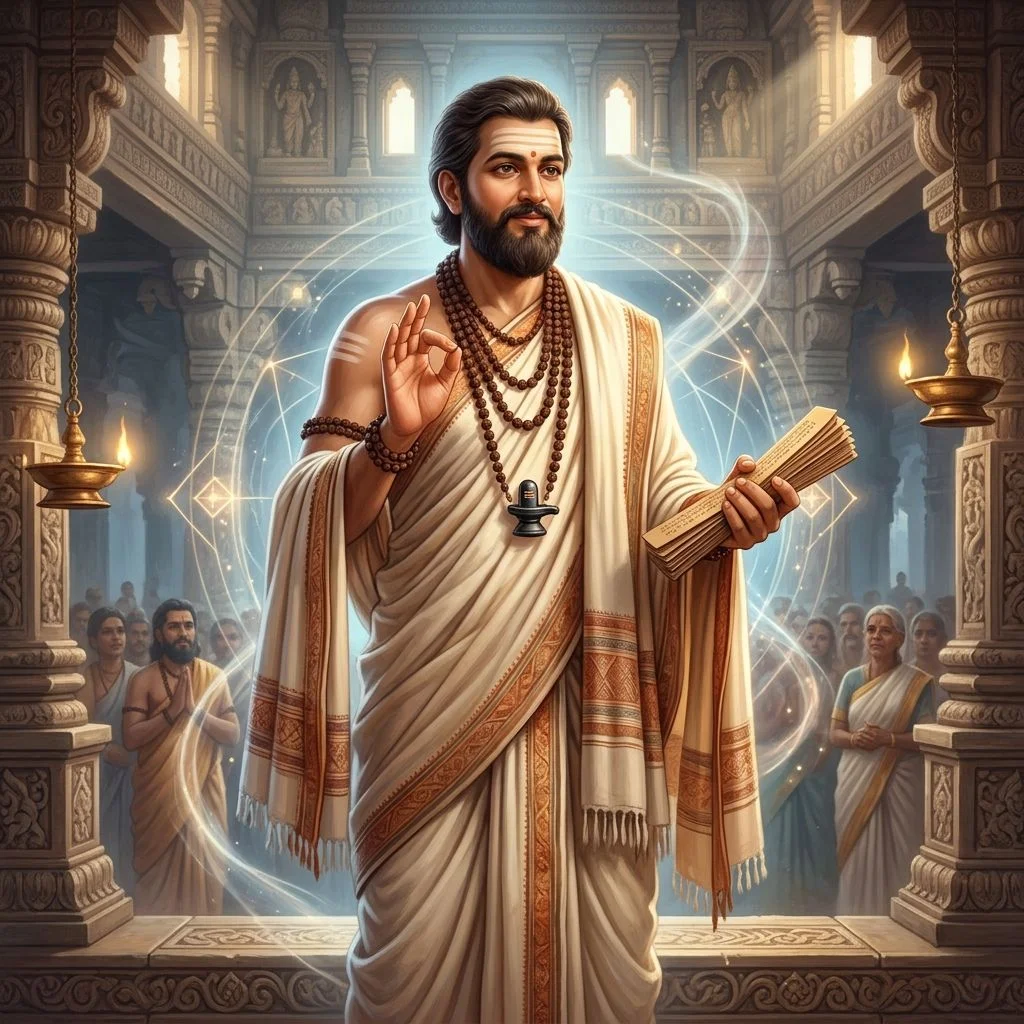
Adi Shankaracharya
Jagadguru
788–820 CE (traditional) · earlier dates argued by some historians Kaladi, Kerala
There is only one reality - Brahman - and you are not separate from it. The world of multiplicity is real but not ultimate.
The teaching. Brahman alone is real (sat); the world is mithya (apparent, not unreal); the individual self (jiva) is non-different from Brahman. Liberation comes through knowledge (jnana), not action; the obstacle is avidya (ignorance), the cure is the realisation of "Aham Brahmasmi". His method is uncompromising: every appearance, however dear, is investigated until only awareness remains.
Key works
Brahma Sutra Bhashya - commentary on Badarayana's Brahma Sutras (the foundational Vedanta text)
Bhashyas on the ten principal Upanishads
Bhagavad Gita Bhashya - line-by-line commentary
Vivekachudamani - "Crest-jewel of discrimination", standalone primer
Atma Bodha, Tattva Bodha, Aparoksha Anubhuti - short prakarana texts
Soundarya Lahari and Bhaja Govindam - devotional hymns (showing he honoured bhakti as preparation for jnana)
Innovations
Established the four mathas (monastic seats) at Sringeri, Dwarka, Puri, and Jyotirmath, each with a designated principal Veda and mahavakya
Codified Panchayatana Pooja - worship of five deities (Shiva, Vishnu, Devi, Surya, Ganesha) on a single altar - to harmonise sectarian rivalries
Revived Sanatana Dharma during a period of Buddhist and Jain dominance, defeating leading scholars of those schools in dialectical debate (most famously Mandana Mishra)
Defined the Dashanami Sampradaya - the ten orders of monastic renunciants
Modern lineage
The four Shankaracharya pithas (Sringeri, Dwarka, Puri, Jyotirmath/Badrinath) continue today, each headed by a sitting Shankaracharya. The Ramakrishna Order and the Chinmaya Mission stand within his lineage.
Read more
Advaita Ashrama (Mayavati) edition of the Brahma Sutra Bhashya - bilingual
Swami Madhavananda · "Vivekachudamani" with translation (Advaita Ashrama)
A.J. Alston · "Shankara on the Absolute" (six volumes, Shanti Sadan)
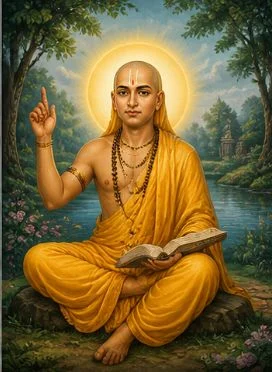
Brahman (Vishnu/Narayana) is one but qualified by an inner body of sentient (chit) and insentient (achit) reality. You are real, distinct, yet eternally inseparable from Him.
The teaching. God, soul, and matter are all real and ontologically distinct, yet the souls and matter constitute the body of God - they are inseparable from Him as a wave from the ocean. Liberation comes through prapatti (loving surrender) and bhakti directed at Sriman Narayana, with Lakshmi as the divine mediatrix. Every soul is eligible - Ramanuja famously climbed the Tirupati hill and shouted the Ashtakshari mantra to all castes, breaking the priestly monopoly.
Key works
Sri Bhashya - magnum opus commentary on the Brahma Sutras
Vedartha Sangraha - concise summary of his Vedantic position
Gita Bhashya - commentary on the Bhagavad Gita
Vedanta Dipa, Vedanta Sara - shorter primers
Three "Gadyas" - Sharanagati Gadya, Sriranga Gadya, Vaikuntha Gadya - prose devotional poems of surrender
Nityagrantha - manual of daily worship
Innovations
Synthesised Tamil Alvar bhakti poetry (the Divya Prabandham) with Sanskrit Vedanta - created the "Ubhaya Vedanta" tradition
Reformed temple worship at Srirangam and codified the Pancharatra Agama liturgy still used in Sri Vaishnava temples
Opened mantra initiation to all jatis - radical for the 11th century
Established the 74 simhasanadhipatis (succession seats) to ensure his teaching survived
Modern lineage
The Sri Vaishnava Sampradaya splits into two sub-schools after him: Vadakalai (northern, more Sanskrit-leaning, headquartered at Kanchi) and Tenkalai (southern, more Tamil-leaning, headquartered at Srirangam). The Ramanuja Mission and many Iyengar temples continue the tradition.
Read more
Sri Vaishnava Granthamala edition of the Sri Bhashya (Madras)
God (Vishnu), souls, and matter are eternally and absolutely distinct. The relationship is one of complete dependence (paratantrya) - every soul, every atom, depends on Vishnu for its being.
The teaching. Reality has five eternal differences (panchabheda): God-soul, God-matter, soul-soul, soul-matter, matter-matter. Souls are individually graded - some destined for liberation, some for endless cycling, some for darkness - a doctrine unique to Madhwa within Vedanta. Bhakti directed at Vishnu (with Vayu as His chief intermediary) is the only path to liberation; even at moksha, the soul retains its individual identity and serves God as a junior person serves a senior.
Key works
Brahma Sutra Bhashya - commentary on the Brahma Sutras
Anuvyakhyana - extended exposition of the Brahma Sutras
Gita Bhashya and Gita Tatparya Nirnaya - commentaries on the Gita
Bhashyas on the ten principal Upanishads
Mahabharata Tatparya Nirnaya - the meaning of the Mahabharata
Rigveda Bhashya (first three suktas) - only Vedanta acharya to comment on the Veda Samhita itself
Dasha-prakaranas - ten short philosophical tracts
Innovations
Established the Krishna temple at Udupi (Sri Krishna Matha) and the Ashta Mathas - the eight monasteries that take rotational charge of Udupi worship in two-yearly paryaya cycles
Identified himself as the third avatar of Vayu (after Hanuman and Bhima) - making him the divine messenger of Vishnu
The Haridasa movement of Karnataka (Purandara Dasa, Kanaka Dasa, Vijaya Dasa, Jagannatha Dasa) flowed directly from his lineage and gave South India its devotional musical tradition
Modern lineage
The eight Udupi mathas (Pejavara, Palimaru, Adamaru, Krishnapura, Puttige, Shirur, Sodhe, Kaniyooru) continue active service today. Pejavara Matha is currently among the most visible. The Akhila Bharata Madhwa Mahamandala publishes scholarly editions.
The world is real and is Krishna himself - there is no Maya. Liberation is by His grace alone (pushti-marga, "the path of nourishment"), independent of merit.
The teaching. Brahman, souls, and the world are all the same Krishna (Krishna in three modes: as Brahman, as inner self, and as world). The path is pushti - the spontaneous gracious flow of Krishna into the devotee, requiring no discipline and earned by no work. Worship of the child Krishna (Bala-Krishna) at Nathdwara is the centerpiece. Sevak (servant) is a higher relationship than jnani (knower).
16 Granthas (Shodasha-Granthas) - short tracts including the Madhurashtakam
Innovations
Founded the Pushti Marga and the Vallabha Sampradaya - distinct from the older Vaishnava sampradayas
Established Krishna worship at Shrinathji, Nathdwara - perhaps the most important Krishna temple in north India
Created the seven seva-routine (saat-jhanki) of Shrinathji that thousands of haveli-style temples still follow daily
Modern lineage
The Vallabha Sampradaya is led by his descendants, the Goswamis. Major centres at Nathdwara, Kankroli, Kamavan, Gokul, Jatipura, Mathura, Vrindavan (the seven seats - saat peeths).
11th–12th century CE (debated; some place him as early as 7th century) Vaiduryapattanam (Andhra Pradesh, traditional)
God, soul, and world are simultaneously different and non-different - like a wave that is neither identical to the ocean nor truly separate from it.
The teaching. The relationship between Brahman and individual soul is bhedabheda - both difference and non-difference, equally real. Worship is centred on Radha-Krishna as the divine couple (Yugala-Sarkar); they are inseparable. Bhakti is the means; surrender (atmanivedana) is the goal. The path is gentler than Madhwa and warmer than Shankara.
Key works
Vedanta Parijata Saurabha - commentary on the Brahma Sutras
Dasha Shloki - ten verses summarising his philosophy
Krishna Stavaraja - devotional hymn
Innovations
First major acharya to centre worship on Radha-Krishna as a couple (predating the Gaudiya tradition of Chaitanya by centuries)
Founded the Nimbarka Sampradaya, one of the four traditional Vaishnava sampradayas (Sri / Brahma / Rudra / Sanaka)
Modern lineage
The sampradaya is headquartered at Salemabad (Rajasthan) and Vrindavan. Currently led by the Sri Nimbarkacharya peethadhipati at Salemabad.
Read more
Roma Bose · "Vedanta Parijata Saurabha - translation" (Royal Asiatic Society of Bengal)
M. Bhandarkar · "Vaisnavism, Saivism and Minor Religious Systems" (Motilal) - chapter on Nimbarka
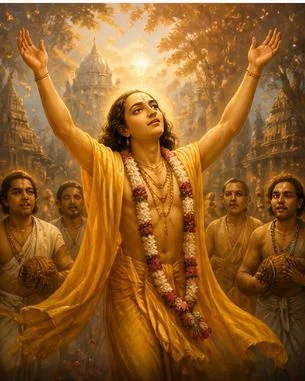
Krishna is the highest reality. The relationship between Krishna and soul is simultaneously one and different in a way the human mind cannot grasp - therefore acintya, inconceivable.
The teaching. Loving devotion to Radha-Krishna, expressed through public chanting (sankirtana) of the maha-mantra "Hare Krishna Hare Krishna Krishna Krishna Hare Hare / Hare Rama Hare Rama Rama Rama Hare Hare", is the only and complete path in this Kali Yuga. Chaitanya himself wrote almost nothing - eight verses, the Shikshashtaka - but his disciples (the Six Goswamis of Vrindavan) produced an enormous body of theology.
Key works
Shikshashtaka - eight verses (the only direct composition)
Krishna Das Kaviraja · Chaitanya Charitamrita - primary biography and theology
Rupa Goswami · Bhakti Rasamrita Sindhu - codification of devotional aesthetics
Jiva Goswami · Sat Sandarbha (Shad Sandarbha) - six theological treatises
Sanatana Goswami · Brihad Bhagavatamrita
Innovations
Reframed the maha-mantra as the central practice for the Kali Yuga, making practice radically accessible
Public sankirtana - devotional chanting in procession through streets - became a defining feature of Bengali Vaishnavism
Sent the Six Goswamis to recover the lost sacred sites of Vrindavan and codify Vraja-bhakti theology
Modern lineage
The Gaudiya Vaishnava tradition. ISKCON (founded by A.C. Bhaktivedanta Swami Prabhupada in 1966) is the modern global expression. Many sadhus and gurus still trace their parampara through the Six Goswamis.
Read more
Gaudiya Math editions (Sridhar Maharaj lineage)
Bhaktivedanta Book Trust · Krishna Das Kaviraja's "Chaitanya Charitamrita" with Bhaktivedanta's purports
Edward Dimock · "The Place of the Hidden Moon" (Chicago UP)
David Haberman · "Acting As a Way of Salvation" (Oxford UP)
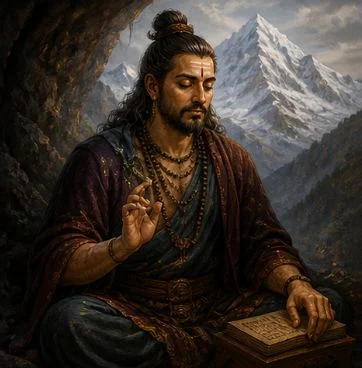
Shiva is the only reality, and Shiva is pure dynamic consciousness (chit-shakti). The world is not maya; it is the divine self-recognition (pratyabhijna) - Shiva playing at being many.
The teaching. Reality is Shiva spontaneously playing all roles. Liberation is recognition (pratyabhijna): noticing that you, the perceiver, are already that divine consciousness. Practice combines tantric ritual, meditation, and aesthetic contemplation - for Abhinava, deep absorption in beauty (rasa) is itself a path to recognition. He is also the founding theorist of Indian aesthetics in his Abhinavabharati.
Key works
Tantraloka - 37 chapters, the encyclopaedic synthesis of Trika tantra
Tantrasara - concise summary of the Tantraloka
Pratyabhijnavimarshini - commentary on Utpaladeva's Pratyabhijna Karika
Abhinavabharati - commentary on Bharata's Natyashastra; foundational text of Indian aesthetics
Paramarthasara - 105-verse summary of his philosophy
Innovations
Wove together the dualistic Shaiva Siddhanta and the non-dual Krama and Kula traditions of Kashmir into a single Trika system
Articulated rasa-bhakti and rasa-yoga - aesthetic experience as a doorway to the absolute
Influenced later Vedantic and Bhakti traditions far beyond Kashmir
Modern lineage
Kashmir Shaivism survived through teachers like Swami Lakshmanjoo (1907–1991). Mark Dyczkowski, John Hughes, and the Lakshmanjoo Academy continue scholarly work.
Read more
Mark Dyczkowski · "The Doctrine of Vibration" (SUNY Press) - accessible introduction
Wear Shiva on your body (the ishta-linga), worship Him without intermediary, work as worship, and treat every devotee as equal regardless of caste or gender.
The teaching. Direct, personal, casteless devotion to Shiva. The ishta-linga (a small linga worn on a thread around the neck) makes the deity portable and the worship private. Kayaka (work) is itself worship; dasoha (sharing) is its expression. Basavanna led a 12th-century social-religious revolution that included women (Akka Mahadevi) and lower-caste poets (Allama Prabhu, Madivala Machideva) as equal sharanas.
Key works
Vachanas - short Kannada free-verse devotional sayings (over 1,300 attributed to Basavanna himself)
Anubhava Mantapa - the assembly hall at Kalyana where sharanas debated; the recorded proceedings (Shunya Sampadane) are the canon
Innovations
Anubhava Mantapa - perhaps the world's first public, casteless, gender-equal democratic religious assembly (12th century)
Vachana literature - replaced Sanskrit with Kannada as the language of devotional philosophy, opening it to ordinary readers
Eight-fold practice (Ashtavarana) and six-stage path (Shatsthala) - a complete soteriology grounded in personal life
Modern lineage
The Lingayat community of Karnataka, North Karnataka, and parts of Maharashtra/Telangana continues today. The Basava Samiti and many Veerashaiva mathas (Suttur, Murugharajendra, Siddhaganga) are active.
Read more
A.K. Ramanujan · "Speaking of Siva" (Penguin Classics) - best English entry to Vachana literature
H. Thipperudraswamy · "The Veerasaiva Saints" (Karnataka University Press)
A consolidator rather than an originator - wrote the most-used summary of Advaita Vedanta and helped found the Vijayanagara empire to defend Sanatana Dharma during a period of military pressure.
The teaching. Following Shankara strictly. The Panchadashi presents Advaita in fifteen chapters of clear, accessible Sanskrit verse - for many serious students it is the standard introduction. Vidyaranya is also remembered for the Sarvadarshana Sangraha, a survey of all sixteen schools of Indian philosophy seen from a Vedantic standpoint - still the best single overview written from inside the tradition.
Key works
Panchadashi - 15-chapter Advaita Vedanta primer in verse
Jivanmukti Viveka - on liberation while still embodied
Sarvadarshana Sangraha - survey of all classical Indian philosophical schools
Anubhutiprakasha - devotional and philosophical hymns
Innovations
Together with his brother Sayana (the Vedic commentator), guided the Sangama brothers Harihara and Bukka in founding the Vijayanagara empire (1336) - a political project to protect dharma
Presided as the 12th Shankaracharya of Sringeri at one of the tradition's critical historical junctures
Modern lineage
Sringeri Sharada Peetham continues. His texts (Panchadashi especially) are core curriculum at Vedanta schools worldwide.
Read more
Swami Swahananda · "Panchadashi" with translation (Sri Ramakrishna Math)
A note on disagreement. Shankara, Ramanuja, and Madhwa all read the same Brahma Sutras and reached three radically different conclusions. The tradition treats this as a feature, not a bug - different temperaments need different approaches, and the debate itself sharpens understanding. If you are serious about study, read at least the Brahma Sutra Bhashyas of two schools side by side. The disagreement is the doorway.
Was this page useful?
One tap helps us learn what to improve. Add a note if you would like to see something specific on this page.
Anonymous votes are stored against a per-session ID; signed-in votes link to your profile. We use this only to decide what to add or improve. We never share or sell this data.