
The short answer
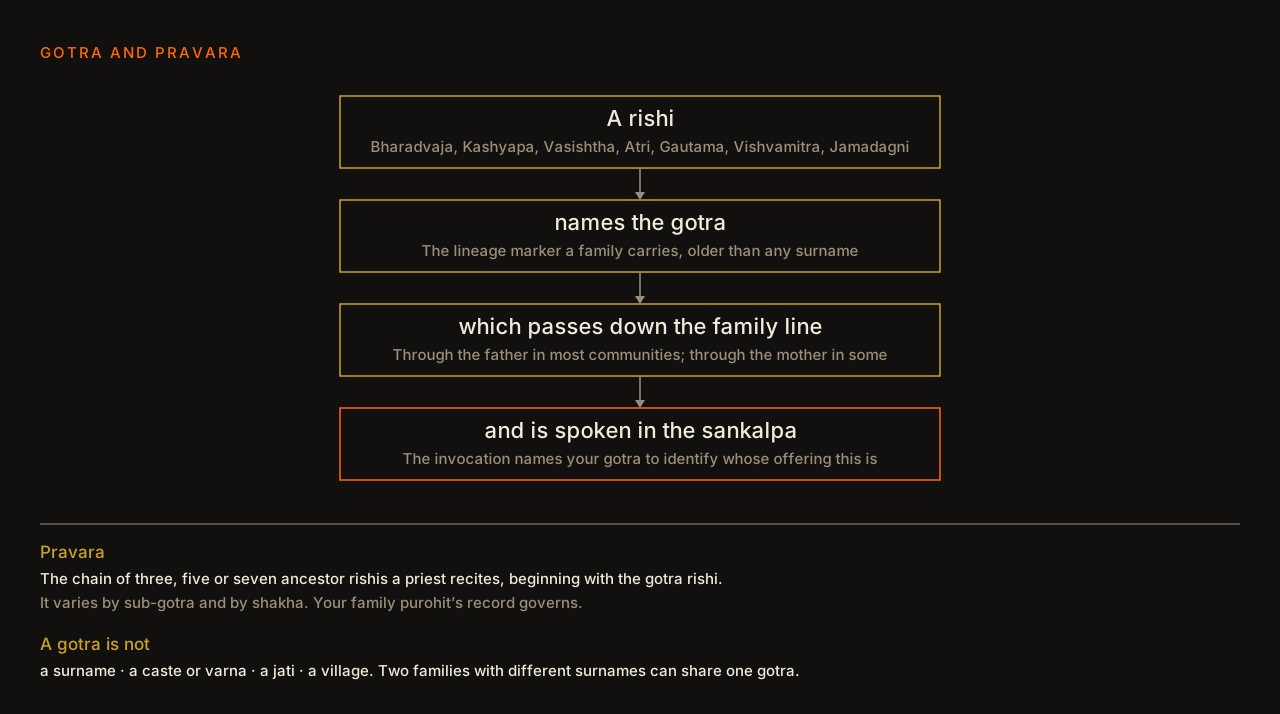
Your gotra is the rishi your family line is traced to. It is a lineage marker, older and more durable than any surname, and it is how a ritual invocation identifies which family an offering is being made for.
The seven rishis most gotras trace to are Vishvamitra, Jamadagni, Bharadvaja, Gautama, Atri, Vasishtha and Kashyapa. Several traditions add Agastya as an eighth. There are hundreds of gotras in practice; those eight are simply the ones a devotee is most often asked for.
Where your gotra is used
Every formal Hindu ritual opens with a sankalpa — a spoken declaration of intent. The sankalpa places the ritual in time and place, and it names the person it is being performed for:
- the country, region and place where the ritual is performed
- the Vedic year, month, paksha, tithi and nakshatra of the day
- the devotee’s gotra
- the devotee’s name
- the deity invoked and the purpose of the rite
A missing gotra does not invalidate anything. The priest uses whichever convention his tradition follows for an unknown lineage, and the ritual proceeds — see where traditions differ for what those conventions are.
How to find yours
In order — the first step answers it for most people.
- Ask the eldest living person in the line you inherit from. Father, grandfather or paternal uncle in a patrilineal family; the corresponding elder in a matrilineal one. This answers it for most people in one conversation.
- Ask your family purohit. Purohits keep gotra and pravara records for the families they serve, often across several generations. This is also the record a priest will recite from, so it settles disagreements.
- Check the family’s ritual paperwork. Wedding invitations, jathaka or horoscope sheets and sambandha documents almost always print the gotra. So do samskara registers and contributor lists at a kuladevata temple.
- Ask your community samaja or archive. Many community associations publish gotra-by-family directories. Treat an online directory as a lead to confirm with an elder or purohit, not as the answer.
- If it is genuinely lost, say so to the priest. Do not guess, and do not postpone the seva. The priest will use whichever convention his tradition follows - see the variations above - and the ritual proceeds.
Gotra and pravara reference
Pravara is the chain of ancestor rishis — three, five or seven, beginning with the gotra rishi — that a priest recites in the fuller form of an invocation. You do not need to memorise yours. The table below is a starting point for recognising the name you have been given.
| Gotra | Pravara rishis | Note |
|---|---|---|
| Bharadvaja | Angirasa · Barhaspatya · Bharadvaja | One of the most widely held gotras across regions and communities. |
| Vishvamitra | Vaishvamitra · Aghamarshana · Kaushika | Sub-lines differ: Devarata and Audala appear in place of Aghamarshana and Kaushika in several recensions. |
| Jamadagni | Bhargava · Chyavana · Apnavana · Aurva · Jamadagnya | A five-rishi pravara, counted among the Bhargava group rather than standing alone. |
| Gautama | Angirasa · Ayasya · Gautama | Shares its first pravara rishi with Bharadvaja; both belong to the Angirasa group. |
| Atri | Atreya · Archananasa · Shyavashva | Some Atreya sub-lines recite a single pravara instead of three. |
| Vasishtha | Vasishtha | Commonly a single-rishi pravara; several sub-gotras of the Vasishtha group recite three. |
| Kashyapa | Kashyapa · Avatsara · Naidhruva | Also the gotra several traditions use when a family gotra is genuinely unknown. See the variations below - that fallback is a practice, not a rule. |
| Agastya | Agastya · Dardhachyuta · Idhmavaha | Counted as an eighth rishi-gotra by traditions that extend the saptarishi list. |
Pravara varies by sub-gotra and by shakha. These are the commonly cited chains, not a ruling: your family purohit’s record governs, and it is the record a priest will actually recite from.
Where traditions differ
Most of what is written about gotra online is stated as though one rule covered every Hindu family. It does not. Each of these is a real practice; each belongs to particular communities.
Gotra passes through the father’s line.
Holds for the patrilineal communities that make up most gotra-using families. Communities that followed marumakkathayam in Kerala or aliyasantana in coastal Karnataka traced descent and inheritance through the mother; families from those traditions should follow their own line rather than assume the patrilineal rule.
A family whose gotra is genuinely lost may be given Kashyapa gotra in the sankalpa.
A widespread practice, not a rule, and not the only one. Other purohits use the kuladevata or the community’s own lineage marker in the same slot. Ask the priest who will perform the ritual which he follows; a seva is never withheld for a missing gotra.
A wife’s ritual gotra becomes her husband’s for joint rites.
The classical rule, and the usual practice in patrilineal communities. Her birth gotra is still recited in some rites performed for her own parents. Families differ, and a growing number retain the birth gotra throughout; the officiating priest follows the family’s instruction.
An adopted child takes the adoptive father’s gotra.
The classical position in the dharmashastra literature. Some schools additionally recite the birth gotra once at the opening of a ritual.
Classical dharma treats a sagotra marriage as a marriage within the lineage, and avoids it.
A statement about classical dharma and about the communities that still observe it, not about Indian law. The Hindu Marriage Act 1955 sets no gotra condition: section 5 bars marriage within the degrees of prohibited relationship and between sapindas, each subject to custom, and does not mention gotra or pravara anywhere. Communities also differ sharply among themselves - several South Indian traditions favour cross-cousin marriage, which is never sagotra, while some North Indian communities additionally avoid the mother’s and grandmothers’ gotras.
Not every community uses a rishi-gotra.
Kshatriya and Vaishya families commonly carry rishi-gotras. Many other communities keep a functionally equivalent marker instead - devak in Maharashtra, bali or bedagu in Karnataka, illam in Kerala - or name the kuladevata. Where a community keeps no rishi-gotra, the priest records the marker that community does keep.
Gotra is not caste, surname or jati
This is the most common confusion. A gotra names only the rishi a family line is traced to — nothing else. Two families with completely different surnames can share a gotra, and a single surname such as Sharma, Patil or Rao can span a dozen of them. The gotra does not fix varna either: Brahmana, Kshatriya and Vaishya families all carry rishi-gotras.
So when a sankalpa form, a matrimonial profile or a temple register asks for your gotra, it wants the rishi-lineage word — Bharadvaja, Kashyapa, Vasishtha — not your community name, your caste or your village. If you have been writing a surname in that field, that is the gap to close.
Sagotra marriage, and what the law says
Classical dharma treats everyone of one gotra as descended from a single rishi, and so reads a sagotra marriage as marriage within the family. The Grihya Sutras and later Smritis bar it, alongside the sapinda rule.
Indian law is a separate question, and readers make real decisions on it. The Hindu Marriage Act 1955 sets no gotra condition at all: section 5 requires that the parties are not within the degrees of prohibited relationship and are not sapindas of each other, each subject to custom, and the Act does not mention gotra or pravara. Sagotra marriage is not barred by statute.
Communities also differ sharply among themselves — several South Indian traditions favour cross-cousin marriage, which is never sagotra, while some North Indian communities avoid the mother’s and grandmothers’ gotras as well. Follow your family’s custom and a learned priest rather than generalising from any one of these.
Sources
- The Early Brahmanical System of Gotra and Pravara — John Brough, Cambridge University Press (1953) (read 31 Aug 2026). A translation of the Gotra-Pravara-Manjari of Purushottama-Pandita with the textual evidence for the late-Vedic system.
- History of Dharmasastra, Volume II, Part I — P. V. Kane, Bhandarkar Oriental Research Institute, Poona (1941) (read 31 Aug 2026). The classical rules on gotra, pravara and their variation between schools.
- The Hindu Marriage Act, 1955 (Act No. 25 of 1955), sections 3 and 5 — India Code, Government of India (read 31 Aug 2026). Section 5 lists the conditions for a Hindu marriage. It names the degrees of prohibited relationship and sapinda relationship, both subject to custom, and does not mention gotra or pravara.
- Madras Marumakkathayam Act 1932 and Madras Aliyasantana Act 1949 — Government of India / Government of Madras (read 31 Aug 2026). Statutory recognition of the matrilineal systems followed by some communities in Kerala and coastal Karnataka.
Where this page describes a practice rather than a text or a statute, it names whose practice it is. Your family purohit’s record governs over any table published here.
Putting it to use
When you offer a seva on SevaCart, the sankalpa form asks for your gotra, your nakshatra and the names of the family members the offering is for. The priest at the partner temple reads these during the ritual, and the photo record shows the moment your name is offered before the deity.
Browse sevas · What goes into a sankalpa · What is a nakshatra
Common questions
What is a gotra?
A gotra is a lineage marker tracing your paternal ancestry back to one of the seven (or eight) Vedic rishis - Vishvamitra, Jamadagni, Bharadvaja, Gautama, Atri, Vasishtha, Kashyapa (and often Agastya). It is used in rituals to identify which family you belong to before the priest offers your sankalpa.
How do I find my gotra?
Ask the eldest living person in the line you inherit from - in a patrilineal family that is your father, grandfather or paternal uncle. Most gotra-using communities are patrilineal, but not all: communities that followed marumakkathayam in Kerala or aliyasantana in coastal Karnataka traced descent through the mother, so follow your own family line rather than assuming the rule. If nobody knows, your family purohit or your kuladevata temple usually holds the record.
Why does the priest ask for it during a pooja?
The sankalpa - the formal declaration of intent that opens a Hindu ritual - names the devotee: gotra (rishi lineage), name, family deity, place, date and ritual purpose. The gotra is how the invocation identifies which family the offering is made for. A missing gotra does not invalidate the ritual: the priest uses the convention his tradition follows for an unknown lineage, and the seva proceeds.
I don't know my gotra - can I still do a seva?
Yes. Several traditions use "Kashyapa gotra" where a family gotra is genuinely unknown, because Rishi Kashyapa is regarded as a universal ancestor - but that is one convention rather than a rule, and other purohits use the kuladevata or the community's own lineage marker in the same slot. Ask the priest performing your seva which he follows. Find your own gotra when you can, and never let "I don't know" stop you from offering a seva.
What is the difference between gotra and pravara?
Gotra is the single rishi who founded your line. Pravara is the list of 3, 5, or 7 ancestor rishis (including the founding one) that the priest recites during sankalpa for fuller lineage acknowledgement. Most devotees only need to know their gotra - the priest knows the pravara mapping.