Samhita
The 10,552 hymns themselves, organised into 10 mandalas. Mandalas 2–7 are the oldest (the "family books"); mandala 9 is entirely devoted to Soma; mandala 10 is the latest and most philosophical (Purusha Sukta, Nasadiya Sukta).

The Veda of mantras - the oldest layer
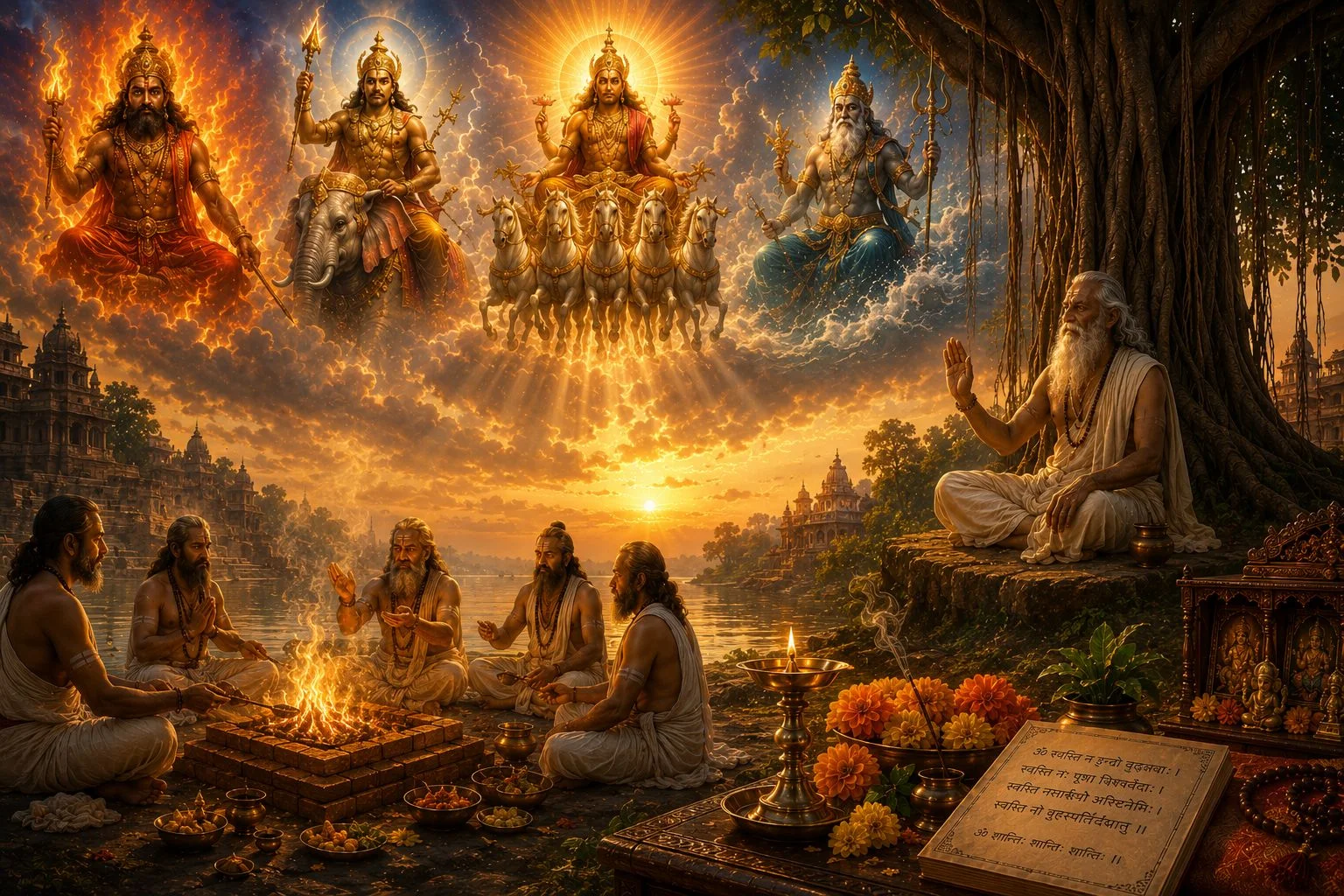
Hymns of praise and invocation to the cosmic forces - Agni, Indra, Varuna, Surya, the Maruts. The seed of every later Hindu mantra.
c. 1500–1200 BCE (composition); orally fixed by 800 BCE
10,552 hymns (suktas) in 10 mandalas (books)
Heard (śruti) by many rishis - Vasishtha, Vishvamitra, Bharadwaja, Atri, Gritsamada, Vamadeva, and others. Each mandala traditionally attributed to one family of rishis.
Ayurveda - Medicine and longevity
The Rigveda is the oldest text in any Indo-European language and the foundation of the entire Hindu canon. It is a collection of hymns to natural and cosmic powers - fire (Agni), the storm (Indra), the cosmic order (Varuna), the sun (Surya), the dawn (Ushas) - sung by ancient seers who claimed not to have written them but to have heard them.
The collection is preserved with extraordinary fidelity through an oral lineage that uses three independent recitation patterns (Pada, Krama, Jata) which redundantly check every syllable. Two reciters separated by a thousand years and a continent will produce the same text - a feat unmatched by any other ancient literature.
For the modern reader, the Rigveda is both a religious primary source and a window into the worldview of late-Bronze-Age India: a society that took rita (cosmic order), satya (truth in word), and yajna (offering) as the load-bearing pillars of life.
The 10,552 hymns themselves, organised into 10 mandalas. Mandalas 2–7 are the oldest (the "family books"); mandala 9 is entirely devoted to Soma; mandala 10 is the latest and most philosophical (Purusha Sukta, Nasadiya Sukta).
Aitareya Brahmana and Kaushitaki Brahmana - prose explanations of how the hymns are deployed in ritual.
Aitareya Aranyaka and Kaushitaki Aranyaka - "forest texts" for those who have moved past householder ritual into contemplative practice.
Aitareya Upanishad and Kaushitaki Upanishad - philosophical conclusions. The mahavakya "prajñānaṁ brahma" (consciousness is Brahman) comes from the Aitareya.
A single principle of order pervades sky, earth, society, and the human heart. To live well is to live in harmony with rita; to lie or to cheat is to violate the structure of the universe itself.
In the Rigveda truth is not just accuracy of statement but a creative power. A truthful speaker can move mountains; a truthful king's rain falls on time.
Reality is sustained by mutual giving. Devas give light, rain, fire; humans give back through yajna. The Bhagavad Gita reframes this Vedic principle as karma yoga - the offering of all action.
Agni is not a fire god - Agni IS fire, in the same way that Vayu IS wind. The Rigvedic devas are personifications of the powers that hold the world together.
Each deva is praised in turn as supreme. Mandala 1.164.46 famously says: ekaṁ sad viprā bahudhā vadanti - "Truth is one; sages call it by many names." This is the foundation of Hindu religious pluralism.
agnim īḷe purohitaṁ yajñasya devam ṛtvijam | hotāraṁ ratnadhātamam ||
"I praise Agni, the household priest, the divine officiant of the offering, the invoker, the bestower of treasures."
Source: Rigveda 1.1.1 - the very first verse of the Rigveda
The first mantra a Brahmin learns. By tradition, every recitation of any Veda begins with this verse.
oṁ bhūr bhuvaḥ svaḥ | tat savitur vareṇyaṁ bhargo devasya dhīmahi | dhiyo yo naḥ pracodayāt ||
"Om. Earth, atmosphere, heavens. May we meditate on the supreme effulgence of the divine sun, that it may inspire our intellect."
Source: Rigveda 3.62.10 - the Gayatri mantra
The most repeated mantra in the world. Composed by Vishvamitra. Every traditional Hindu morning practice centres on it.
sahasra-śīrṣā puruṣaḥ sahasrākṣaḥ sahasra-pāt | sa bhūmiṁ viśvato vṛtvāty atiṣṭhad daśāṅgulam ||
"The cosmic person has a thousand heads, a thousand eyes, a thousand feet. Pervading the earth on every side, He extends ten fingers beyond it."
Source: Rigveda 10.90 - Purusha Sukta, verse 1
The hymn that gives the most famous Rigvedic creation account, used in temple worship to invite the cosmic person into the ritual space.
nāsad āsīn no sad āsīt tadānīṁ nāsīd rajo no vyomā paro yat |
"There was neither non-existence nor existence then; there was no realm of air, no sky beyond it."
Source: Rigveda 10.129 - Nasadiya Sukta, verse 1
The Hymn of Creation. One of the most philosophically advanced verses in any ancient literature; ends in honest agnosticism: "Even the gods came after - who then knows whence creation has arisen?"
Region: Pan-Indian
Status: Actively chanted - the only complete surviving Rigvedic recension
Region: Northern India historically
Status: Mostly lost; fragments survive
Region: North and East
Status: The associated Grihya/Srauta sutras are widely followed even where the Samhita lineage is gone
Region: Bengal, parts of North
Status: Rare; some active families
The Gayatri mantra (Rigveda 3.62.10) sits at the heart of the daily twilight ritual performed by tens of millions of Hindus at sunrise, noon, and sunset.
Recite Rigveda 1.1.1 (agnim īḷe purohitaṁ) before starting a journey, opening a business, or entering a new house. It invokes Agni as the witness.
The Sri Sukta (Rigveda 5 appendix) is the principal hymn of Lakshmi puja; the Purusha Sukta is recited at every Vaishnava temple's daily worship.
Rigvedic Apri hymns and the verses to Maruts and Indra are still chanted at house-warmings (Vastu Shanti) and at illness in many traditional families.
Mandala 10's philosophical hymns - Nasadiya Sukta, Hiranyagarbha Sukta - are accessible and rewarding even in pure English translation. Read them slowly the way you would read poetry, not scripture.
Rigvedi Brahmin families across India (especially in Maharashtra, Karnataka, Tamil Nadu, Andhra, and Bengal) maintain the Shakala recension. Annual conventions (Veda Sammelanas) bring chanters together. Major centres of recitation include Nashik, Pune, Sringeri, Tirupati, and Varanasi.