Samhita
Two main divisions - Purvarchika (the "earlier" hymns, 585 verses arranged by deity) and Uttararchika (the "later", 1,225 verses arranged by ritual application). The Aranyaka-Samhita is a small appendix.

The Veda of melody - the womb of Indian classical music
The same Rigvedic mantras, but sung. The Samaveda is where Vedic recitation becomes Vedic music - and from there, the entire 5,000-year-old tradition of Indian classical music is born.
c. 1200–1000 BCE
1,875 verses (saman) - of which 1,771 are drawn directly from the Rigveda but set to specific melodies. Only 75 verses are unique to the Samaveda.
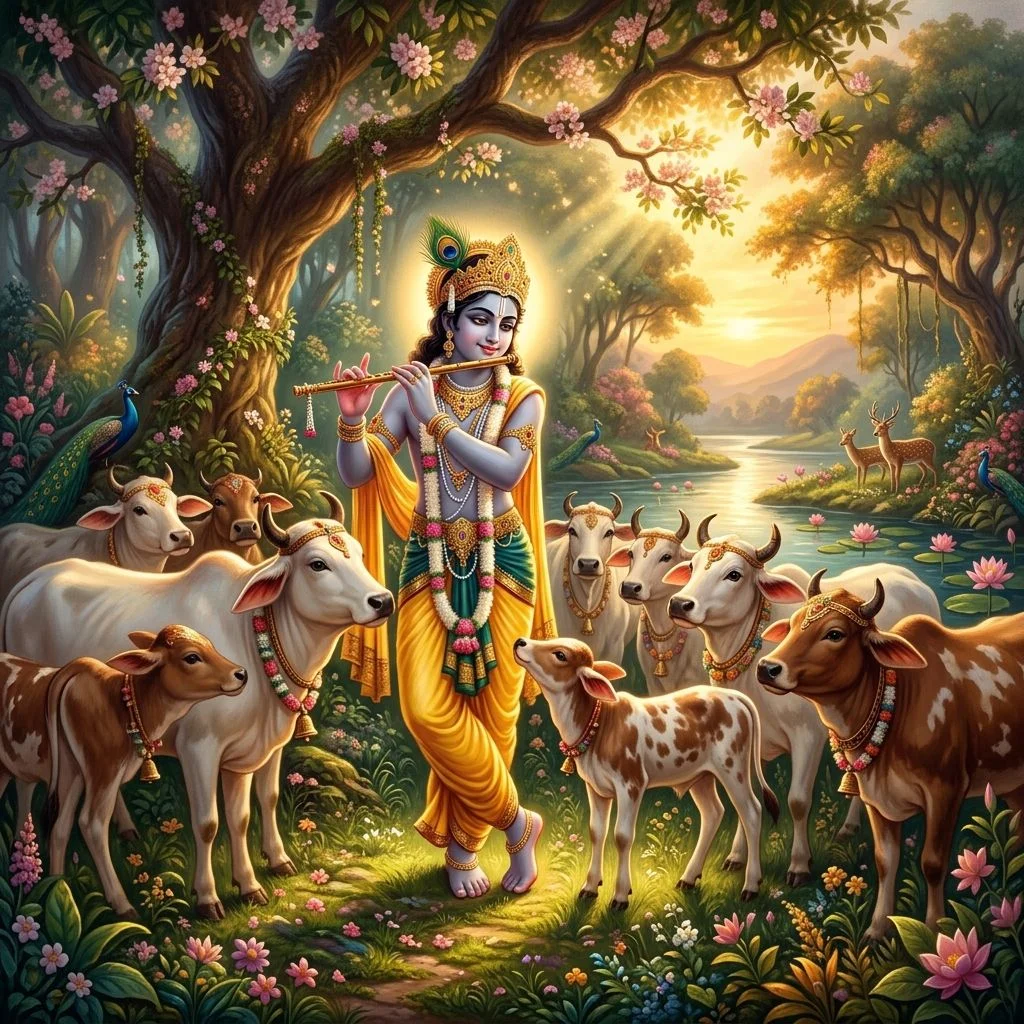
The melodies (samans) were heard by the rishis of the Samaveda lineage. Krishna himself says in the Bhagavad Gita 10.22: "vedānāṁ sāma-vedo'smi" - "Among the Vedas, I am the Sama Veda."
Gandharvaveda - Music, dance, and theatre
The Samaveda is unique among the four. It is not primarily a collection of new mantras - most of its 1,875 verses are quotations from the Rigveda, particularly from mandalas 8 and 9. What makes it a separate Veda is that each verse comes attached to a specific melody (saman) and a precise rule for how to chant it: which syllables are stretched, which are held on a long single note (vistara), which are folded back on themselves (stobha), where the breath rests.
The Samaveda is therefore the oldest musical notation in the world. It uses seven svaras - sa, re, ga, ma, pa, dha, ni - the same seven notes that became the foundation of every raga in Indian classical music. The names "swaraprakara" and "svara-mandala" appear in Samavedic technical literature centuries before the formalisation of ragas.
In ancient practice, no major yajna was complete without Samavedic chanters. Where the Rigvedi recited the words and the Yajurvedi performed the ritual actions, the Samavedi sang the offering aloud. This three-voice structure (Hota / Adhvaryu / Udgata) is preserved at the largest Vedic rituals still performed today.
Two main divisions - Purvarchika (the "earlier" hymns, 585 verses arranged by deity) and Uttararchika (the "later", 1,225 verses arranged by ritual application). The Aranyaka-Samhita is a small appendix.
Tandya Mahabrahmana (also called Panchavimsha - the largest), Shadvimsha Brahmana, Samavidhana Brahmana, Jaiminiya Brahmana, and several smaller ones. The Tandya specifies the exact melodic application of every saman.
Talavakara Aranyaka (Jaiminiya Upanishad Brahmana) - contains the Kena Upanishad as its concluding section.
Chandogya Upanishad (the longest Samavedic Upanishad - source of the mahavakya "tat tvam asi"), Kena Upanishad, Maitrayaniya Upanishad. The Chandogya alone is about 1/10 of the total Upanishadic corpus.
Mantras work because of their vibration, not just their meaning. The Samaveda is the most explicit demonstration: the same words from the Rigveda, sung with specific melodies, become a different practice with a different effect.
For the Samavedi, performing a saman is itself an offering. This is the conceptual root of Indian devotional music - kirtan, bhajan, namasankirtana - all the way to modern Carnatic and Hindustani classical traditions.
The seven notes (sapta-svara) of Indian music are first systematised in the Samaveda. The word "swara" itself is Samavedic technical vocabulary.
Bhuh, Bhuvah, Svah - earth, atmosphere, heavens - are first used as a triplet in Samavedic Upanishads as a meditation aid. They are now the prefix to the Gayatri.
The mahavakya "That Thou Art" - perhaps the single most studied sentence in Hindu philosophy - comes from the Chandogya Upanishad of the Samaveda. Father Uddalaka Aruni teaches it to son Shvetaketu through nine successive analogies.
agna āyāhi vītaye gṛṇāno havyadātaye |
"O Agni, come for the offering, praised by us, to receive the oblation."
Source: Samaveda Purvarchika 1.1 - the opening saman, sung in the Gayatra melody
The first verse a Samavedi student learns. Drawn from Rigveda 6.16.10 but set to its own melody.
tat tvam asi śvetaketo
"That Thou Art, O Shvetaketu."
Source: Chandogya Upanishad 6.8.7 (and following) - repeated nine times
The mahavakya. The father has just demonstrated through analogies that the essence behind every appearance is one. He concludes each demonstration: "and that essence - that is what you are."
oṁ ity ekākṣaraṁ brahma
"Om - this single syllable is Brahman."
Source: Chandogya Upanishad 1.1.1
The opening of the Chandogya. The text immediately tells the student that Om is not just a sound but Brahman in audible form.
satyam eva jayate nānṛtaṁ
"Truth alone triumphs, not falsehood."
Source: Mundaka Upanishad 3.1.6 - but echoed across Samavedic literature
The national motto of India is from the Atharvavedic Mundaka, but the Samavedic Chandogya is full of similar declarations of satya as the highest reality.
Region: Pan-Indian - most popular
Status: Actively chanted - the dominant Samavedic recension today
Region: Maharashtra, Gujarat
Status: Actively chanted by some priestly families
Region: Kerala (Nambudiri Brahmins), Karnataka (Havyaka Brahmins)
Status: Rare and precious - a different melodic tradition that some scholars consider the oldest surviving
Every bhajan, kirtan, namasankirtana, and devotional song you have ever heard sits within a tradition that descends from Samavedic chant. To listen to good kirtan is to participate in a 3,000-year-old line.
The seven svaras, the concept of raga (a melodic mood), the idea of tala (rhythmic cycle) - all have roots in Samavedic music theory. A serious student of Carnatic or Hindustani music is studying a systematised descendant of the Samaveda.
In every major South Indian temple - Tirupati, Sabarimala, Guruvayur, Madurai, Sringeri - daily seva includes Samavedic chant by trained Samavedis.
Soma yagas (the most elaborate Vedic rituals - Athirathra, Atyagnishtoma) require Samavedic chanters as one of the four officiants. These are still performed in Kerala every 12 years.
Listening to Samavedic chant - especially Jaiminiya recitation - is itself meditative. Recordings by the Mahesh Yogi institutes, the Veda Vyasa Samvardhana Trust, and several university archives are now freely available online.
Every meditation that uses Om as its anchor is using the foundational Samavedic teaching: that this single syllable is Brahman in audible form.
Samaveda is the rarest of the four streams in living chanting tradition. Major centres: Kuruppam (Kerala - Jaiminiya), Mattur and Hosanagara (Karnataka - Kauthuma), Tirupati, Mysore, and several Maharashtrian Konkanastha Brahmin families. Total active Samavedic chanters in India today are estimated in the low thousands - UNESCO listed Vedic chanting as Intangible Cultural Heritage in 2008 partly to protect this tradition.