Skip to content
Back to wisdom hub

Bhagavad Gita

The song of the divine

By Sevasannidhi LLPUpdated 19 May 2026

श्रीमद्भगवद्गीता

Eighteen chapters. Seven hundred and one verses, all here in Devanagari, transliteration and plain English. Read straight through or jump to any chapter below.

All 701 verses available - chapter by chapter
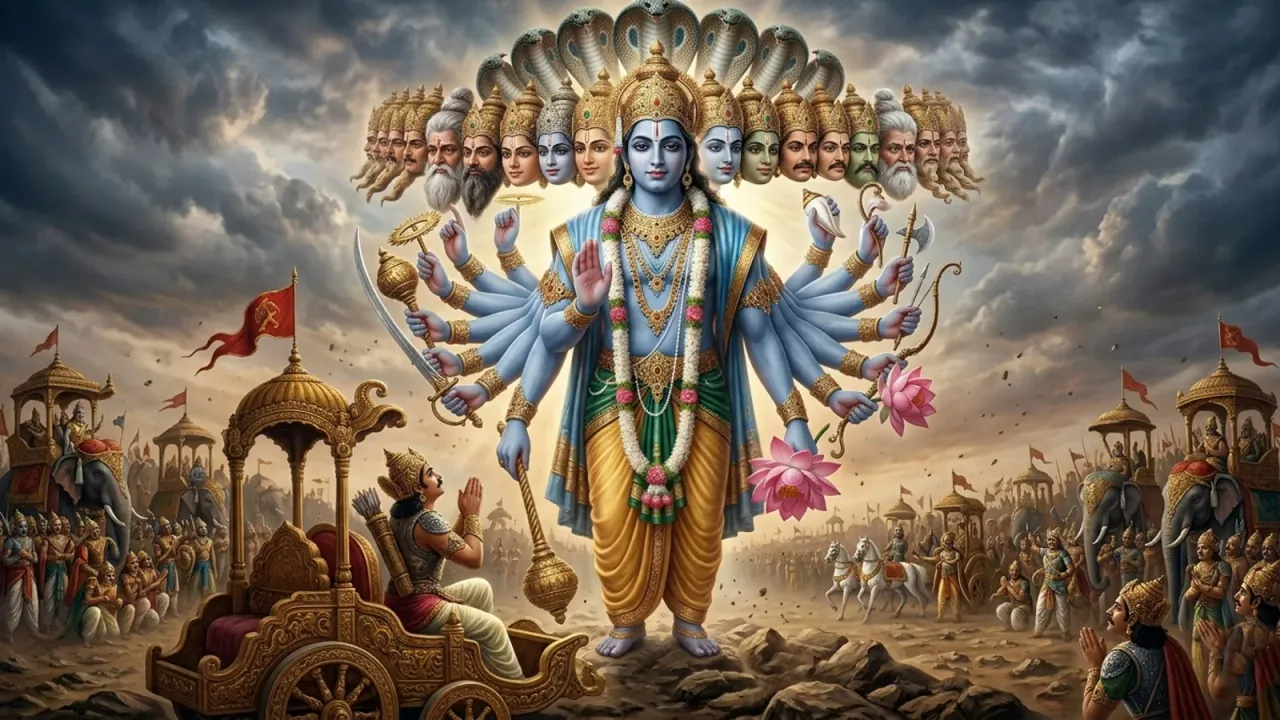
Lord Krishna instructing Arjuna on the battlefield of Kurukshetra

Opening invocation · गीता ध्यानम्

पार्थाय प्रतिबोधितां भगवता नारायणेन स्वयं व्यासेन ग्रथितां पुराणमुनिना मध्ये महाभारतम्। अद्वैतामृतवर्षिणीं भगवतीमष्टादशाध्यायिनीं अम्ब त्वामनुसन्दधामि भगवद्गीते भवद्वेषिणीम्॥

O Mother Bhagavad Gita, the destroyer of bondage - taught to Partha by Lord Narayana himself, compiled by the ancient sage Vyasa in the midst of the Mahabharata, raining the nectar of non-dual wisdom across eighteen chapters - I meditate on you.

What is the Bhagavad Gita?

The Bhagavad Gita - “the song of the divine” - sits inside the sixth book of the Mahabharata. On the morning the great battle is about to begin, the warrior Arjuna asks his charioteer Krishna to take him into the middle of the field so he can see both armies. There he sees relatives, teachers, friends arrayed on both sides. He puts down his bow and refuses to fight. The Gita is what Krishna says to him.

What begins as a battlefield counselling session becomes a complete philosophical text. Krishna draws from the Upanishads, the Samkhya tradition, the yoga schools. He reveals himself as the Divine itself. The teaching is universal - about duty, attachment, knowledge, action, devotion, death, and liberation. Eighteen chapters, seven hundred verses.

For two thousand years the Gita has been the most quoted, most translated and most lived text of Sanatana Dharma. Adi Shankara, Ramanuja, Madhva all wrote major commentaries on it. Tilak, Vivekananda, Aurobindo, Swami Chinmayananda did the same in modern times. It is short enough to read in six hours. It is deep enough to read for a lifetime.

The eighteen chapters

Each chapter is summarised in plain English with its signature shloka in Devanagari, transliteration and meaning.

1

Arjuna's Despair

अर्जुनविषादयोग · 47 verses

The crisis of conscience

On the field of Kurukshetra, Arjuna sees fathers, teachers and friends arrayed in both armies. His bow slips from his hand. The rest of the Gita is the answer to his collapse.

न च शक्नोम्यवस्थातुं भ्रमतीव च मे मनः। निमित्तानि च पश्यामि विपरीतानि केशव॥

na ca śaknomy-avasthātuṃ bhramatīva ca me manaḥ, nimittāni ca paśyāmi viparītāni keśava.

- I cannot stand my ground; my mind whirls. I see only ill omens, O Keshava.

Gita 1.30

Read all 47verses →
2

The Yoga of Knowledge

साङ्ख्ययोग · 72 verses

The deathless Self

Krishna's first teaching. The Self is unborn, undying. It cannot be cut by weapons, burnt by fire, drowned by water. Do your duty without grief.

नैनं छिन्दन्ति शस्त्राणि नैनं दहति पावकः। न चैनं क्लेदयन्त्यापो न शोषयति मारुतः॥

nainaṃ chindanti śastrāṇi nainaṃ dahati pāvakaḥ, na cainaṃ kledayanty-āpo na śoṣayati mārutaḥ.

- Weapons cannot cut Him, fire cannot burn Him, water cannot drench Him, wind cannot dry Him.

Gita 2.23

Read all 72verses →
3

The Yoga of Action

कर्मयोग · 43 verses

Action without attachment

You cannot escape karma by inaction. Act without claiming the fruit. Action offered to the Divine purifies the actor.

कर्मण्येवाधिकारस्ते मा फलेषु कदाचन। मा कर्मफलहेतुर्भूर्मा ते सङ्गोऽस्त्वकर्मणि॥

karmaṇy-evādhikāras-te mā phaleṣu kadācana, mā karma-phala-hetur-bhūr-mā te saṅgo’stv-akarmaṇi.

- You have a right to action alone, never to its fruit. Do not be motivated by results - but do not be attached to inaction either.

Gita 2.47 (often grouped here)

Read all 43verses →
4

The Yoga of Knowledge and Renunciation

ज्ञानकर्मसन्न्यासयोग · 42 verses

Avatara dharma

Krishna reveals he has taught this yoga before - to Vivasvan, to Manu, to Ikshvaku. He descends in every age when dharma weakens.

यदा यदा हि धर्मस्य ग्लानिर्भवति भारत। अभ्युत्थानमधर्मस्य तदात्मानं सृजाम्यहम्॥

yadā yadā hi dharmasya glānir-bhavati bhārata, abhyutthānam-adharmasya tadātmānaṃ sṛjāmy-aham.

- Whenever dharma declines and adharma rises, O Bharata, I manifest myself.

Gita 4.7

Read all 42verses →
5

The Yoga of Renunciation in Action

कर्मसन्न्यासयोग · 29 verses

The same goal, two paths

Karma-sannyasa (offering the action) and karma-yoga (skill in action) lead to the same liberation. The wise see both as one.

ब्रह्मण्याधाय कर्माणि सङ्गं त्यक्त्वा करोति यः। लिप्यते न स पापेन पद्मपत्रमिवाम्भसा॥

brahmaṇy-ādhāya karmāṇi saṅgaṃ tyaktvā karoti yaḥ, lipyate na sa pāpena padma-patram-ivāmbhasā.

- One who offers actions to Brahman and acts without attachment is untouched by sin - like a lotus leaf untouched by water.

Gita 5.10

Read all 29verses →
6

The Yoga of Self-Mastery

आत्मसंयमयोग · 47 verses

The yogi at meditation

A practical chapter - sit erect, half-eyes closed, on a clean seat in a clean place. Eat moderately, sleep moderately, work moderately. The mind is fickle but can be tamed by abhyasa and vairagya.

युक्ताहारविहारस्य युक्तचेष्टस्य कर्मसु। युक्तस्वप्नावबोधस्य योगो भवति दुःखहा॥

yuktāhāra-vihārasya yukta-ceṣṭasya karmasu, yukta-svapnāvabodhasya yogo bhavati duḥkha-hā.

- For one moderate in food, recreation, action, sleep and waking - yoga becomes the destroyer of sorrow.

Gita 6.17

Read all 47verses →
7

The Yoga of Knowledge and Wisdom

ज्ञानविज्ञानयोग · 30 verses

My higher and lower nature

Krishna distinguishes his lower (eight-fold) prakriti from his higher (jiva). All beings are born of these two. Among thousands, perhaps one strives for perfection.

मन्मना भव मद्भक्तो मद्याजी मां नमस्कुरु। मामेवैष्यसि सत्यं ते प्रतिजाने प्रियोऽसि मे॥

man-manā bhava mad-bhakto mad-yājī māṃ namas-kuru, mām-evaiṣyasi satyaṃ te pratijāne priyo’si me.

- Fix your mind on Me, be devoted to Me, sacrifice for Me, bow to Me - you shall come to Me. Truly I promise - for you are dear to Me.

Gita 18.65 (echo: "Krishna recites in 9.34 too")

Read all 30verses →
8

The Yoga of the Imperishable Brahman

अक्षरब्रह्मयोग · 28 verses

The hour of death

Whatever a person remembers at the moment of leaving the body, that they become. So practise - habitually - the remembrance of the Divine.

अन्तकाले च मामेव स्मरन् मुक्त्वा कलेवरम्। यः प्रयाति स मद्भावं याति नास्त्यत्र संशयः॥

anta-kāle ca mām-eva smaran muktvā kalevaram, yaḥ prayāti sa mad-bhāvaṃ yāti nāsty-atra saṃśayaḥ.

- One who remembers Me at the hour of death and leaves the body comes to My state. Of this there is no doubt.

Gita 8.5

Read all 28verses →
9

The Royal Knowledge, the Royal Secret

राजविद्याराजगुह्ययोग · 34 verses

Bhakti is the easiest way

The most direct path: offer a leaf, a flower, a fruit, a sip of water - with love, and Krishna accepts it. He becomes the friend of even the most wretched if they turn to him.

पत्रं पुष्पं फलं तोयं यो मे भक्त्या प्रयच्छति। तदहं भक्त्युपहृतमश्नामि प्रयतात्मनः॥

patraṃ puṣpaṃ phalaṃ toyaṃ yo me bhaktyā prayacchati, tad-ahaṃ bhakty-upahṛtam-aśnāmi prayatātmanaḥ.

- Whoever offers Me a leaf, a flower, a fruit, water - with love, with a pure heart - I accept that offering of devotion.

Gita 9.26

Read all 34verses →
10

The Yoga of Divine Glories

विभूतियोग · 42 verses

Wherever excellence shines

Krishna names his manifestations - among rivers, the Ganga; among mountains, the Himalaya; among trees, the Ashvattha. Wherever there is splendour and power, He is the seed.

यद्यद्विभूतिमत्सत्त्वं श्रीमदूर्जितमेव वा। तत्तदेवावगच्छ त्वं मम तेजोऽंशसम्भवम्॥

yad-yad-vibhūtimat-sattvaṃ śrīmad-ūrjitam-eva vā, tat-tad-evāvagaccha tvaṃ mama tejo’ṃśa-sambhavam.

- Whatever has glory, brilliance, vigour - know that to be born of a fragment of My splendour.

Gita 10.41

Read all 42verses →
11

The Vision of the Universal Form

विश्वरूपदर्शनयोग · 55 verses

The terrifying Vishvarupa

Arjuna asks to see Krishna's true cosmic form. Krishna grants divine sight. Arjuna sees the universe contained in Krishna's body - luminous, terrible, time itself devouring all worlds. He pleads to see the gentle four-armed form again.

कालोऽस्मि लोकक्षयकृत्प्रवृद्धो लोकान्समाहर्तुमिह प्रवृत्तः। ऋतेऽपि त्वां न भविष्यन्ति सर्वे येऽवस्थिताः प्रत्यनीकेषु योधाः॥

kālo’smi loka-kṣaya-kṛt-pravṛddho lokān-samāhartum-iha pravṛttaḥ, ṛte’pi tvāṃ na bhaviṣyanti sarve ye’vasthitāḥ pratyanīkeṣu yodhāḥ.

- I am Time, the great destroyer of worlds, here to consume the worlds. Even without you, all these warriors arrayed against you shall not survive.

Gita 11.32

Read all 55verses →
12

The Yoga of Devotion

भक्तियोग · 20 verses

The qualities of the devotee

Bhakti is supreme. The devotee who is friendly to all, free from possessiveness, even-minded in pleasure and pain, content, self-restrained, firm in resolve - that one is dear to Me.

अद्वेष्टा सर्वभूतानां मैत्रः करुण एव च। निर्ममो निरहङ्कारः समदुःखसुखः क्षमी॥

adveṣṭā sarva-bhūtānāṃ maitraḥ karuṇa eva ca, nirmamo nirahaṅkāraḥ sama-duḥkha-sukhaḥ kṣamī.

- Without enmity to any being, friendly and compassionate, free of "mine," free of ego, equal in joy and sorrow, forgiving - such a devotee is dear to Me.

Gita 12.13

Read all 20verses →
13

The Field and the Knower of the Field

क्षेत्रक्षेत्रज्ञविभागयोग · 35 verses

Body, soul, and the Self of all

The body is the field; the consciousness within is the knower. Beyond both is the supreme Self, who dwells equally in all beings, undiminished.

समं सर्वेषु भूतेषु तिष्ठन्तं परमेश्वरम्। विनश्यत्स्वविनश्यन्तं यः पश्यति स पश्यति॥

samaṃ sarveṣu bhūteṣu tiṣṭhantaṃ parameśvaram, vinaśyatsv-avinaśyantaṃ yaḥ paśyati sa paśyati.

- One who sees the supreme Lord dwelling equally in all beings - undying among the dying - sees truly.

Gita 13.27

Read all 35verses →
14

The Three Modes

गुणत्रयविभागयोग · 27 verses

Sattva, Rajas, Tamas

Sattva binds with light and joy, rajas with action and craving, tamas with darkness and sloth. Cultivate sattva. Then transcend even sattva to reach the eternal.

मां च योऽव्यभिचारेण भक्तियोगेन सेवते। स गुणान् समतीत्यैतान् ब्रह्मभूयाय कल्पते॥

māṃ ca yo’vyabhicāreṇa bhakti-yogena sevate, sa guṇān samatītyaitān brahma-bhūyāya kalpate.

- Whoever serves Me with unwavering devotion goes beyond the three modes and is fit for absorption in Brahman.

Gita 14.26

Read all 27verses →
15

The Yoga of the Supreme Person

पुरुषोत्तमयोग · 20 verses

The cosmic ashvattha

Krishna describes the inverted Ashvattha tree - roots above, branches below - the cosmos as a tree to be cut by the sword of detachment.

ममैवांशो जीवलोके जीवभूतः सनातनः। मनःषष्ठानीन्द्रियाणि प्रकृतिस्थानि कर्षति॥

mamai-vāṃśo jīva-loke jīva-bhūtaḥ sanātanaḥ, manaḥ-ṣaṣṭhānīndriyāṇi prakṛti-sthāni karṣati.

- A fragment of My eternal Self, becoming a jiva in the world of the living, draws the six senses (mind being the sixth) from prakriti.

Gita 15.7

Read all 20verses →
16

Divine and Demonic Natures

दैवासुरसम्पद्विभागयोग · 24 verses

The two kinds of human

Daivi sampada - fearlessness, purity, charity, self-restraint, honesty, gentleness. Asuri sampada - pride, arrogance, anger, harshness, ignorance. The same human can grow either.

अभयं सत्त्वसंशुद्धिर्ज्ञानयोगव्यवस्थितिः। दानं दमश्च यज्ञश्च स्वाध्यायस्तप आर्जवम्॥

abhayaṃ sattva-saṃśuddhir-jñāna-yoga-vyavasthitiḥ, dānaṃ damaś-ca yajñaś-ca svādhyāyas-tapa ārjavam.

- Fearlessness, purity of heart, steadiness in the yoga of knowledge, charity, self-restraint, sacrifice, study of scripture, austerity, simplicity.

Gita 16.1

Read all 24verses →
17

The Three Kinds of Faith

श्रद्धात्रयविभागयोग · 28 verses

You become what you believe

Sattvic, rajasic, tamasic - every person, every food, every austerity, every act of giving has these three flavours. We are made of our shraddha.

ॐतत्सदिति निर्देशो ब्रह्मणस्त्रिविधः स्मृतः। ब्राह्मणास्तेन वेदाश्च यज्ञाश्च विहिताः पुरा॥

oṃ-tat-sad-iti nirdeśo brahmaṇas-tri-vidhaḥ smṛtaḥ, brāhmaṇās-tena vedāś-ca yajñāś-ca vihitāḥ purā.

- Om, Tat, Sat - this threefold designation of Brahman is established. By it the brahmanas, the Vedas, and the sacrifices were ordained of old.

Gita 17.23

Read all 28verses →
18

The Yoga of Liberation by Renunciation

मोक्षसन्न्यासयोग · 78 verses

Surrender as the final word

The longest and concluding chapter. Sannyasa = renunciation of action; tyaga = renunciation of fruit. Krishna sums up all earlier teachings and ends with the supreme word: surrender all dharmas to Me - I will free you from all sin.

सर्वधर्मान् परित्यज्य मामेकं शरणं व्रज। अहं त्वा सर्वपापेभ्यो मोक्षयिष्यामि मा शुचः॥

sarva-dharmān-parityajya mām-ekaṃ śaraṇaṃ vraja, ahaṃ tvā sarva-pāpebhyo mokṣayiṣyāmi mā śucaḥ.

- Abandon all dharmas and take refuge in Me alone. I will liberate you from all sins. Do not grieve.

Gita 18.66 - the Charama Shloka

Read all 78verses →

The final word · चरम श्लोक

सर्वधर्मान् परित्यज्य मामेकं शरणं व्रज। अहं त्वा सर्वपापेभ्यो मोक्षयिष्यामि मा शुचः॥

sarva-dharmān-parityajya mām-ekaṃ śaraṇaṃ vraja,
ahaṃ tvā sarva-pāpebhyo mokṣayiṣyāmi mā śucaḥ.

“Abandon all dharmas and take refuge in Me alone. I will liberate you from all sins. Do not grieve.”

- Bhagavad Gita 18.66 · the Charama Shloka, the supreme verse of surrender

Translations are paraphrastic to keep meaning accessible. For verbatim study consult Sankaracharya, Ramanuja, Madhva, or any modern scholarly edition. Detailed verse-by-verse commentary is available at trusted sources such as sacred-texts.com and Gita Supersite (IIT-K).
Explore our free Vedic toolsExplore all →
Free previewVedic Kundli (Janma)Rashi + nakshatra free. Unlock the full chart – lagna, navagrahas, dashas, North + South.Daily PanchangaTithi, nakshatra, yoga, karana, vara – unlimited timeline. + Rashi phala + ceremonial muhurta.Muhurta CalculatorAuspicious dates for chudakarana, upanayana, vivaha, griha-pravesha – 11 samskaras.Rashi Bhavishya (Today)Daily rashi forecast based on your janma rashi + moon transit. Includes do/avoid + Vimshottari dasha context if DOB+time provided.Kundli MatchAshtakoota 36-point compatibility – Varna, Vashya, Tara, Yoni, Graha, Gana, Bhakoot, Nadi.Personal Vastu AnalyserDirection recommendations from your lagna + moon-rashi + current Mahadasha.PopularFind YourselfGotra, nakshatra, kuladevata, lineage – start here.PopularComplete Sanatan Library130+ wisdom pages – Vedas, Puranas, Yoga, Tantra, Pilgrimage, Sciences.Search the Library (A–Z)Find any of the 180+ wisdom pages by name, term, or URL – across all 12 categories. One-tap copy + CSV export.Sacred SciencesYoga, Ayurveda, Jyotisha, Vastu – the four applied disciplines of Sanatana Dharma.Mantras + StotrasFull text mantras for every major deity – 16+ deities, 500+ mantras + stotras.Sacred Pilgrimage12 Jyotirlingas, 51 Shakti Peethas, 108 Divya Desams, Char Dham.