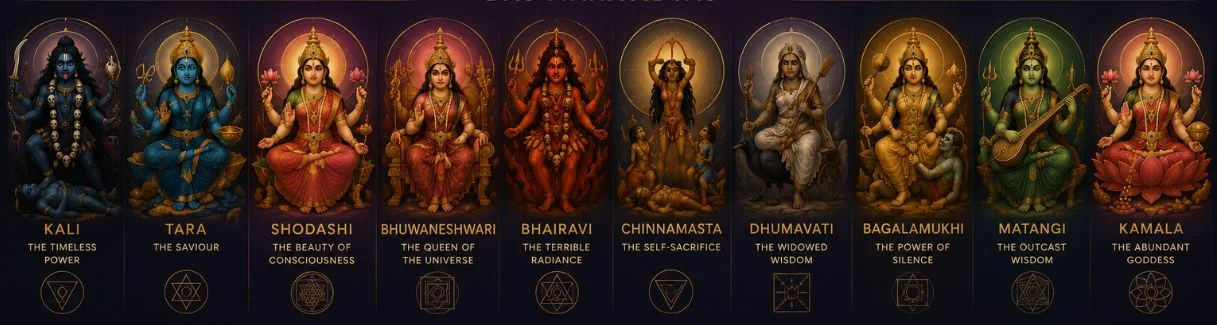
Fierce, sovereign, and initiatory - the 64 Yoginis form the complete mandala of Shakti's cosmic power. From Kali at the centre to Maha-Yogini at the outer ring, each embodies a distinct force of consciousness.
01
Kali
Shakti: Time, dissolution, liberation
Weapon: Khadga (sword) and severed head
The primordial Yogini, dark as the night sky, who dances on Shiva. She destroys ignorance and time itself, granting fearlessness to her devotees.
02
Kapalini
Shakti: The skull-bearer; transformation through death
Weapon: Kapala (skull-cup) and trident
She carries a garland of skulls and drinks from a skull-cup, embodying the Kapalika stream of Shaiva-Shakta tantra. Governs rites of passage and reversal of fate.
03
Kulla
Shakti: Earth-power and hidden wealth
Weapon: Spade and lotus
A chthonic Yogini linked to the underworld and to buried treasures. She governs agricultural abundance and the secret powers of the earth.
04
Kurukulla
Shakti: Attraction, enchantment, love-magic
Weapon: Flower-arrow bow and hook
Kurukulla is the red Yogini of fascinating power (vashikarana). She is honoured in both Hindu and Buddhist tantric traditions as the goddess of magnetism and desire-fulfilment.
05
Virodhini
Shakti: Obstruction and removal of obstacles
Weapon: Barrier staff and noose
She blocks the path of enemies and negative forces. As her name suggests (virodhini = obstructor), she governs the power to paralyse and halt hostile action.
06
Viprachitta
Shakti: Fierce wisdom, curse-power
Weapon: Axe and skull
One of the ancient asuri Yoginis mentioned in the Devi Mahatmya. She embodies the fierce intelligence that cuts through illusion and defeats pride.
07
Ugra
Shakti: Terrible power, wrath, storm-force
Weapon: Thunderbolt and fire
Her name means "fierce." She personifies the terrifying aspect of Shakti - the storm that clears before renewal. Governs severe austerities and control of weather-forces.
08
Ugraprabha
Shakti: Fierce radiance, solar wrath
Weapon: Flaming disc and spear
Her radiance is intense and blinding. She combines Ugra's ferocity with the burning light of higher knowledge, burning away karmic residue.
09
Dipa
Shakti: Light, illumination, revelation
Weapon: Lamp and arrow
Dipa means "lamp." She illuminates the darkness of ignorance and is propitiated at night in inner-chamber rituals. Her flame reveals hidden truths.
10
Nila
Shakti: Blue cosmic expanse, sky-power
Weapon: Blue lotus and sword
Nila is the blue Yogini associated with the infinite sky-consciousness. She corresponds to the Nila Sarasvati tradition of the North-East.
11
Ghana
Shakti: Cloud, rain, dense power
Weapon: Thundercloud and noose
She governs the monsoon-forces and dense, accumulated power. Her name means "thick/dense" - she represents the accumulated weight of shakti before it breaks as rain.
12
Balaka
Shakti: Child-power, innocence as strength
Weapon: Sugarcane bow and flower-arrow
Balaka appears as a child-goddess (bala = child). She governs the power of the child-form of the Devi - pure, spontaneous, and devastatingly powerful.
13
Matra
Shakti: Matrix, mother-power, measure
Weapon: Measuring rod and lotus
Matra is the primordial mother-measure, the matrix from which all Yoginis arise. She governs proportion, form, and the womb of creation.
14
Mudra
Shakti: Seal, gesture, locked power
Weapon: Mudra (ritual hand gesture) and bell
She governs the power of mudras - sacred hand gestures that seal and transmit energy. She is the Yogini of symbolic language and ritual sealing.
15
Mita
Shakti: Measured restraint, proportion
Weapon: Scale and noose
Mita means "measured" or "restrained." She governs the balance between fierce and gentle, the right proportion of effort in spiritual practice.
16
Maha-Kali
Shakti: Supreme time-dissolution
Weapon: Sword, shield, severed head, trishul
The great Kali - beyond even the first Kali in the mandala. She dissolves entire world-epochs and bestows fearlessness to those who approach her correctly.
17
Kamesvari
Shakti: Sovereign of desire and bliss
Weapon: Sugarcane bow and five flower-arrows
First of the Nitya goddesses in the Sri Vidya (Shodashi) tradition. She embodies the bliss-aspect of Tripura Sundari. Governs fulfilment of righteous desires.
18
Bhagamalini
Shakti: Garland of the vulva (cosmic generativity)
Weapon: Noose, goad, lotus, and book
Second Nitya Yogini. She represents the flowering of creation, the universe as a garland offered to the Devi. Governs fertility and creative proliferation.
19
Nityaklinna
Shakti: Ever-moist, always aroused, fluid cosmos
Weapon: Skull-cup and skull-staff
Third Nitya. She embodies the eternal moisture of creation - the fluid, alive quality of the cosmos. Her bija is Klim. Governs desire, moisture, and perpetual renewal.
20
Bherunda
Shakti: Terror, formidable power
Weapon: Axe, trident, and severed head
Fourth Nitya. Bherunda means "terrifying." She governs the formidable aspect of the Devi that makes even other gods tremble. Associated with the terrific bird-mount Bherunda.
21
Vahnivasini
Shakti: Fire-dweller, fire-goddess
Weapon: Fire-torch and sacrificial ladle
Fifth Nitya. She dwells in fire (vahni = fire) and governs all fire rituals (homas). She is the Yogini who carries oblations to the other goddesses.
22
Mahavajresvari
Shakti: Great thunderbolt-sovereign
Weapon: Vajra (thunderbolt) and lotus
Sixth Nitya. She wields the great vajra - the indestructible weapon that destroys ignorance. Governs power, invincibility, and the cutting-through of obstacles.
23
Sivaduti
Shakti: Shiva's messenger, emissary of the absolute
Weapon: Sword and skull
Seventh Nitya. She is the messenger of Shiva - a fierce form named in the Devi Mahatmya as the one Devi sent to negotiate with Chanda and Munda. Governs divine communication.
24
Tvarita
Shakti: Swift, lightning-fast power
Weapon: Sword, hook, noose, and goad
Eighth Nitya. Her name means "swift." She governs speed of spiritual progress, the lightning-flash of grace, and rapid fulfilment of mantra practice.
25
Kulasundari
Shakti: Beauty of the Kula lineage
Weapon: Noose, goad, and ankusha
Ninth Nitya and a form of Tripura Sundari. She is the beautiful sovereign of the Kaula tradition. Her worship involves the secret Kula rituals of the Sri Vidya lineage.
26
Nitya
Shakti: Eternal, the undivided feminine eternal
Weapon: Lotus and abhaya gesture
Tenth Nitya. She embodies the eternal (nitya) aspect of the Devi - unchanging, ever-present, the background consciousness behind all manifestation.
27
Nilapataka
Shakti: Blue-banner, victory-standard
Weapon: Blue banner and sword
Eleventh Nitya. Her blue banner signals the Devi's victory over darkness and demonic forces. She is invoked for success in difficult undertakings.
28
Vijaya
Shakti: Victory, conquest, success
Weapon: Bow, arrow, and sword
Twelfth Nitya. Vijaya means victory. She governs all forms of triumph - in battle, litigation, competition, and on the spiritual path.
29
Sarvamangala
Shakti: All-auspiciousness
Weapon: Lotus and gesture of boons
Thirteenth Nitya. She embodies all that is auspicious. She is invoked at the beginning of ceremonies to ensure a blessed outcome.
30
Jvalamalini
Shakti: Ring of flames, fire-garland
Weapon: Flaming garland and spear
Fourteenth Nitya. She wears a garland of flames and governs the fire-field that surrounds and protects the Devi's mandala from negative forces.
31
Chitra
Shakti: Variegated, artistic, multi-coloured
Weapon: Paintbrush and noose
Fifteenth Nitya. Chitra means "variegated / painted." She governs art, colour, illusion (maya), and the variegated appearance of the manifested world.
32
Mahanitya
Shakti: Great eternity, the supreme eternal
Weapon: Trishul and bell
Sixteenth and final Nitya - identified with Tripura Sundari herself at the full-moon peak. She completes the lunar cycle of 16 Nitya goddesses.
33
Chamunda
Shakti: Slayer of Chanda and Munda demons
Weapon: Trishul, skull-cup, and noose
Chamunda emerges from the furrowed brow of Kali during the battle with Chanda and Munda (Devi Mahatmya). She is gaunt, terrifying, and all-consuming.
34
Varahi
Shakti: Boar-power, earth-turning, command
Weapon: Plough, goad, and sword
The boar-headed Yogini - female counterpart of Varaha (Vishnu's boar avatar). She commands the underworld and earth-forces, granting power over enemies.
35
Indrani
Shakti: Royal sovereignty, thunderstorm-power
Weapon: Vajra (thunderbolt) and noose
The shakti of Indra. She governs royal authority, rain, and the heavens. One of the Saptamatrikas, she appears in every major Matrika-Yogini mandala.
36
Brahmani
Shakti: Creative power, Vedic authority
Weapon: Kamandalu (water-pot), rosary, and lotus
The shakti of Brahma, seated on a swan. She governs creation, Vedic learning, and the power of sacred sound. One of the Saptamatrikas.
37
Maheshvari
Shakti: Supreme Shaiva sovereignty
Weapon: Trishul, drum, and abhaya gesture
The shakti of Maheshvara (Shiva), riding a bull. She is the great Shaiva Matrika, governing renunciation, yoga, and the fierce grace of Shiva.
38
Kaumari
Shakti: War, youthful energy, strategy
Weapon: Spear and peacock-banner
Shakti of Kumara (Skanda/Kartikeya). She governs youth, valour, warfare strategy, and the purification of desire through tapas.
39
Vaishnavi
Shakti: Preservation, dharma, cosmic order
Weapon: Conch, disc, mace, and lotus
The shakti of Vishnu, mounted on Garuda. She governs preservation of dharma, cosmic order, and protection of the righteous. One of the Saptamatrikas.
40
Narasimhi
Shakti: Lion-power, fierce protection
Weapon: Claws and discus
The female lion-headed shakti corresponding to Narasimha. She is invoked to annihilate impossible obstacles and protect initiates at moments of extreme crisis.
41
Aparajita
Shakti: The unconquered, invincibility
Weapon: Sword and shield
Her name means "unconquered." She is the Yogini who cannot be defeated and who grants invincibility to those she favours. Widely worshipped in Bengal and Odisha.
42
Bala
Shakti: Child-goddess, raw latent power
Weapon: Book and rosary
Bala is the three-syllabled, three-eyed child-form of Tripura Sundari. Her simplicity conceals tremendous power - her bija is Aim Klim Sauh.
43
Yaksini
Shakti: Yaksha nature-spirit power, forest-wisdom
Weapon: Fruit-tree branch and noose
A Yogini of the Yaksha lineage, she governs the forest, hidden wealth in the earth, and the liminal spaces between the human and spirit worlds.
44
Padmavati
Shakti: Lotus-dweller, gentle sovereignty
Weapon: Lotus and conch
She dwells in the lotus of the heart. Padmavati governs grace, prosperity, and spiritual opening - the lotus blooming in dark water as the awakening soul.
45
Ghantakarna
Shakti: Bell-eared, sound-power, resonance
Weapon: Bell and sword
She wears enormous bells at her ears, symbolising her mastery over sacred sound (nada). She is the Yogini of mantric resonance and sonic protection.
46
Bhadrakali
Shakti: Auspicious-Kali, fierce grace
Weapon: Sword, shield, and trident
Bhadrakali combines the ferocity of Kali with auspiciousness (bhadra). She is especially worshipped in Kerala (Bhadrakali temples) and Odisha.
47
Mahalakshmi
Shakti: Supreme abundance and cosmic beauty
Weapon: Lotus, conch, discus, and mace
The great Lakshmi as a Yogini - she appears in the Devi Mahatmya (chapter 11) as the supreme goddess who absorbs all other goddesses back into herself.
48
Guhyakali
Shakti: Hidden Kali, secret dark wisdom
Weapon: Skull-staff and damaru
The secret (guhya = hidden) form of Kali, known only through tantric initiation. She represents the innermost, hidden level of consciousness.
49
Smarahanana
Shakti: Destroyer of Kamadeva, conquest of desire
Weapon: Fire and bow
Named for the destruction of Smara (Kamadeva, the god of erotic desire). She governs sublimation of desire into spiritual fire - the burning of longing into liberation.
50
Raktadantika
Shakti: Blood-toothed, fierce consuming power
Weapon: Blood-cup and sword
Her blood-red teeth mark her as a consumer of life-force. She is invoked to consume negative karma and disease. Related to the Raktachanda form of Chamunda.
51
Vaishnavi-Yogini
Shakti: Vaishnavite cosmic integration
Weapon: Disc and conch
A distinct Yogini of the Vaishnava current within the 64, separate from Vaishnavi the Matrika. She brings the Vaishnava perspective - compassion and dharma - into the tantric circle.
52
Pracanda
Shakti: Violent, tempestuous, destroying foes
Weapon: Club and severed head
Pracanda means "violent" or "tempestuous." She destroys foes with extreme force and governs the unstoppable aspect of divine anger purified of ego.
53
Candakshini
Shakti: Fierce-eyed, burning gaze
Weapon: Bow and eye-bolt
She has the fierce eye (canda-akshi) that burns obstacles on sight. Her glance alone destroys impurity and grants direct perception of reality.
54
Katyayani
Shakti: Warrior-Devi, the sage Katyayana's daughter
Weapon: Sword, shield, trident, and lotus
A major Navadurga form. She was born from the combined light of the Trimurti and all devas to slay Mahishasura. Governs righteous battle and protection of dharma.
55
Bhuvaneshvari
Shakti: Sovereign of the cosmos, world-womb
Weapon: Noose, goad, and boon-gesture
The fourth Mahavidya, she IS the cosmos itself - her body is the universe. She governs space, expansion, and the mothering of all phenomena.
56
Tripura-Bhairavi
Shakti: Fierce austerity, consuming fire
Weapon: Rosary, book, and fire-gesture
The fifth Mahavidya. She is the fire of tapas, the sun, and ferocious spiritual heat. Her red complexion and bright form burn away all impurity through sustained practice.
57
Dhumavati
Shakti: Smoke, inauspiciousness, withholding grace
Weapon: Winnowing basket and crow-banner
The seventh Mahavidya - the widow-goddess, gaunt and smoke-grey. She governs unfulfilled desire, loss, widowhood, and the aspect of the Devi that never grants material wishes.
58
Bagalamukhi
Shakti: Paralysis, speech-stopping, victory in argument
Weapon: Club and tongue-pulling gesture
The eighth Mahavidya. She pulls the tongue of enemies and paralyses all opposition. Widely invoked in court cases and competitive situations.
59
Matangi
Shakti: Outcaste wisdom, polluted power, music
Weapon: Sword, noose, goad, and skull
The ninth Mahavidya. She governs polluted offerings (ucchishta), music, speech, and the power that arises from the margins of society. She is the Shakta Sarasvati.
60
Kamala
Shakti: Lotus abundance, grace, wealth
Weapon: Lotus and pot of gold
The tenth Mahavidya - Lakshmi in the tantric mandala. She grants abundance, beauty, and worldly blessings when propitiated through the full Sri Vidya path.
61
Ganga
Shakti: Purification, river-power, sacred descent
Weapon: Pot and lotus
Ganga as Yogini governs purification and the sacred descent of divine grace into the physical world, just as the celestial river descends to earth through Shiva's matted locks.
62
Yamini
Shakti: Night-power, nocturnal mysteries
Weapon: Night-lamp and noose
Yamini governs the night and its mysteries. She is the Yogini of dreams, nocturnal siddhi practices, and the hidden power that works in darkness.
63
Siddha-Yogini
Shakti: Accomplished siddha, perfection of practice
Weapon: Siddha-staff and skull
She is the embodied form of accomplished yogic power - the Yogini who has perfected all 64 arts. She reveals herself to practitioners who complete the full mandala sadhana.
64
Maha-Yogini
Shakti: The great Yogini - supreme female mystic
Weapon: All weapons combined
The 64th Yogini is Maha-Yogini, the supreme - she who encompasses all other 63 and resolves the entire mandala back into undifferentiated Shakti. Identified with Tripura Sundari at the centre.