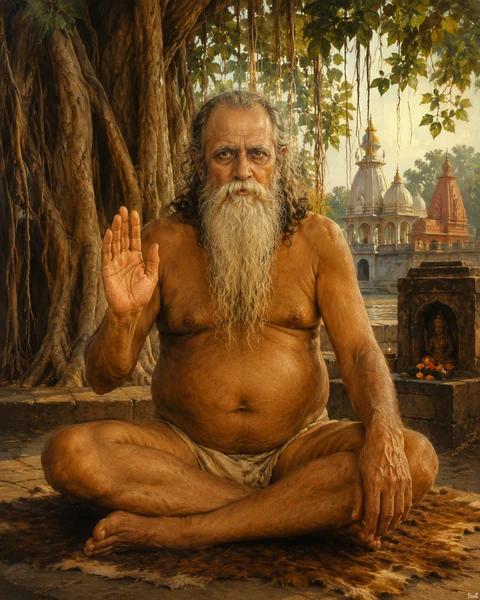
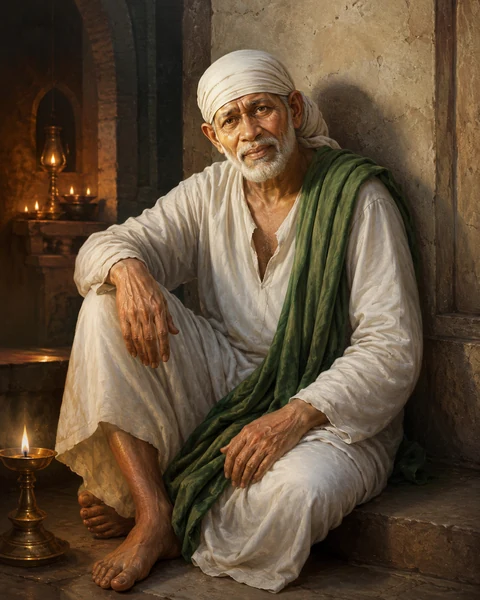
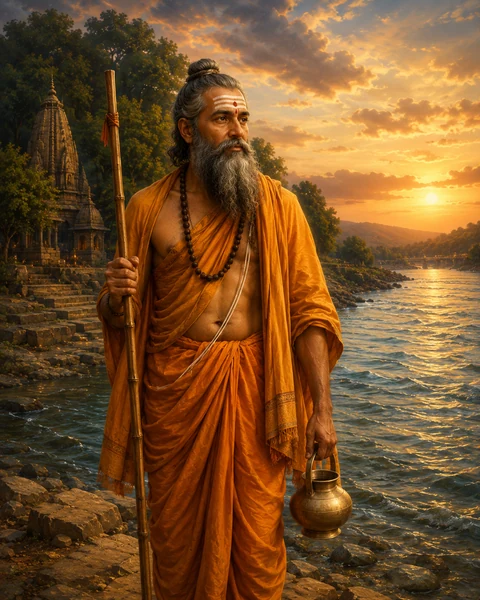
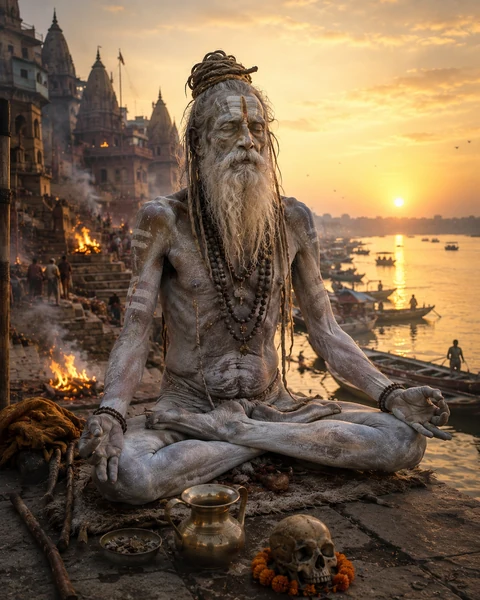
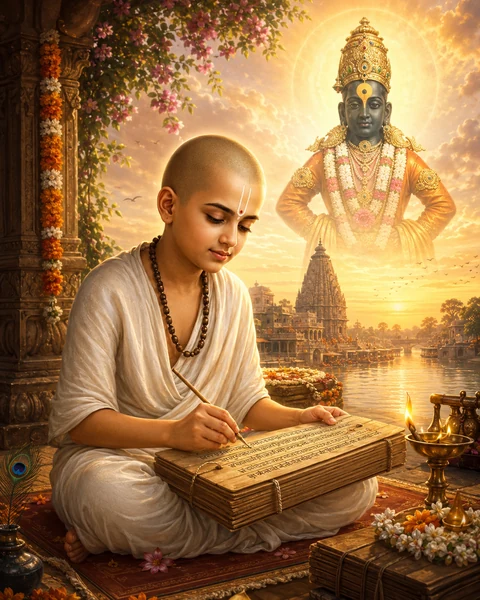
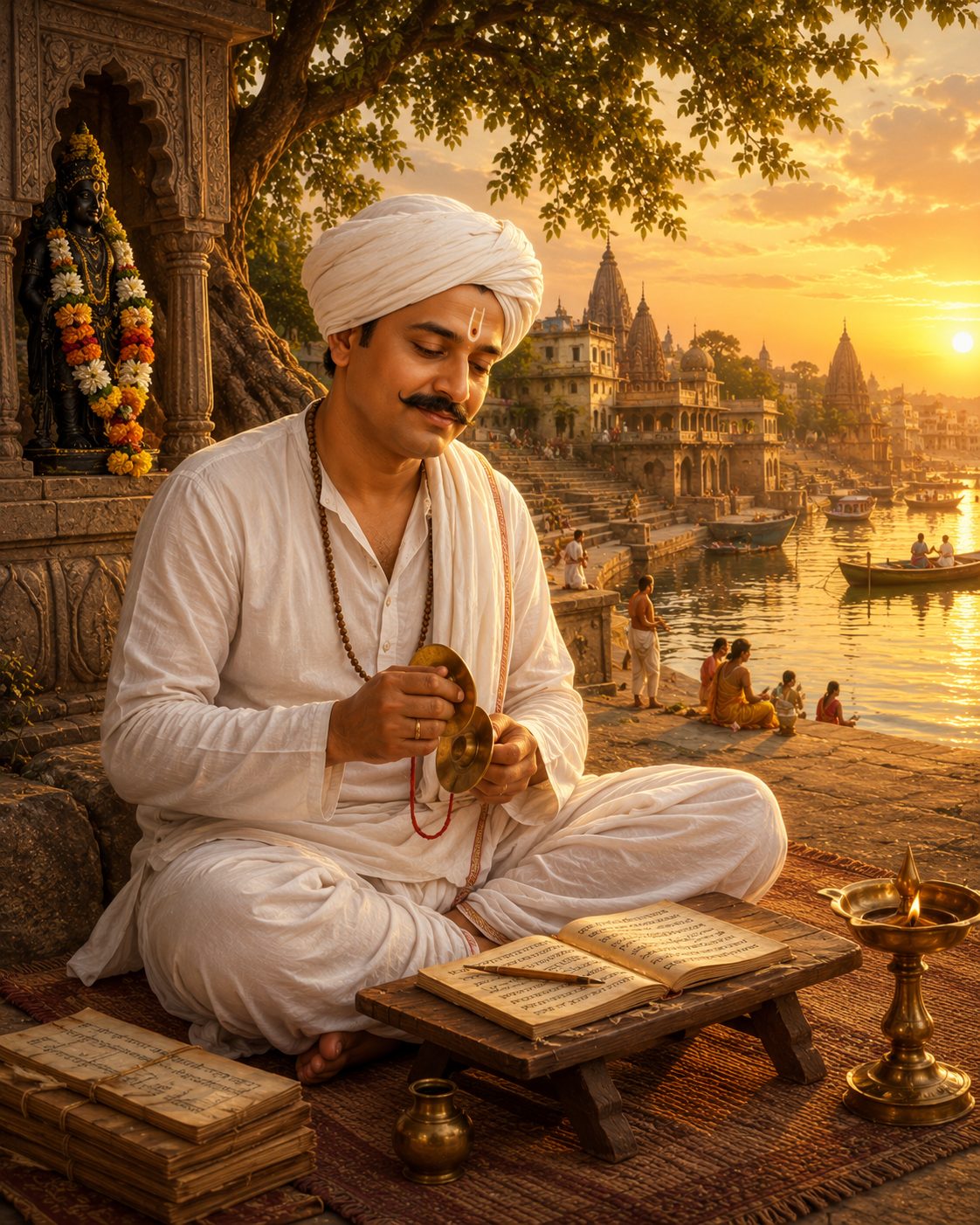
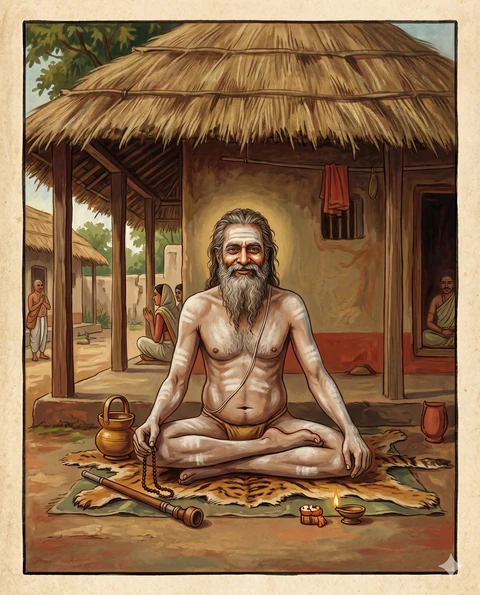
The supreme principle of Sanatana Dharma: knowledge does not transmit by reading alone. A living, realised Guru - and the unbroken parampara behind him - is the channel. Below: Guru-etymology, Guru Gita verses, the 24 Gurus of Dattatreya, and detailed biographies of 12 great Avadhutas - from Dattatreya himself down to Gajanan Maharaj.
When King Yadu asked Sri Dattatreya: "How did you attain such wisdom?", the Avadhuta replied: "I have taken 24 teachers - but not human ones. Nature itself was my Guru." This is the opening of Bhagavata Skandha 11 - a foundational meditation on observing the universe as one's teacher.
1Earth (Prithivi) · पृथिवी
Forbearance (titiksha). The earth bears all - trampling, ploughing, digging, dumping - without complaint. The sage too must bear all that the body and circumstance bring.
Non-attachment. The air passes over fragrant flowers and rotting carcasses alike, taking nothing of either. The sage moves through the world without absorbing its qualities.
Indivisibility. The sky is one even though appearing to be divided by jars and rooms. The Atman is one even though appearing as many in many bodies.
Purity and transparency. Water cleans without being stained. The sage purifies others by his mere presence yet remains unblemished.
Burning without leaving residue. Fire consumes what is offered, leaving only ash - no trace. The sage burns his karma in the fire of jnana.
Apparent change, underlying constancy. The moon waxes and wanes only in appearance; its substance is unchanging. So is the body - the Atman within does not change.
Reflection without contamination. The sun is reflected in countless pots of water and remains one. The Atman is reflected in countless minds and is unaffected.
Attachment causes destruction. The father-pigeon, distraught after the hunter caught his mate and children, threw himself into the net too. Excessive attachment to family blinds wisdom.
Contentment with what comes. The python waits motionless and eats whatever wanders into its mouth. The sage accepts what fortune brings without striving.
10Ocean (Samudra) · समुद्र
Depth and unfluctuating fullness. Rivers swell or dry; the ocean remains. The sage's depth is constant whether prosperity flows in or out.
Sense-attraction destroys. The moth, drawn to the flame, is consumed. Yielding to sense-objects (especially sight) destroys discrimination.
Take a little from each. The bee gathers nectar from many flowers without harming any. The sage takes wisdom from many scriptures and many teachers without exhausting any.
13Elephant (Hasti) · हस्ती
Lust traps the mighty. The elephant is trapped by a wooden female-decoy in a pit. Lust ensnares the strongest. Hence the sage avoids the company of women (or men, for women renunciates).
14Honey-gatherer (Madhuhara) · मधुहर
The greedy lose their hoard. The honey-gatherer steals the bee's honey; the bee dies, the man enjoys. So with the miser who hoards - others enjoy his wealth after his death. Spend in dharma while you live.
Sound-attachment traps. The deer is caught by the hunter's flute. Surrendering to seductive sounds (music, gossip, praise) leads to bondage.
Taste destroys. The fish swallows the baited hook out of taste-greed. Rasa-lolupata (tongue-greed) is the easiest path to ruin.
17Pingala (the courtesan) · पिङ्गला
Despair leads to liberation. Pingala, the courtesan of Videha, waited night after night for a customer who would pay her well. When none came, she despaired - "I have wasted my life on bodies" - and turned within. The moment she gave up hope of external satisfaction, peace dawned. Disappointment is the door to vairagya.
18Curlew bird / Kurara · कुरर
Possession invites attack. The bird carrying a piece of flesh was attacked by other birds; when it dropped the flesh, it was left in peace. Possessions invite attacks; renunciation grants safety.
19Child (Arbhaka) · अर्भक
Spontaneous joy without past or future. The child plays without remembering yesterday's hurts or anticipating tomorrow's exams. The sage too lives in the present, free of memory-burden.
20Maiden (Kumari) · कुमारी
Silence in solitude. A maiden alone in her home was pounding rice with her bangles. The bangles clanged. To avoid scandal (suitors would think she had company), she removed bangles one by one until only one remained on each wrist, making no sound. Lesson: solitude requires reducing to bare-minimum - including company. One Guru, one disciple, no crowd.
21Arrow-maker (Sharakara) · शरकार
Single-pointed focus. The arrow-maker was so absorbed in shaping an arrow that he did not notice the king's procession passing right beside him. Such ekagrata (one-pointedness) is required for samadhi.
Solitary travel, no fixed abode. The snake lives alone, sleeps in caves it does not build, never gathers possessions. The sannyasi too should be alone, parivrajaka, possessing nothing.
23Spider (Urnanabha) · ऊर्णनाभ
Creator absorbs the creation. The spider creates the web from itself and reabsorbs it. So Brahman projects the universe out of itself and withdraws it at pralaya. Saguna-Brahman creates from his own shakti.
24Caterpillar / Bhramara-kita (Wasp & worm) · भ्रमरकीट
Become what you meditate upon. The wasp captures a worm, stings it into immobility, and continuously visits it. The worm, fixated in fear on the wasp, eventually transforms into a wasp itself. The disciple meditating on the Guru becomes the Guru. "Tan-mayata" - identification by intense focus.
Each entry includes birth, parents, samadhi, miracles, teachings, mantra. Place names are provided for cultural reference; please verify before pilgrimage.
Birthplace - Mahur (Mahurgad, Nanded district, Maharashtra) - one of the 3.5 Shakti-peethas + the Datta-mula-peetha. The peak of Mahurgad is considered Dattatreya's eternal abode.
Samadhi - Has no samadhi. Believed to be eternally alive, wandering the holy peaks of Mahur, Girnar (Gujarat), Audumbar (Maharashtra), Gangapur (Karnataka), and the Himalayas. Devotees seek darshan in the form of unexpected guests, mendicants, animals.
Parents - Father: Sage Atri (one of the Saptarshi). Mother: Anasuya (the supreme pativrata, who turned the trimurti into infants when they tested her chastity, then nursed them). The trimurti became one being - Dattatreya - "datta" (given) + "atreya" (son of Atri).
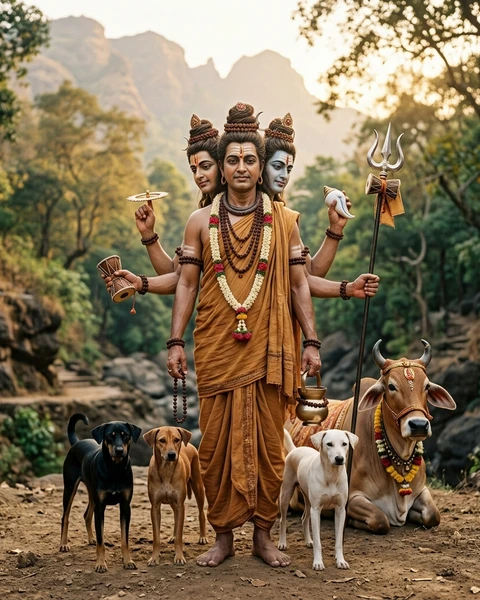
Early life - Born with the three-fold nature of Brahma-Vishnu-Shiva combined. Three heads, six arms, accompanied by 4 dogs (the 4 Vedas) and a cow (the earth). Renounced from birth - never accepted any role except that of wandering avadhuta.
Initiation - None. Self-luminous from birth - the Adi-Guru himself.
Miracles + Lilas
- Granted darshan to Parashurama on Gandhamadana mountain and taught him the Tripura Rahasya.
- Granted self-realisation to King Yadu through the discourse of the 24 Gurus (Bhagavata Skandha 11).
- Continues to test devotees by appearing in disguise - as a beggar, a drunkard, a butcher, a courtesan - to test their saraddha (faith) and bhava (devotion). Only the pure-hearted recognise him.
- Multiplied food at countless ashrams, cured leprosy, raised the dead, transformed sceptics into bhaktas.
Teachings - Authorship of the Avadhuta Gita - the supreme treatise on the avadhuta-state (8 chapters, ~289 verses, pure non-dualism). Teachings to Yadu (Bhagavata Skandha 11): "Brahman is everywhere; the universe itself is your Guru. Observe 24 things in nature and you have all of Vedanta." Authorship attributed to him for the Jivanmukti-Viveka and Tripura Rahasya.
Mantra - Mool mantra: ॐ द्रां दत्तात्रेयाय नमः (Om Draam Dattatreyaya Namah). Bija: द्रां (Draam). Gayatri: ॐ दत्तात्रेयाय विद्महे दिगम्बराय धीमहि तन्नो दत्तः प्रचोदयात्॥
Legacy - Adi-Guru of the Avadhuta tradition. Datta Jayanti: Margashirsha Purnima - celebrated across Maharashtra, Karnataka, Andhra, Goa, Konkan. Major kshetras: Mahur, Girnar, Audumbar, Gangapur, Kuravapur, Pithapuram, Narsobawadi, Varadahalli.
Birthplace - Pithapuram (Pithikapuram, East Godavari district, Andhra Pradesh) - the home of his parents Apalaraja and Sumati. Now a major Datta pilgrimage centre with a Sripada Vallabha samsthanam.
Samadhi - Entered samadhi at Kuravapur (Kuruvapuram, a tiny island in the Krishna river on the Andhra-Karnataka border) at age 30. Believed not to have died but to continue offering darshan to devotees on the island.
Parents - Father: Apalaraja Sharma (a learned brahmin). Mother: Sumati Maharani (a great pativrata who fed Datta in beggar-form and received his boon).
Early life - Born by the boon of Dattatreya (who appeared as a wandering ascetic and was fed by Sumati on a shraddha day). Spoke spiritual truths as a child. At age 7, after upanayana, performed the Veda recitation with such authority that the elders prostrated. Renounced at age 16 and walked to Kashi.
Initiation - Self-initiated - recognised as the first Datta-avatar of the historical (post-Vedic) era. Considered a direct emanation of Dattatreya.
Miracles + Lilas
- Cured a poor washerman (a former king cursed for past sins) and restored his royal jiva-vasana in his next birth as the founder of the Vasavi Kanyaka community.
- Restored a brahmana's dead son to life at Kuravapur. The boy had drowned in the Krishna; Sripada simply called "Wake up!" and the boy stood up.
- Multiplied the grain of a niggardly householder 8-fold after the man honoured the avadhuta's begging request.
- Cured leprosy of a brahmin by mere darshan.
- Predicted his own next incarnation (as Narasimha Saraswati) at the time of his samadhi: "I shall return in 28 years at Karanja Lad."
Teachings - No written text. Taught by darshan, mauna, and miracles. Emphasised: (1) Datta-bhakti above all; (2) Anushthana - daily japa of Datta-mantra; (3) Annadana - feeding the hungry; (4) Pitri-tarpana on amavasya days.
Mantra - Sripada-mantra: ॐ श्रीपाद श्रीवल्लभाय नमः (Om Shripada Shrivallabhaya Namah).
Legacy - First historical Datta-avatar. Pithapuram + Kuravapur are the two principal Sripada-kshetras. Devotees perform parikrama between the two during Datta Jayanti week. The Sripada Sri Vallabha Charitamrutam (Telugu, c. 18th C, by Shankar Bhatt) is the principal biographical source.
Birthplace - Karanjapura (modern Karanja Lad, Washim district, Maharashtra). Born to a Smarta brahmana family of the Apastamba-shakha.
Samadhi - At age 80, walked into the Kardali-vana (banana grove) at the foot of Sri Shaila mountain (Kurnool district, Andhra Pradesh). Declared: "I shall not die. I enter nija-ananda-samadhi. Seek me here." Believed to still be in continuous samadhi - Sri Swami Samartha of Akkalkot is held to be the same Narasimha Saraswati emerging from this samadhi after ~370 years.
Parents - Father: Madhava (brahmin). Mother: Amba-bai. Birth-name: Narahari.
Early life - Born with full teeth and a fully-developed tongue. From birth until age 7, the only syllable he uttered was "Om". At age 7, after upanayana and brahmopadesa, he began to speak in fluent Sanskrit and proceeded to recite the four Vedas + six Vedangas from memory - astonishing the assembly. Declared his renunciation. His mother wept; he consoled her: "Mata, do not grieve. I shall not be separated from you. Remember me, and I shall come."
Initiation - Took sannyasa-diksha at age 7 from Sri Krishna Saraswati (a senior avadhuta of the Saraswati-dashanami order) at Kashi. Given the name Narasimha Saraswati.
Miracles + Lilas
- Travelled across Maharashtra and Karnataka - established Audumbar (a sangam of the Krishna and an audumbara-vriksha) as a Datta-kshetra.
- Settled 12 years at Narsobawadi (Nrisinha-wadi, on the confluence of Krishna and Panchaganga). Massive miracles. The niggardly householder's grain-stores filled 8-fold.
- At Ganagapura (modern Gulbarga district, Karnataka), pacified a Yavana (Bahmani) king who had threatened brahmanas - appeared in the king's dream and turned his sword to flowers.
- Restored a dead brahmana's son to life at Ganagapura via a 7-day Saptaha-Parayana of his own (yet-to-be-composed) Charitre.
- Walked into Kardali-vana at age 80 - declared in advance that he was not dying but entering eternal samadhi. Believed to still be available to those who reach Kardali-vana in pure faith.
Teachings - Taught primarily by living example. Established the Saptaha-Parayana method (7-day recitation of the Sri Guru Charitre - though the text was composed later by Saraswati Gangadhar, the framework was instituted by Narasimha Saraswati). Emphasised: (1) Anushthana - strict daily rituals; (2) Anna-dana on Thursdays; (3) Pilgrimage to the Datta-kshetras (Audumbar, Narsobawadi, Ganagapura, Pithapuram, Kuravapur).
Mantra - Narasimha Saraswati mantra: ॐ श्री नृसिंह सरस्वत्यै नमः (Om Shri Nrisimha Saraswatyai Namah). Ganagapura nirgun-paduka mantra: दिगंबरा दिगंबरा श्रीपाद वल्लभ दिगंबरा (Digambara Digambara Shripada Vallabha Digambara).
Legacy - Second Datta-avatar of the historical era. Ganagapura is the supreme Datta-kshetra of South India - pilgrims fast on Thursdays, bathe in the Bhima-Amarja sangam, and offer prasadam at his nirgun-padukas. The Sri Guru Charitre (53 adhyayas, Saraswati Gangadhar, 1538 CE) is his definitive biography. Sri Swami Samartha of Akkalkot is believed to be his post-samadhi continuation.
Birthplace - Born 7 December 1908 at Lad-Chinchili village (formerly Belgaum district, Karnataka - now in Bagalkote/Belgaum region). Birth-name: Sridhara Bhat (some sources: Krishna Bhat). Brahmin family of the Apastamba-shakha.
Samadhi - Entered nija-ananda-samadhi on 19 April 1973 (Vaishakha Krishna Trayodashi, Friday) at Varadahalli, Sagara taluk, Shimoga district, Karnataka. Pre-announced the moment to his disciples; entered samadhi seated. The samadhi-mandir is the most-visited Datta-pilgrimage centre of South Karnataka.
Parents - Father: Naryana Bhat. Mother: Kamalabai. Lost his mother while still a child - this early grief deepened his vairagya.
Early life - Spiritually precocious from age 5 - drew Om and Sri-yantras on the floor. Recited the Bhagavad Gita from memory by age 9. At age 17, walked from his village to Sajjanagad (Sant Ramdas Samartha's samadhi near Satara, Maharashtra) on foot, in a single year, sustained only by alms.
Initiation - Took sannyasa-diksha in 1942 at Shigehalli (near Sirsi, Uttara Kannada, Karnataka) from Sri Shivananda Swamigalu - Swami Shivananda Saraswati of the Shigehalli matha - into the Advaita sampradaya, and was honoured with the title "Shrimat Paramahamsa Parivrajakacharya Bhagavan Sri Sridhara Swami." A lifelong upasaka of Samartha Ramdas and the Dasbodh.
Miracles + Lilas
- Walked the entire Indian sub-continent approximately 5 times in 30 years as a strict parivrajaka - never staying more than 3 nights in one place. Survived on alms, no money, no possessions beyond his danda and kamandalu.
- Refused all photograph and film capture for the first 40 years of his sannyasa. The first photo taken (1957) was developed only after his explicit permission was granted years later.
- At Varadahalli, drew water from a dry well by mere sankalpa during a drought year - the well has remained perennial since.
- Cured chronic illnesses of disciples by mere darshan or by sending vibhuti. Numerous documented cases in the disciple-biographies.
- Pre-announced his samadhi date 7 years in advance (1966). His samadhi was prepared by himself and Sri Bhima Bhatta during the final 2 years.
Teachings - Strict Advaitin in philosophy; practical Datta-bhakta in devotion; Rama-bhakta in chanting (carrying forward Sant Ramdas's Rama-bhakti from Sajjanagad). Five-fold sadhana: (1) atma-nishtha - abidance in the Self; (2) seva - practical service; (3) anushthana - daily ritual and japa; (4) sad-grantha-pathana - daily reading of sacred texts; (5) brahmacharya for sannyasins, dharma-niyama for householders.
Mantra - Sri Shridhara mantra: ॐ श्री श्रीधराय नमः (Om Shri Shridharaya Namah). Daily japa recommended by him: श्री राम जय राम जय जय राम (Sri Ram Jaya Ram Jaya Jaya Ram).
Legacy - The most prominent 20th-century Datta-avatar of Karnataka. Author of the 21-volume Sri Shridhara Granthamala - including Bhagavad Gita Bhashya (Kannada commentary), Krishna Karnamrita Bhashya, Sri Sai Charitra Bhashya, Bhagavata-Manjari, Datta-Pranava, and numerous Sanskrit + Kannada stotras. Varadahalli samadhi-mandir draws lakhs annually for Datta Jayanti (Margashirsha Purnima) and his Punyatithi (19 April). Padukas at Varadahalli and Sajjanagad.
Birthplace - Birth-place officially unknown - believed by tradition to be Sri Narasimha Saraswati himself, emerging from Kardali-vana nija-ananda-samadhi (1458) after ~370 years. First publicly appeared at Akkalkot (Solapur district, Maharashtra) in 1857.
Samadhi - Mahasamadhi at Akkalkot on 30 April 1878 (Chaitra Vadya 13, Tuesday). His last words: "Phir milenge - vatavruksha maharaj" ("We shall meet again - at the banyan tree"). The samadhi-mandir at Akkalkot is one of India's most-visited Datta-kshetras, drawing lakhs daily.
Parents - Unknown by historical record. Tradition identifies him with Sri Narasimha Saraswati.
Early life - Before his appearance at Akkalkot, he was sighted at various places - Mangalvedha (where he stayed ~12 years), Pandharpur, Mohol. At all these places he was known by different names: Chanchal Bharti, Digambar Swami, Dakurkar Maharaj. His true identity emerged only at Akkalkot.
Initiation - No diksha-guru known - considered self-existent (svayam-prakata). When asked about his lineage, he would point silently to the sky.
Miracles + Lilas
- Cured incurables - leprosy, tuberculosis, mental illness - by mere darshan, by giving vibhuti, or by giving a piece of his own bidi/chillim.
- Prophesied to Sri Sai Baba of Shirdi when Sai (as a young man) came to Akkalkot: "Go to Shirdi. Your work is there. We are one."
- Multiplied food for thousands of devotees on hundreds of occasions - a handful of rice fed crowds.
- Read minds and answered un-asked questions. Spoke in any language the questioner used - Marathi, Kannada, Telugu, Hindi, Sanskrit, sometimes Arabic.
- Pre-announced his mahasamadhi to the day. On the morning of 30 April 1878, said: "I am tired. Today I leave." Sat under his vatavruksha and left the body.
Teachings - Taught primarily by darshan, presence, and short cryptic utterances. Recurring phrase: "Bhiyu nakos. Me tujhya pathishi aahe" ("Don't fear. I am behind you."). Emphasised: (1) Unwavering faith in the Guru; (2) Daily seva - feeding others; (3) No fancy sadhana - simple anushthana + complete surrender.
Mantra - Swami Samartha mantra: श्री स्वामी समर्थ जय जय स्वामी समर्थ (Sri Swami Samartha Jaya Jaya Swami Samartha).
Legacy - The most-revered Datta-avatar of the modern period in Maharashtra-Karnataka. Akkalkot samadhi-mandir is the third most-visited Datta-kshetra after Ganagapura and Audumbar. His parampara - through Bhau Maharaj Khanderiya, Cholappa Maharaj, Sri Ananda Sagar, and others - extends into the 20th and 21st centuries.
Birthplace - Birth-place historically uncertain. Two traditions: (1) Pathri village in Parbhani district (Maharashtra) - confirmed by post-1990 research; (2) Brahmin family of unknown name. He himself never disclosed.
Samadhi - Mahasamadhi at Shirdi (Ahmednagar district, Maharashtra) on 15 October 1918 (Vijayadashami day). Samadhi-mandir at Shirdi is among India's three most-visited shrines (alongside Tirupati and Vaishno Devi).
Parents - Officially unknown. He arrived at Shirdi as a teenager (c. 1858) and gave no genealogy. Said to be Datta-avatar by his devotees; said to be Sufi pir by Muslim devotees; he himself transcended both labels.
Early life - Arrived at Shirdi village around age 16 - appeared seated under a neem tree, eyes closed in meditation. When the villagers approached, he gave one word: "Sai" (Persian for saint). Lived at first under the neem tree, then in the dilapidated mosque he renamed Dwarakamai ("Mother of Dwaraka").
Initiation - Tradition holds he was initiated by Sri Venkusa of Selu (a sufi-vedantin guru). Sri Swami Samartha of Akkalkot is also said to have recognised him as an equal avatar.
Miracles + Lilas
- Cured incurables - cholera, smallpox, paralysis, blindness, mental illness - by udi (sacred ash from the dhuni-fire he kept perpetually burning), by darshan, by bhaji-prasad.
- Materialised water by striking the ground; turned water into oil and lit lamps with it when the merchant refused him oil.
- Bilocated and even multi-located - devotees report him appearing in 3 cities on the same day at the same hour.
- Read minds. Knew the past, present, and future of every devotee who came. Often answered questions before they were asked.
- Pre-announced his mahasamadhi. On Vijayadashami 1918, said: "I am leaving the body. But do not weep - my tomb shall speak. Live the life I have shown." Left the body seated on Tatya Patil's lap.
Teachings - Famous central teaching: "Sabka malik ek" ("The Lord of all is One"). Brought Hindu and Muslim devotees to the same dhuni-fire - Hindu pujari and Muslim faqir prayed side by side at Dwarakamai. Eleven sayings (Sai Baba's 11 Vachanas) form the daily creed of his devotees. Emphasised: (1) Shraddha (faith); (2) Saburi (patience); (3) Anna-dana (food-giving); (4) Daridra-narayana-seva (service to the poor).
Mantra - Sai mantra: ॐ साईं श्री साईं जय जय साईं (Om Sai Shri Sai Jaya Jaya Sai). Bhajan-mantra: ॐ साईं राम (Om Sai Ram). Sai Gayatri: ॐ शिर्डीवासाय विद्महे सच्चिदानन्दाय धीमहि तन्नो साईं प्रचोदयात्॥
Legacy - The most-popular saint-figure of 20th century India. Sai Satcharitra (Hemadpant / Govind Raghunath Dabholkar, 1929) is his definitive biography (53 chapters in Marathi). Shirdi's daily darshan exceeds 60,000 pilgrims; on festival days, 4-5 lakh. Devotees include Hindus, Muslims, Christians, Sikhs, Parsis. Identified by many Datta-bhaktas as the 5th major Datta-avatar of the historical era.
Birthplace - Born 13 August 1854 at Mangaon village (Sindhudurg district, Konkan, Maharashtra). Birth-name: Vasudev Ganesh Tembe. Chitpavan brahmin family of strict Vedic orthodoxy.
Samadhi - Mahasamadhi at Garudeshwar (on the Narmada, Narmada district, Gujarat) on 23 June 1914 (Ashadha Shukla Pratipada). Samadhi-mandir at Garudeshwar - pilgrims circumambulate the Narmada and visit on Datta Jayanti.
Parents - Father: Ganesh Bhat Tembe. Mother: Ramabai. Married at young age (per Chitpavan custom) - wife passed away early.
Early life - Spiritually precocious. Married twice in youth - both wives died early, which deepened his vairagya. Studied Sanskrit, Vedanta, Mimamsa, Jyotisha rigorously. At ~age 40 took sannyasa-diksha from Sri Narayan Saraswati at Ujjain. Given name Vasudevananda Saraswati.
Initiation - Sannyasa-diksha at Ujjain (~1894) from Sri Narayan Saraswati (Dashanami Saraswati order, Vyasa-Shankara lineage).
Miracles + Lilas
- Cured a leper at Mangaon by mere touch - the man went on to become a senior disciple.
- Restored a brahmin's drowned son at Garudeshwar by going into the Narmada and bringing him up.
- Performed Datta-yajna at Garudeshwar that drew brahmanas from across India - multiplied yajna-rice to feed thousands.
- Wrote prolifically in Sanskrit and Marathi while travelling (no permanent ashram for most of his life).
- Pre-announced his samadhi date and time. Sat in padmasana on the Narmada-tat and entered samadhi on Ashadha Shukla Pratipada.
Teachings - The first major Datta-avatar of the modern period to compose substantial Sanskrit and Marathi texts. Strict orthodox brahmin avadhuta - insisted on full Vedic ritual, sandhya-vandana, and varna-ashrama observance for his householder-disciples. Five-fold practice: (1) Daily sandhya; (2) Datta-mantra-japa; (3) Anna-dana; (4) Saptaha-Parayana of Sri Guru Charitre; (5) Narmada-parikrama at least once in a lifetime.
Mantra - Tembe Swami mantra: ॐ वासुदेवानन्द सरस्वत्यै नमः (Om Vasudevananda Saraswatyai Namah).
Legacy - Author of Datta Purana (12 skandhas, Sanskrit, 1900), Datta Mahatmya, Datta-Lila-Amrut, Saptashati-Guru-Charitra Sara, Sri Gurudeva-Stavah, and ~50 other works. Garudeshwar samadhi-mandir is a primary Datta-kshetra of Gujarat. His writings are the bridge between the medieval Sri Guru Charitre and the modern Datta-sahitya tradition.
Birthplace - Born 1607 at Vizianagaram (Holy-narsipur region, said to be in present-day Andhra Pradesh or Karnataka - accounts vary). Telugu brahmin family. Birth-name: Shivaramaiya.
Samadhi - Mahasamadhi at Kashi (Varanasi) on 26 December 1887. Samadhi-mandir at Panchaganga Ghat, near Manikarnika in Varanasi. Lived in Varanasi for the last ~150 years of his life, openly seen by lakhs of pilgrims - well-documented by 19th-century travellers, photographers, and householder-devotees.
Parents - Father: Narasimha Rao. Mother: Vidyavati. Both passed when he was in his 40s - at which point he renounced.
Early life - Spent ~40 years as a householder before renouncing. After his parents' death, took sannyasa at age 78 from Sri Bhagiratananda Saraswati at Pushkar. Then wandered the Himalayas for ~30 years before settling at Kashi around 1737.
Initiation - Sannyasa-diksha at age 78 (~1685) from Sri Bhagiratananda Saraswati at Pushkar (Dashanami Saraswati order).
Miracles + Lilas
- Lived primarily on the cremation-ghats of Kashi (Manikarnika, Harishchandra) - naked digambara, often seated on a corpse-pyre or on the river-bank in meditation.
- Was seen floating on the Ganga for hours, on his back, perfectly motionless - eyes closed, body unaffected by current.
- Drank a vessel of milk poisoned by a sceptical British officer - and was unaffected. The officer's servant who had prepared the milk, however, fell ill.
- Sri Ramakrishna Paramahamsa came to Varanasi in 1868 and met Trailanga Swami. They sat together in silent samadhi. Ramakrishna later said: "He is the walking Shiva of Banaras. Whatever Shiva is, he is."
- Pre-announced his samadhi. On 26 December 1887, indicated to his attendants that he was leaving. Sat in padmasana on the ghat and entered samadhi at age 280.
Teachings - Spoke very little - long periods of complete silence. When he did speak, it was in Telugu, Sanskrit, or Hindi - short, cryptic, Advaitic. Sometimes communicated only by writing on the ground in chalk. Author of Mahavakya-Ratnavali (40 verses, Sanskrit). Emphasised: (1) Kashi-vasa - the holiness of Varanasi; (2) Renunciation of all conventional restrictions for the avadhuta; (3) Direct perception of Shiva in all forms.
Mantra - Trailanga mantra: ॐ त्रैलङ्गाय नमः (Om Trailangaya Namah). Recommended Kashi-mantra: काशी विश्वनाथाय नमः (Kashi Vishvanathaya Namah).
Legacy - The most-famous naked-avadhuta of modern Kashi. Photographs of him (taken in the 1870s-1880s) survive - showing a tall, white-bearded, completely-naked sage seated by the Ganga. The Panchaganga Ghat samadhi is still active. His direct disciple Sri Ganapati Sarasvati continued the line.
Birthplace - Born 1275 CE at Apegaon (Paithan taluk, Aurangabad district, Maharashtra) - a small village on the Godavari river. Brahmin family of the Yajurveda-shakha. Birth-name: Jnanadeva.
Samadhi - Entered live-samadhi (sanjeevan-samadhi - entering samadhi while still in the body) at Alandi (Pune district, Maharashtra) on Kartika Vadya Trayodashi, 1296 CE - at age 21. The Alandi samadhi-mandir is among the supreme pilgrimage centres of Maharashtra. The annual Wari (foot-pilgrimage from Alandi to Pandharpur) carries his padukas.
Parents - Father: Vitthalpant Kulkarni. Mother: Rukmini-bai. Both parents were excommunicated by orthodox brahmins for Vitthalpant's earlier sannyasa-then-return to householder-life. The four children - Nivritti (elder brother + guru), Jnaneshwar, Sopan, Mukta-bai - were treated as outcastes. The parents eventually drowned themselves in the Indrayani at Tryambakeshwar to save the children from social stigma.
Early life - Raised in deep poverty and social ostracism. The four siblings were refused upanayana and Veda-adhikara by the local brahmins. They appealed to a council at Paithan - Jnaneshwar made a buffalo recite the Vedas to prove that Atman is in all beings, and won the case for vidya-adhikara.
Initiation - Diksha-guru: his own elder brother Sri Nivritti Nath, who had received Nath-sampradaya initiation from Gahini Nath (a direct disciple of Gorakhnath, Adi-Nath lineage from Matsyendranath).
Miracles + Lilas
- Made a buffalo recite the Vedas at Paithan to refute orthodox brahmins who denied him vidya-adhikara.
- Wrote the Jnaneshwari (Bhavartha-Dipika) - a 9000-ovi Marathi commentary on the Bhagavad Gita - at age 16. The supreme literary monument of Marathi Bhakti and Advaita.
- Made a wall walk to receive a yogi-guest (Chang-deva Maharaj, said to be 1400 years old by yogic siddhi). Chang-deva, riding a tiger with a snake-whip, was humbled by the wall-riding 14-year-old; he became Jnaneshwar's disciple.
- Composed the Anubhavamruta (Amrutanubhava) - 800 verses on Advaita-vedanta - and the Haripatha (28 abhangs of Vitthal-bhakti).
- Pre-announced his sanjeevan-samadhi 3 months in advance. Pilgrims gathered. He entered the samadhi-pit at Alandi, sat in padmasana, gave final blessings, and was sealed in. Devotees believe he is still alive in samadhi.
Teachings - Synthesised Nath-yoga + Advaita-vedanta + Vithoba (Krishna)-bhakti. The Jnaneshwari is the foundational Marathi spiritual text - every line of the Gita expanded with profound, lyrical, Marathi commentary. Founded the Varkari-sampradaya (Pandharpur-walking-pilgrim tradition) along with his contemporary Sant Namdev.
Mantra - Jnaneshwar's central abhang-line: ज्ञानदेवो म्हणे विठ्ठलाची भेटी ("Jnanadev says - meeting with Vitthal"). Recommended mantra: ॐ ज्ञानेश्वराय नमः (Om Jnaneshwaraya Namah). Pandharpur-mantra: विठ्ठल विठ्ठल जय हरि विठ्ठल (Vitthal Vitthal Jaya Hari Vitthal).
Legacy - The supreme jagad-guru of Marathi Bhakti. Founder of the Varkari tradition. Author of Jnaneshwari, Amrutanubhava, Haripatha, Changdev Pasashti. Alandi sanjeevan-samadhi mandir is the primary kshetra. The annual Pandharpur Wari (carrying his padukas + Tukaram's padukas from Alandi + Dehu) draws 10+ lakh pilgrims each Ashadha.
Birthplace - Born 1533 at Paithan (Aurangabad district, Maharashtra) - the same town where Jnaneshwar made the buffalo recite the Vedas. Brahmin family of the Deshastha-Rigvedi shakha. Birth-name: Eknath.
Samadhi - Entered jala-samadhi (water-samadhi) at Paithan in the Godavari river on Phalguna Vadya Shashti, 1599 CE. Samadhi-mandir at Paithan; the river-spot is marked. Annual punyatithi attracts thousands.
Parents - Lost both parents in early childhood. Raised by his paternal grandfather Chakrapani - a noted Sanskrit scholar of Paithan. Childhood marked by deep bhakti - recitation of Bhagavata and Sri Guru Charitre from age 6.
Early life - Spiritually mature from childhood. At age 12, walked from Paithan to Devagiri (Daulatabad) - about 80 km - to find his guru Sri Janardan Swami, a Datta-bhakta who was a treasury-official of the Nizam Shah.
Initiation - Diksha-guru: Sri Janardan Swami of Devagiri (a direct disciple of Narahari Sonar, who was in the Datta-Nath lineage). Eknath served Janardan for 6 years as personal attendant - sweeping, cooking, doing accounts - before receiving spiritual initiation.
Miracles + Lilas
- Wrote Eknathi Bhagavata - a 12,000-ovi Marathi commentary on Bhagavata Skandha 11 (Krishna-Uddhava-Samvada) - at the explicit command of Janardan Swami.
- Wrote Bhavartha Ramayana - a complete Marathi Ramayana - as a continuation of Eknathi Bhagavata. (Composed up to the Yuddha Kanda; completed by his son Hari Pandit after his samadhi.)
- Carried a sick untouchable boy on his shoulders to Paithan-ghat for daily bath - orthodox brahmins shunned him but he persisted, declaring "Atman is in all".
- Fed brahmanas in his courtyard along with all castes simultaneously - a revolutionary act in 16th-century brahmin Paithan. Was excommunicated; he simply absorbed the punishment with grace.
- Composed ~300 abhangs in Marathi (the Eknathi-Bhajan corpus) on Vitthal, Krishna, Datta, and the householder-saint path.
Teachings - Founded the householder-saint (grihastha-sannyasi) path. Showed by living example that one can be a married householder, run a family, and yet be a fully-realised saint. The five-fold daily practice: (1) Sandhya-vandana; (2) Bhagavata-pathana; (3) Datta-mantra-japa; (4) Anna-dana; (5) Bhajan in the evening with family. His Marathi works (Eknathi Bhagavata, Bhavartha Ramayana, Rukmini Swayamvara) carry forward the Jnaneshwari lineage.
Mantra - Eknath mantra: ॐ श्री एकनाथाय नमः (Om Shri Eknathaya Namah). Bhajan: एकनाथ हरि एकनाथ (Eknath Hari Eknath).
Legacy - The supreme householder-saint of the Varkari tradition. Bridge between Jnaneshwar (13th C) and Tukaram (17th C). His Eknathi Bhagavata is the supreme Marathi devotional text after the Jnaneshwari. Paithan samadhi-mandir continues to draw devotees on Phalguna Vadya Shashti annually.
Birthplace - Born 1608 at Dehu (Pune district, Maharashtra) - on the Indrayani river. Kunbi (cultivator) family of the Maore (More) clan. Birth-name: Tukaram Bolhoba Ambile.
Samadhi - Vaikuntha-prayana ("departure to Vaikuntha") at Dehu on Phalguna Vadya Dwitiya, 1649 CE - at age 41. Tradition holds that he was bodily taken to Vaikuntha by Vishnu's vimana (no corpse was ever found). Dehu samadhi-spot is marked on the Indrayani bank.
Parents - Father: Bolhoba Ambile (cultivator). Mother: Kankai. Lost both parents in his teens. His elder brother Savaji left home for sannyasa. Tuka inherited the family farm + responsibility for younger siblings + first wife Rakhumai (who died in a famine) + second wife Jijabai.
Early life - Suffered terrible adversity: (1) Both parents died young; (2) First wife and eldest son died in the 1629 famine; (3) Farm failed; (4) Debts mounted. In the depths of this suffering, he climbed Bhandara mountain (Bhandara Daongar, near Dehu) and wept for Vitthal. Vitthal appeared and granted him bhakti.
Initiation - No formal human diksha-guru. Tukaram had a dream-vision (svapna-diksha) in which Sri Babaji Chaitanya (a saint of the Nath-lineage descending from Raghav Chaitanya) appeared and gave him the Rama-Krishna mantra. He always considered Vitthal himself his Sadguru.
Miracles + Lilas
- Composed ~5000 abhangs in colloquial Marathi - the supreme corpus of Bhakti-poetry in any Indian language.
- When orthodox brahmins (led by Rameshwar Bhatt of Wakhari) declared his abhang-manuscripts heretical and made him drown them in the Indrayani, Tukaram fasted for 13 days on the river-bank. The abhangs floated back up from the river intact - Vitthal had preserved them. Rameshwar Bhatt became a disciple.
- Was visited by Chhatrapati Shivaji Maharaj - declined his gift of gold-coins, saying "Vitthal is my wealth". Shivaji prostrated and left.
- Fed a man-eating tiger that came to his door - by feeding it gently, the tiger left without harming anyone.
- Vaikuntha-prayana: On Phalguna Vadya Dwitiya 1649, in front of his family and many devotees, a celestial vimana (chariot of light) descended at Dehu. Tukaram stepped onto it. The vimana ascended. No body, no corpse - only his cloth and rosary remained. Witnessed by hundreds.
Teachings - Pure Vitthal-bhakti in colloquial Marathi - accessible to farmers, women, children, untouchables. His abhangs are sung daily across Maharashtra. Emphasised: (1) Naam-sankirtana - chanting Hari's name; (2) Sad-sanga - keeping company of saints; (3) Sahaja-bhava - natural, untroubled devotion; (4) No caste, no ritual hierarchy - "vitthal is in your heart". Carried forward the Jnaneshwar-Eknath Varkari lineage.
Mantra - Tuka's central abhang-line: तुका म्हणे ज्ञान विठ्ठल विठ्ठल ("Tuka says - knowledge is Vitthal-Vitthal"). Mantra: ॐ श्री तुकारामाय नमः (Om Shri Tukaramaya Namah). Pandharpur naam: विठ्ठल विठ्ठल जय हरि विठ्ठल (Vitthal Vitthal Jaya Hari Vitthal).
Legacy - The greatest Marathi Bhakti poet. His ~5000 abhangs are the supreme devotional corpus of Marathi. Dehu samadhi-mandir + the Tukaram-Beej (his vaikuntha-prayana day) draw lakhs. The annual Wari (Dehu-Alandi-Pandharpur foot-pilgrimage) carries his padukas alongside Jnaneshwar's. Sant Tukaram + Sant Jnaneshwar are the twin pillars of the Varkari tradition.
Birthplace - Birth-place unknown. Appeared mysteriously at Shegaon village (Buldhana district, Vidarbha, Maharashtra) on Magha Vadya Saptami, 1878 CE - seen for the first time eating leftover rice from a discarded thali behind a hotel.
Samadhi - Mahasamadhi at Shegaon on 8 September 1910 (Bhadrapada Shukla Rishi-panchami, Thursday). Samadhi-mandir at Shegaon is a primary Datta-kshetra of Vidarbha, drawing lakhs annually - managed today by the Sri Gajanan Maharaj Sansthan Shegaon trust.
Parents - Officially unknown. Like Sri Swami Samartha, he never disclosed his origin. Devotees consider him svayam-prakata (self-manifest).
Early life - Appeared as a fully-formed avadhuta at Shegaon - no childhood, no parents, no village-origin known. First witnessed eating leftover rice; the witness (Bankatlal Agasaram, a Shegaon merchant) recognised him as a great soul and prostrated. Bankatlal became his first major bhakta.
Initiation - No diksha-guru known. Said to be a direct Datta-vibhuti - the next link after Sri Sai Baba and Sri Akkalkot Swami.
Miracles + Lilas
- Lit a chillim (clay-pipe for smoking) by sprinkling cold water on it - a famous miracle witnessed by hundreds. Tradition: "the chillim that never went out".
- Multiplied food on countless occasions - a small quantity of bhakri (millet-bread) fed crowds of 500+ devotees.
- Cured a leprosy patient who came begging - wiped his hand on the leper's wounds, the wounds closed instantly.
- Vanished from one place and appeared in another within minutes - bilocation documented by separate eye-witnesses at Shegaon, Akola, Pandharpur.
- Pre-announced his samadhi 1 month in advance. On 8 September 1910, sat in padmasana, gave final blessings, said "Gan Gan Ganat Bote" (his recurring nirgun-mantra), and entered samadhi. Was sealed into the samadhi-pit at Shegaon.
Teachings - Spoke very little - frequently uttered only one phrase: "Gan Gan Ganat Bote" (a cryptic Marathi-Vedic chant of unknown precise meaning, treated as his mool-mantra). Taught by darshan, presence, and miracles. Emphasised: (1) Anna-dana on a massive scale (his sansthan today runs free-food kitchens for 30,000+ daily); (2) Daridra-narayana-seva; (3) Total surrender to the Guru.
Mantra - Gajanan Mool Mantra: गण गण गणात बोते (Gan Gan Ganat Bote). Mantra: ॐ श्री गजानन महाराजाय नमः (Om Shri Gajanan Maharajaya Namah).
Legacy - The supreme Datta-vibhuti of Vidarbha. His Vijay Granth (Sant Dasganu Maharaj, 1939, in 21 adhyayas) is the definitive biography. Shegaon samadhi-mandir + the Sansthan today run schools, hospitals, free-food kitchens, and a major Datta-temple complex. Annual Punyatithi (Rishi-panchami, Bhadrapada Shukla 5) draws 10+ lakh pilgrims.