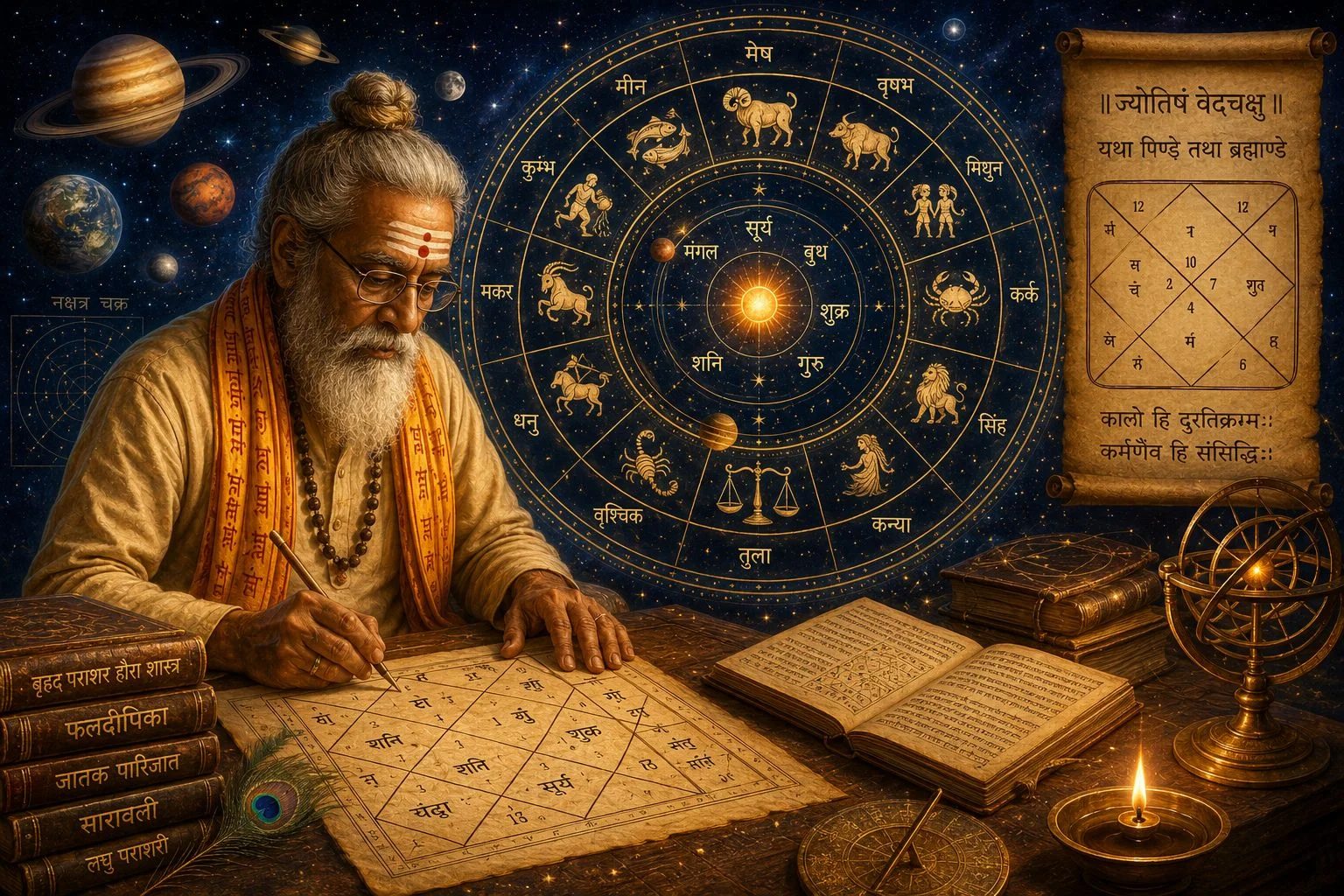
12 Rashis (zodiac signs)
Mesha to Meena. Each rashi has a presiding planet (lord), an element, a modality, and characteristic qualities.
Vedic astrology - the science of cosmic timing
Reading the position of the nine planets (navagraha), 27 nakshatras, and 12 rashis at the moment of birth to understand a person's karma, talents, challenges, and timing.
One of the six Vedangas (limbs of the Veda); originally an Upaveda
Surya himself (the sun god) is said to have taught the science to Maya the architect; Parashara (c. 1500 BCE) and Varahamihira (505–587 CE) are the great human systematisers.
Jyotisha means "the science of light". Unlike Western tropical astrology which uses the sun-sign, Vedic astrology uses the sidereal zodiac - anchored to the actual fixed stars - and emphasises the position of the moon at birth (janma rashi).
It rests on three foundations: the 12 rashis (zodiac signs), the 27 nakshatras (lunar mansions), and the 9 grahas (the seven visible planets plus the two lunar nodes Rahu and Ketu). Time itself is measured by the panchang - five limbs of the lunar calendar.
Jyotisha is not fortune-telling. It is a map of karma - what tendencies you bring into this life, what dasha (planetary period) you are running, what timings are favourable for which acts. A serious Jyotisha consultation feels less like prediction and more like reading the score of a symphony you are already playing.
Mesha to Meena. Each rashi has a presiding planet (lord), an element, a modality, and characteristic qualities.
Lunar mansions, each 13°20' of the zodiac. Each has a deity, ruling planet, and quality. Your janma nakshatra (the moon's position at birth) is the most personally important point.
Surya, Chandra, Mangala, Budha, Brihaspati, Shukra, Shani, Rahu, Ketu. The seven visible planets plus the two lunar nodes (ascending and descending).
A planetary period system. Each person passes through long dashas (Saturn 19 years, Venus 20, Sun 6, Moon 10, etc.) that colour the years of life.
The chart is divided into 12 houses - each governing a domain of life (self, wealth, siblings, mother, children, enemies, marriage, longevity, dharma, career, gains, losses/liberation).
Tithi (lunar day), vara (weekday), nakshatra (lunar mansion), yoga (sun-moon angle), karana (half-tithi). Together they determine the auspicious moment (muhurta) for any new venture.
Specific combinations of planets in a chart that produce reliable effects - Raja Yoga (royal), Dhana Yoga (wealth), Gajakesari Yoga, Pancha-mahapurusha Yoga, etc.
Author of the Brihat Parashara Hora Shastra - the foundational classical text. Father of Vyasa, grandfather of the Mahabharata heroes.
The Jaimini Sutras - an alternative chart-reading system using "chara dashas" (variable periods). Still actively used in South India.
Court astrologer to Chandragupta II. Wrote three masterworks (Brihat Samhita, Brihat Jataka, Pancha Siddhantika) and integrated Greek astrology with Indian.
The Bhrigu Samhita - claims to contain pre-written charts for every soul who would ever live. Surviving palm-leaf records still consulted at Hoshiarpur, Punjab.
The Saravali - encyclopaedic compilation of Jyotisha principles.
The 20th-century revivalist who founded the Astrological Magazine and translated many classical texts into English.
Modern systematiser; teaches Parashari and Jaimini together at the Bharatiya Vidya Bhavan, Delhi.
Every Hindu wedding traditionally happens at a moment chosen by a Jyotishi after considering both partners' charts, the panchang, and seasonal factors.
Pre-marriage compatibility check based on the two birth nakshatras. Eight kuta factors are scored; ≥18/36 is considered acceptable.
Many Indian businesses launch on auspicious dates calculated from the founder's chart and the panchang.
The Vastu Shanti / Griha Pravesha is always done on a specific Jyotisha-calculated moment.
A 30-minute conversation with a competent Jyotishi will tell you which planet's period you're running and what to lean into / be careful about for the next few years.
Check today's panchang before starting anything important. Free apps and our own /wisdom/panchang page give it.
Bharatiya Vidya Bhavan offers formal Jyotisha certifications. The Council of Vedic Astrology in the US has its own curriculum. Many Indian universities (Banaras Hindu University, Sampurnanand Sanskrit University) offer degrees in Jyotir Vidya.
One tap helps us learn what to improve. Add a note if you would like to see something specific on this page.
Anonymous votes are stored against a per-session ID; signed-in votes link to your profile. We use this only to decide what to add or improve. We never share or sell this data.