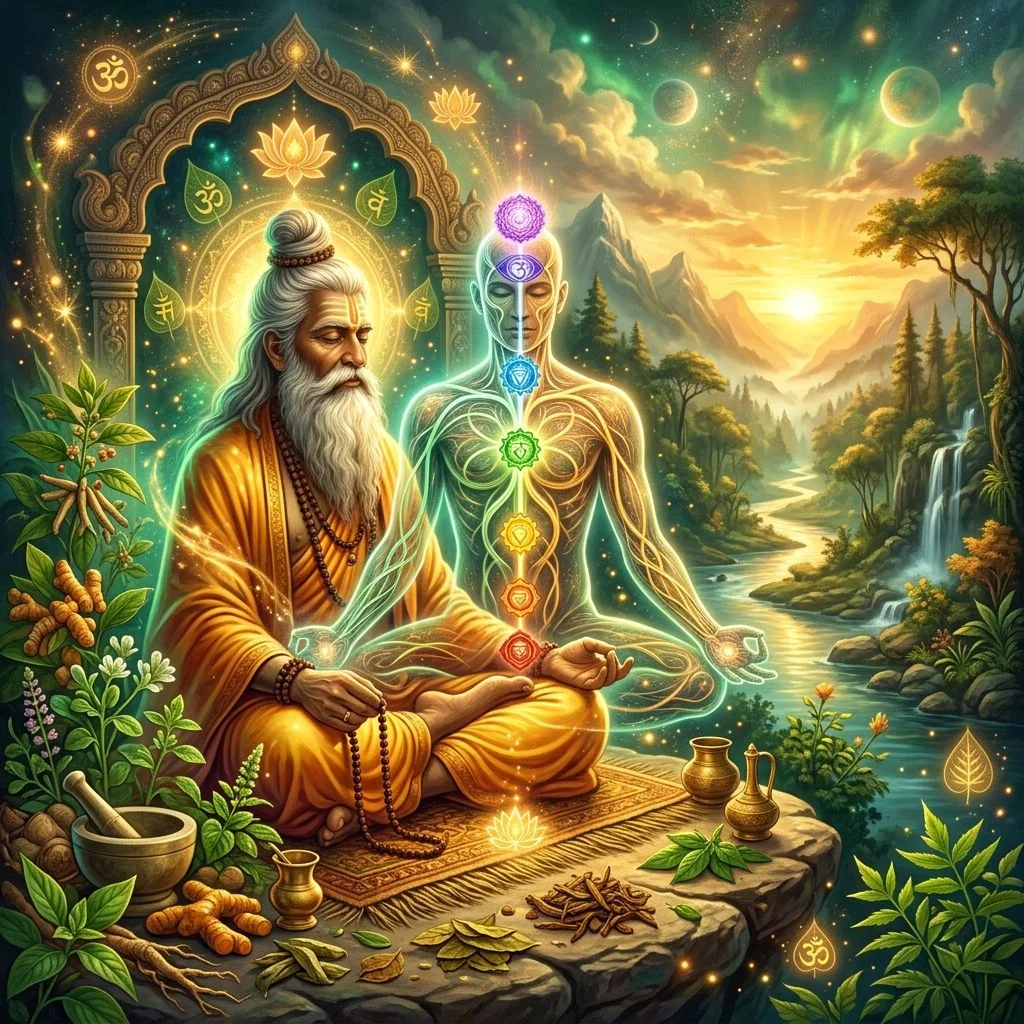
Three doshas
Vata (air + ether, governs movement), Pitta (fire + water, governs transformation), Kapha (earth + water, governs structure). Each person has a unique prakriti (constitution) of all three.
The science of life - Hindu medicine, oldest complete medical system
A complete medical system based on the balance of three doshas (Vata, Pitta, Kapha) and the seven dhatus (tissues), addressing body, mind, and lifestyle as one continuous whole.
Upaveda of the Atharvaveda
Lord Dhanvantari (the divine physician who emerged from the churning of the ocean of milk). Systematised by Charaka (medicine), Sushruta (surgery), and Vagbhata (synthesis).
Ayurveda is the world's oldest continuously-practised medical system. Its roots are in the Atharvaveda; its first systematic texts predate Greek and Chinese medicine. The name means "knowledge (veda) of life (ayur)".
Where Western medicine separates body from mind and treats disease as something external to attack, Ayurveda treats the person as one continuous system whose foods, sleep, climate, season, emotional life and spiritual practice are all medicine or all poison together. The same fennel seed is medicine for one constitution and irritant for another.
The two great early texts - the Charaka Samhita (medicine) and the Sushruta Samhita (surgery) - describe diagnosis by pulse, urine, tongue, and observation; over 700 medicinal plants and 60 surgical instruments; cataract surgery, plastic surgery (rhinoplasty), and ear-reconstruction long before Europe knew of them.
Vata (air + ether, governs movement), Pitta (fire + water, governs transformation), Kapha (earth + water, governs structure). Each person has a unique prakriti (constitution) of all three.
Rasa (plasma), rakta (blood), mamsa (muscle), meda (fat), asthi (bone), majja (marrow), shukra (reproductive). Each dhatu feeds the next.
The single most important concept. Strong agni means well-digested food becomes nourishment; weak agni means it becomes ama (toxin). Most disease begins as poor digestion.
Sweat, urine, faeces. Regular elimination is a daily diagnostic.
Sweet, sour, salty, pungent, bitter, astringent. A balanced meal includes all six. Each taste affects each dosha differently.
Five cleansing therapies - vamana (induced vomiting), virechana (purgation), basti (enema), nasya (nasal cleanse), rakta-mokshana (bloodletting). Performed seasonally as deep reset.
Daily routine and seasonal routine. The 24-hour cycle and the six-season year both have prescribed practices to keep the doshas in balance.
The divine origin - emerged from the churning of the ocean of milk holding the pot of amrita. Worshipped on Dhanteras two days before Diwali; the patron deity of all physicians.
The first great teacher of internal medicine. Charaka was his student's student.
Compiled the Charaka Samhita - the foundational text of Ayurvedic medicine. Established the eight-branch organisation (Ashtanga) of Ayurveda.
The "father of surgery". His Sushruta Samhita describes 300 surgical procedures, 120 instruments, and the first plastic surgery and cataract surgery in recorded history.
Author of the Ashtanga Hridaya - the most-quoted clinical reference, condensing Charaka and Sushruta into a usable practical manual.
The Madhava Nidana - diagnostic manual, the first systematic Ayurvedic disease classification.
Agni is strongest when the sun is highest. Eating late at night leaves food undigested, creating ama (toxin) overnight. Ayurveda predicted modern chrono-nutrition by 2,000 years.
Cold water dampens agni. Sipping warm water especially after meals improves digestion.
Five minutes of warm-oil self-massage before bathing nourishes the skin, calms vata, and slows ageing.
Three fruits - amalaki, bibhitaki, haritaki - taken at night gently cleanse the digestive tract. Safe for daily long-term use.
Cooling foods (coconut, cucumber, melons) in summer. Warming foods (ghee, ginger, dates) in winter. Light foods (mung dal, vegetables) in monsoon.
Visit any vaidya for a one-hour consultation to learn whether you are vata, pitta, or kapha dominant. Knowing this answers half the questions you have about your own body.
India's Ministry of AYUSH governs Ayurveda. Over 250,000 Ayurvedic physicians practise across the country. WHO has formally recognised Ayurveda as a traditional medical system. Major centres: Arya Vaidya Sala (Kottakkal, Kerala), Patanjali Ayurved (Haridwar), Banaras Hindu University, Gujarat Ayurved University (Jamnagar).
One tap helps us learn what to improve. Add a note if you would like to see something specific on this page.
Anonymous votes are stored against a per-session ID; signed-in votes link to your profile. We use this only to decide what to add or improve. We never share or sell this data.