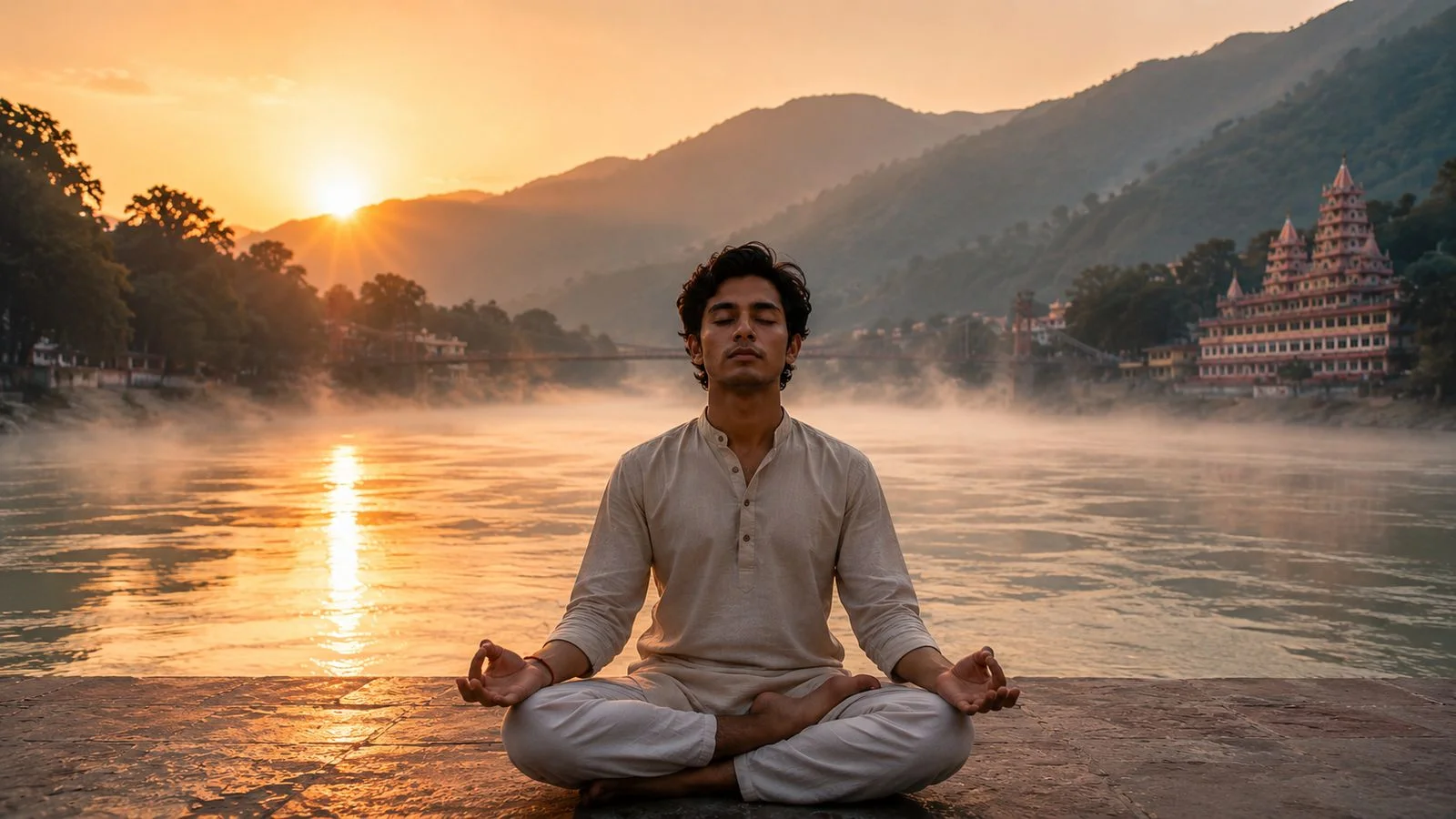
Chitta-vritti-nirodha
Yoga Sutra 1.2 - "yoga is the stilling of the fluctuations of the mind". The entire syllabus is in service of this single goal.
The science of yoking the wandering mind
Eight progressive limbs - yama, niyama, asana, pranayama, pratyahara, dharana, dhyana, samadhi - that move attention from outer behaviour to absorbed awareness.
Closely associated with the Yajurveda; Patanjali codified the system around 200 BCE
Hiranyagarbha (the mythic first teacher); systematised by Patanjali in the Yoga Sutras (c. 200 BCE). Earlier roots in the Upanishads (Katha, Shvetashvatara) and the Bhagavad Gita (chapters 5–6).
The word yoga comes from the root yuj, "to yoke". It is the discipline of yoking the wandering mind so it can rest in its own clarity. Around 200 BCE, the sage Patanjali codified centuries of oral teaching into 196 short aphorisms - the Yoga Sutras - and gave the world the eight-limbed path (Ashtanga) that almost every modern Hindu meditation teacher draws from.
Yoga in classical India is not the same as the modern asana-only "yoga class". Asana is only the third of eight limbs. The first two - yama (restraint) and niyama (observance) - are how you live the rest of your day; the last three - dharana, dhyana, samadhi - are progressively deeper states of inner attention.
The Bhagavad Gita describes four temperament-matched paths: Bhakti yoga (devotion), Karma yoga (selfless action), Jnana yoga (knowledge), and Raja yoga (meditation). Most practitioners blend two or three.
Yoga Sutra 1.2 - "yoga is the stilling of the fluctuations of the mind". The entire syllabus is in service of this single goal.
Yama, niyama, asana, pranayama, pratyahara, dharana, dhyana, samadhi. Each limb prepares the next.
Bhakti (love), Karma (action), Jnana (knowledge), Raja (meditation). The Gita treats them as complementary.
In tantric yoga (Hatha tradition), the spiritual energy (kundalini) lies coiled at the base of the spine. Practice awakens it and lets it rise through seven chakras to the crown.
The subtle body has 72,000 nadis (channels). The three principal - Ida (lunar, left), Pingala (solar, right), Sushumna (central) - meet at the chakras. Five pranas circulate through them.
The eighth limb - the meditator, the act of meditation, and the object dissolve into one. Patanjali distinguishes savikalpa (with form) and nirvikalpa (without).
Codified the Yoga Sutras - the foundational text. By tradition the same Patanjali who wrote the Mahabhashya on Sanskrit grammar and the Ayurvedic Charaka Samhita commentary.
Founder of the Nath sampradaya. Developed Hatha Yoga as we know it. His disciple Goraknath spread Hatha across India.
Disciple of Matsyendranath. Travelled across north India teaching Hatha. The town of Gorakhpur is named after him.
Author of the Hatha Yoga Pradipika - the most widely studied Hatha manual.
Introduced yoga to the West at the 1893 Parliament of Religions. His "Raja Yoga" book translated and popularised Patanjali for English readers.
The "father of modern yoga". Teacher of B.K.S. Iyengar, K. Pattabhi Jois, T.K.V. Desikachar, and Indra Devi. Almost every modern asana lineage descends from him.
Iyengar Yoga - precision alignment, use of props. His book Light on Yoga is still the global reference for asana.
Brought Kriya Yoga to America. Author of Autobiography of a Yogi.
A daily five-minute meditation, done for forty days, will measurably change how you respond to stress. Start with the breath, return when distracted.
Slow alternate-nostril breathing (anuloma viloma) for two minutes before sleep - drops heart rate, improves sleep quality.
Twelve postures, twelve breaths, twelve bija mantras. A complete morning practice in ten minutes that the body and mind both crave.
Even five minutes of namasankirtana (the Lord's names) before bed is bhakti yoga. No technique required - just sincere attention.
Do the next task without grasping for praise or recognition. The Gita's teaching is meant for office work as much as for warriors.
India's Ministry of AYUSH (Ayurveda, Yoga, Unani, Siddha, Homoeopathy) formalises Yoga as a national health system. The UN-recognised International Yoga Day on 21 June (Summer Solstice) draws hundreds of millions of practitioners worldwide.
One tap helps us learn what to improve. Add a note if you would like to see something specific on this page.
Anonymous votes are stored against a per-session ID; signed-in votes link to your profile. We use this only to decide what to add or improve. We never share or sell this data.