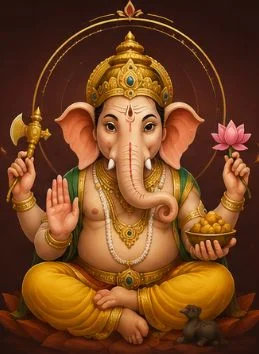
Vivaha is the 13th of the 16 samskaras - and the most sacrament-rich. The Manu Smriti lists 8 classical types in descending dharmic order; the modern Hindu wedding follows the Brahma form (the supreme). The ceremony itself has 16 sub-rituals - from mandap-consecration through saptapadi (the 7 vows around Agni) to vidaai (the bride's departure). Kundli-milan precedes everything: the Ashta-koota matches bride + groom on 8 axes for 36 total points.
№ 1
Brahma · ब्रह्म विवाह
Praiseworthy (prashasta)The father invites a worthy groom (suvidya, sushila, vidya-sampanna) - invites him to the home, ceremonially gives the daughter ornamented with jewels + clothes, and the marriage proceeds with vedic mantras. No dowry-demand from the groom side.
Modern status - The supreme + only-recommended form today. The standard modern Hindu marriage follows the Brahma form.
№ 2
Daiva · दैव विवाह
Praiseworthy (prashasta)The father gives the daughter to a ritvij (priest officiating his yajna) as part of the yajna-dakshina. Considered slightly inferior because the bride is treated as part of a payment.
Modern status - Obsolete - yajnas in this form not commonly performed.
№ 3
Arsha · आर्ष विवाह
AcceptableThe father gives the daughter to a rishi after the groom offers a token cow + bull. The token is purely symbolic; the rishi gives the cow + bull back. Less elaborate than Brahma.
Modern status - Obsolete in practice. Some rural Brahmana marriages still nominally invoke this form.
№ 4
Prajapatya · प्राजापत्य विवाह
AcceptableThe father invites the groom + says "may you both fulfil your dharma together" - the dharmic-companion clause. No fee or dowry. Slightly later than the Brahma form.
Modern status - Standard modern civil-court marriage often resembles the Prajapatya form.
№ 5
Asura · आसुर विवाह
Disapproved (aprashasta)The groom's family pays a substantial amount (bride-price) to the bride's family. The "buying" of the bride. Manu Smriti: "Where wealth is taken - that is Asura, the way of demons."
Modern status - Banned under the Dowry Prohibition Act (1961). However, reverse-dowry (bride-price) still practised in some communities.
№ 6
Gandharva · गान्धर्व विवाह
Disapproved (aprashasta)Mutual consent of the bride + groom, without family approval. The "love marriage". Considered legitimate in the Mahabharata (Dushyanta + Shakuntala) but disapproved by Manu Smriti.
Modern status - The modern "love marriage" - increasingly accepted but still socially complicated in many families.
№ 7
Rakshasa · राक्षस विवाह
ForbiddenMarriage by forcible abduction - the groom carries off the bride after defeating her kin in combat. Bhishma's abduction of the three princesses of Kashi for Vichitravirya (Mahabharata, Adi Parva 96) is the classical textual example. Strictly forbidden by later Dharma Shastras. (Note: Krishna-Rukmini is not a Rakshasa vivaha - Rukmini herself sent a letter requesting Krishna to rescue her; Bhagavata Purana 10.52-53 makes clear it was her willing invitation.)
Modern status - Criminal abduction under Indian Penal Code. Strictly forbidden.
№ 8
Paishacha · पैशाच विवाह
ForbiddenMarriage by deception - the groom assaults / drugs / takes advantage of the bride while she is unconscious / drunk / unaware. The most adharmic of all forms.
Modern status - Criminal under Indian Penal Code (rape + abuse). The Manu Smriti calls this the worst of all dharmic deviations.
№ 1
Misri (engagement) · सगाई / नियामक
Pre-wedding. Both families meet. Misri (rock sugar) + dry-fruits exchanged. The wedding muhurta is fixed.
Significance: Formal commitment between families before the wedding day.
№ 2
Tilak / Sagai-ras · तिलक
Father of the bride visits the groom's home, applies tilak on groom's forehead, gives gifts. Acceptance of the groom by the bride's family.
Significance: Public ratification of the marriage.
№ 3
Ganesha Pooja / Mandap Sthapana · गणेश पूजा
On wedding morning. Mandap (4-pillared marriage canopy) is consecrated. Ganesha worship initiates all subsequent rituals.
Significance: Obstacle-removal before the central rite.
№ 4
Var-puja · वर पूजा
The bride's father formally welcomes the groom + party at the mandap entrance. Washes the groom's feet, offers honey + curd.
Significance: Treating the groom as Vishnu / the supreme guest.
№ 5
Kashi Yatra (Brahmana tradition) · काशी यात्रा
A staged drama: the groom (a brahmachari) "renounces" the world and starts walking to Kashi. The bride's father intercepts and convinces him to enter grihastha-ashrama instead.
Significance: Marks the transition from brahmacharya to grihastha - voluntary choice, not compulsion.
№ 6
Jaimala / Varmala · जयमाला
Bride + groom exchange garlands while standing facing each other.
Significance: Mutual acceptance. The two become a couple.
№ 7
Kanyadana · कन्या दान
The supreme act. The father places the daughter's right hand in the groom's right hand and pours water through their joined hands while reciting the sankalpa: "I give my daughter to [groom-name] of [gotra] gotra of [Veda-shakha]. May you accept her as your dharmapatni for dharma + artha + kama. Not for moksha - for moksha she belongs only to Bhagavan."
Significance: The Father gives - formally transferring guardianship from father to husband. Cosmically, the father gives the daughter back to Lakshmi-source.
№ 8
Panigrahana · पाणिग्रहण
The groom grasps the bride's hand - the "accepting of the hand". The first physical contact in the ritual.
Significance: Acceptance of the bride. The contract is now mutual + physical.
№ 9
Vivah-homa / Agni-sthapana · विवाह होम
A new fire is kindled in the mandap. The married couple stands before Agni; the priest offers ahutis (ghee + grain) into the fire.
Significance: Agni is the witness - the only one of the 33 koti devas who is physically present. The marriage is sealed in Agni's witness.
№ 10
Laja-homa · लाज होम
The bride's brother places parched rice (laja) in her cupped hands; she then offers it into the fire. Repeated 3 times.
Significance: The brother's blessing. Also: the bride's commitment of substance to the new agni-kula she is joining.
№ 11
Ashmarohana · अश्मारोहण
The groom places the bride's right foot on a stone (silla). "Be steady like this stone."
Significance: Pledge of marital steadiness against the trials to come.
№ 12
Saptapadi · सप्तपदी
The seven steps around the fire. With each step, the couple speaks a vow - for food, strength, prosperity, happiness, progeny, harmonious seasons, lifelong companionship + sakhya (friendship). After the 7th step the marriage is COMPLETE - even if all other rites are missed, saptapadi makes it legal.
Significance: The legal heart of the marriage. The 7 vows are the dharmic charter.
№ 13
Sindur-dan · सिन्दूर दान
The groom applies sindur (vermilion) on the bride's forehead-parting (mang). She is now sumangali (married woman).
Significance: Visible marker of married status. Lakshmi-bhava is awakened in the bride.
№ 14
Mangalsutra-bandhana · मङ्गल सूत्र बन्धन
The groom ties the mangalsutra (sacred thread with two gold pendants) around the bride's neck.
Significance: The married woman's necklace - worn for life, removed only after the husband's death.
№ 15
Anugamana / Griha-pravesha · गृह प्रवेश
The bride enters the groom's home, gently kicking over a rice-pot at the threshold (signifying her bringing Lakshmi into the home).
Significance: The new bride is Lakshmi entering the husband's home.
№ 16
Vidaai / Bidaai · विदाई
The bride says farewell to her natal family + leaves with the groom. The most emotional moment of the wedding for the bride's family.
Significance: Transition complete. The bride is now of the groom's family.
Before agreeing to a marriage, the kundlis (birth-charts) of bride + groom are matched across 8 axes. Each axis carries 1-8 points; total max = 36. Below the 18-point threshold the match is considered inauspicious - remedies must be performed before proceeding.