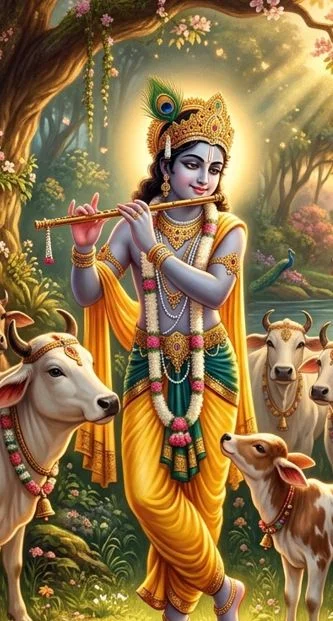
15 key events in Krishna's life spanning Mathura, Gokul, Vrindavan, Mathura-Kamsa, Dwaraka, Kurukshetra, and Prabhasa. Plus 2 less-known Gitas Krishna delivered: the Uddhava Gita (his deathbed teaching to Uddhava - Bhagavata 11.6-29, 1100 verses) and the Kapila Gita (Bhagavata 3.25-33 - Sankhya in narrative form, taught by avatar Kapila to his mother Devahuti).
Devaki + Vasudeva imprisoned by Kamsa (told by a celestial voice that their 8th child would slay him). Kamsa had already smashed the 7 previous children against a stone. The 8th was Krishna - born at midnight in the prison. Vasudeva carried him in a basket across the Yamuna (rains parted, Adishesha shielded). Exchanged for Yashoda + Nanda's newborn daughter.
Significance - The avatar's arrival is announced by cosmic signs - Yamuna parts, prison-doors open, guards put to sleep. The supreme example of divine descent into adversity.
Kamsa sent the rakshasi Putana disguised as a beautiful nurse with poisoned breast-milk. Yashoda welcomed her, mistaking her for benign. Putana suckled Krishna; he drank her life-breath along with the milk. Putana resumed her true form (huge demoness) + died.
Significance - First demon-slaying. The infant Krishna, by accepting the offering with bhava, transformed the offerer's fate - Putana attained moksha. The compassion of the avatar.
Trinavarta, a whirlwind-rakshasa, snatched Krishna up into the sky to dash him on the ground. Krishna made himself increasingly heavy. Trinavarta could not hold him, plummeted, was killed.
Significance - Whirlwind demon = the rajas-vata that lifts beings into ego-flight. The Lord becomes heavier than ego can carry.
Krishna stole butter from neighbours (a delight to all). One day Yashoda tried to tie him to a mortar in punishment. Every rope she tried was too short by two inches. Finally Krishna accepted being bound - hence "Damodara" (rope-bound-on-belly). He dragged the mortar across the yard, knocked down twin arjuna trees (releasing two cursed gandharvas, sons of Kubera, from their tree-form).
Significance - "Bhakti binds the unbindable." The infinite can only be bound by a mother's thread - a thread of pure love. Karthika Damodara month is named for this lila.
The Yamuna had been poisoned by Kaliya - a thousand-hooded naga whose venom killed everything that drank the river. Krishna jumped into the Yamuna, fought Kaliya, danced on his many hoods. Kaliya's wives pleaded for mercy. Krishna spared Kaliya, banished him to the ocean (where he came from).
Significance - Dance on the serpent's heads = the supreme image of the dharmic conquering the venomous. Krishna transforms - not destroys - the poisonous (a model for spiritual ego-work).
The cowherds annually worshipped Indra for rain. Krishna asked: why worship a distant deva when the immediate cause of cowherd-prosperity is the Govardhana hill (whose grass feeds the cows)? They redirected the puja to Govardhana. Indra, enraged, sent torrential rains to drown Gokul. Krishna lifted Govardhana hill on his left-hand little finger; the village + cows sheltered under it for 7 days + 7 nights. Indra repented + bowed.
Significance - The supreme example of "swadeshi worship" - honour the local nourisher, not the distant abstract. Also Krishna's first cosmic-display before his foster-village. Govardhana Pooja on Karthika Shukla Pratipada commemorates this.
The young gopis bathed naked in the Yamuna while performing a Katyayani-vrata (asking the goddess for Krishna as husband). Krishna climbed a kadamba tree on the bank, took their clothes up with him. He returned them only one-by-one, asking each gopi to come up to him with hands folded (not covering herself). The lesson: before the Divine, no garment.
Significance - Often misread. The lesson: before God, all coverings (caste, name, body) are nakedness. Total surrender requires nothing-held-back. Krishna here teaches the gopis sharanagati at its purest.
№ 8
Maha-Rasa (the cosmic dance)
Vrindavan~10 years old, Sharad Purnima night
On Sharad Purnima (full moon of autumn), Krishna multiplied himself - a separate Krishna for each gopi. He danced with the gopis in the Rasa-mandala. The supreme lila - the cosmic dance of the Soul with all souls. Lasted a "kalpa-night" (cosmic compression of time).
Significance - The supreme symbol of bhakti-yoga. Each soul has its own personal Krishna. The Bhagavata Purana's most-praised section (Skandha 10, chapters 29-33). "Hearing the Maha-Rasa with faith removes lust" (per the Bhagavata's phala-shruti).
Kamsa, hearing of Krishna's feats, invited him + Balarama to a wrestling-festival at Mathura. The gopis wept; Krishna had to leave. Akrura drove the chariot. At Mathura, Krishna killed Kuvalayapida (mad elephant), then Chanura + Mushtika (two wrestlers), then leaped onto Kamsa's throne + killed him by dragging him by the hair down the stairs.
Significance - The exit from Vrindavan was final - Krishna never went back. The cowherd-lover transformed into the king-warrior. The two halves of Krishna (Vrindavan + Mathura/Dwaraka) are kept separate by tradition - Pushti Marga focuses on Vrindavan-Krishna; ISKCON includes both; Gaudiya emphasizes Vrindavan; Madhva emphasizes Mahabharata-Krishna.
After Kamsa's death, his father-in-law Jarasandha (king of Magadha) attacked Mathura repeatedly. Krishna evacuated the Yadava clan to a new island-city - Dwaraka - built by Vishvakarma on the sea coast of modern Gujarat in a single night.
Significance - The strategic retreat that becomes a 5000-year dynastic capital. Dwaraka is one of the 7 Sapta Puri pilgrimage cities.
Princess Rukmini of Vidarbha was being given by her brother Rukmi to Shishupala (Krishna's cousin + enemy). She wrote Krishna a letter - "if you do not come for me, I shall die." Krishna abducted her from her swayamvara-temple visit. Defeated Rukmi + Shishupala's army. Married her at Dwaraka.
Significance - Krishna's 8 principal queens (Ashta-Mahishi): Rukmini, Satyabhama, Jambavati, Nagnajiti, Kalindi, Mitravinda, Bhadra, Lakshmana. Plus 16,100 rescued from Narakasura.
Krishna's childhood friend Sudama, by now an impoverished brahmana, visited Dwaraka with only a small pouch of broken rice (chipped flakes) as gift. Krishna received him on the throne, washed his feet, ate the broken rice with great relish. Sudama returned home - his hut had been transformed to a palace.
Significance - The supreme example of friendship transcending social difference. Krishna honours childhood-friendship above royal protocol.
On the eve of the Kurukshetra war, Arjuna refused to fight. Krishna (Arjuna's charioteer) delivered the 700-verse Bhagavad Gita in 18 chapters between the two armies. After the discourse, Arjuna picked up Gandiva + fought.
Significance - The supreme philosophical legacy of Krishna. The Bhagavad Gita is the most-translated Hindu text - into 80+ languages. See /wisdom/bhagavad-gita.
Per Gandhari's curse (for not preventing the war), the Yadava clan annihilated itself in a brawl at Prabhasa. The Yadava chiefs, drunk + provoked by an old rishi's sting (the iron-pestle-from-a-pregnant-male-charm Vyasa story), killed each other with eraka-grass (which had grown from the iron-pestle's filings, made deadly by destiny).
Significance - The dynasty Krishna built ended in one day. Cosmic order requires balance - Krishna's 8 principal queens, all of Dwaraka, all of his Yadava clan - perish in the span of his physical body.
After the Yadava massacre, Krishna sat under a peepal tree in a forest, in meditation, his foot raised. A hunter (Jara) saw the foot, mistook it for a deer, shot. The arrow pierced Krishna's foot. Jara, on recognising Krishna, was inconsolable. Krishna comforted him + said: "you are Vali reborn; the arrow from-behind that you shot is the karmic-return for my arrow from-behind in Treta Yuga." Krishna then left his body.
Significance - The closing of a karmic loop. Vali (Ramayana) had been shot by Rama from behind; that karma returned to its source. Krishna's departure marks the start of Kali Yuga. Per Bhagavata, Krishna left on Phalguna Krishna Trayodashi, 3102 BCE.
The 24 gurus (Bhagavata 11.7-9)
Krishna recounts the Avadhuta-Dattatreya story - Dattatreya described 24 gurus from nature (earth, air, sky, water, fire, sun, moon, dove, python, sea, moth, bee, elephant, honey-thief, deer, fish, the prostitute Pingala, kurara bird, child, the maiden grinding wheat, snake, the spider, arrow-maker, caterpillar). Each natural phenomenon teaches a specific spiritual lesson. The supreme example: nature herself is the guru.
The 9 forms of bhakti (Bhagavata 7.5.23, expanded in Uddhava Gita)
shravana (hearing), kirtana (chanting), smarana (remembering), pada-sevana (foot-service), archana (worship), vandana (prayer), dasya (servitude), sakhya (friendship), atma-nivedana (self-surrender). Practising any one of these as the sole sadhana grants moksha.
The 4 yogas - Kali Yuga emphasis
Krishna lists 4 paths - karma, jnana, dhyana, bhakti. He explicitly says: in Kali Yuga, when the body cannot endure austerity + the mind cannot still itself for jnana + karma-yoga is contaminated - only bhakti, especially kirtana, is sufficient. The doctrine adopted by Chaitanya 4500 years later.
On the world being mithya yet real
Krishna teaches a middle path between Advaita's "world is illusion" and Dvaita's "world is fully real" - the world is real-yet-impermanent, like a dream that the dreamer experiences but eventually wakes from. The basis for the Achintya-bheda-abheda doctrine of Gaudiya Vaishnavism.