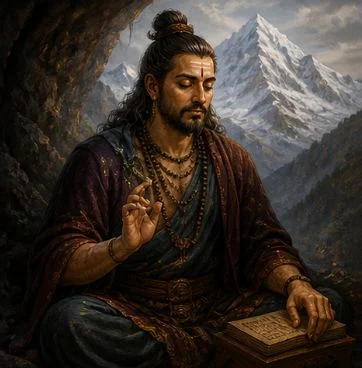
त्रिक काश्मीर शैव · Trika · Kashmir Shaivism (non-dualistic)
Abhinavagupta
950–1016 CE Kashmir
Shiva is the only reality, and Shiva is pure dynamic consciousness (chit-shakti). The world is not maya; it is the divine self-recognition (pratyabhijna) - Shiva playing at being many.
The teaching
Reality is Shiva spontaneously playing all roles. Liberation is recognition (pratyabhijna): noticing that you, the perceiver, are already that divine consciousness. Practice combines tantric ritual, meditation, and aesthetic contemplation - for Abhinava, deep absorption in beauty (rasa) is itself a path to recognition. He is also the founding theorist of Indian aesthetics in his Abhinavabharati.
Major works
- Tantraloka - 37 chapters, the encyclopaedic synthesis of Trika tantra
- Tantrasara - concise summary of the Tantraloka
- Pratyabhijnavimarshini - commentary on Utpaladeva's Pratyabhijna Karika
- Abhinavabharati - commentary on Bharata's Natyashastra; foundational text of Indian aesthetics
- Paramarthasara - 105-verse summary of his philosophy
What he changed
- Wove together the dualistic Shaiva Siddhanta and the non-dual Krama and Kula traditions of Kashmir into a single Trika system
- Articulated rasa-bhakti and rasa-yoga - aesthetic experience as a doorway to the absolute
- Influenced later Vedantic and Bhakti traditions far beyond Kashmir
Living lineage today
Kashmir Shaivism survived through teachers like Swami Lakshmanjoo (1907–1991). Mark Dyczkowski, John Hughes, and the Lakshmanjoo Academy continue scholarly work.
Where to read more
- Mark Dyczkowski · "The Doctrine of Vibration" (SUNY Press) - accessible introduction
- Jaideva Singh · translations of "Pratyabhijnahrdayam", "Spanda Karikas", "Vijnana Bhairava" (Motilal)
- Lyne Bansat-Boudon · "An Introduction to Tantric Philosophy" (Routledge) - translates Paramarthasara with commentary
- Lakshmanjoo Academy archive (lakshmanjooacademy.org)
Other acharyas
Adi Shankaracharya →
Advaita Vedanta · Pure non-dualism
Ramanujacharya →Vishishtadvaita · Qualified non-dualism
Madhwacharya →Dvaita · Dualism
Vallabhacharya →Shuddhadvaita · Pure non-dualism (with grace)
Nimbarkacharya →Dvaitadvaita · Dual-non-dualism
Chaitanya Mahaprabhu →Achintya Bhedabheda · Inconceivable difference and non-difference
Basavanna →Lingayat / Veerashaiva
Vidyaranya →Advaita Vedanta