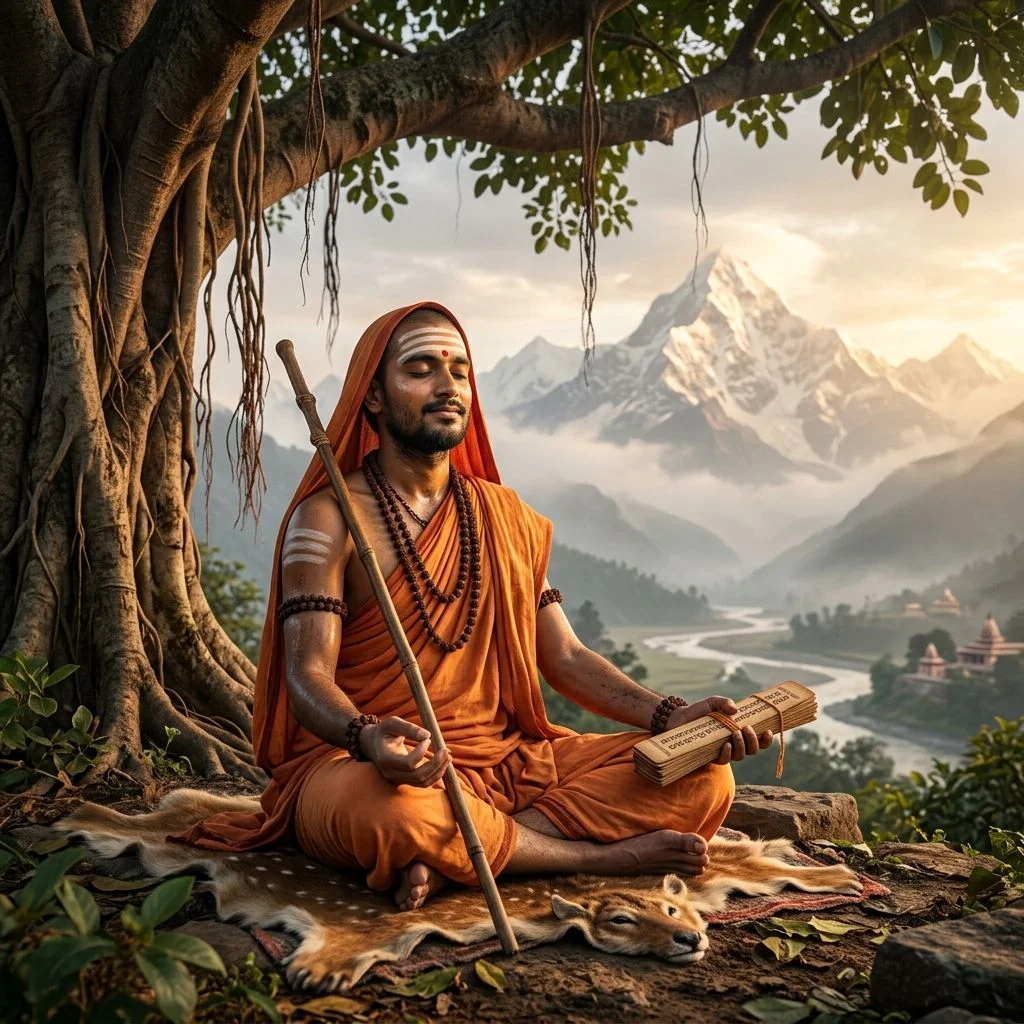
अद्वैत वेदान्त · Advaita Vedanta · Pure non-dualism
Adi Shankaracharya
Jagadguru
788–820 CE (traditional) · earlier dates argued by some historians Kaladi, Kerala
There is only one reality - Brahman - and you are not separate from it. The world of multiplicity is real but not ultimate.
The teaching
Brahman alone is real (sat); the world is mithya (apparent, not unreal); the individual self (jiva) is non-different from Brahman. Liberation comes through knowledge (jnana), not action; the obstacle is avidya (ignorance), the cure is the realisation of "Aham Brahmasmi". His method is uncompromising: every appearance, however dear, is investigated until only awareness remains.
Major works
- Brahma Sutra Bhashya - commentary on Badarayana's Brahma Sutras (the foundational Vedanta text)
- Bhashyas on the ten principal Upanishads
- Bhagavad Gita Bhashya - line-by-line commentary
- Vivekachudamani - "Crest-jewel of discrimination", standalone primer
- Atma Bodha, Tattva Bodha, Aparoksha Anubhuti - short prakarana texts
- Soundarya Lahari and Bhaja Govindam - devotional hymns (showing he honoured bhakti as preparation for jnana)
What he changed
- Established the four mathas (monastic seats) at Sringeri, Dwarka, Puri, and Jyotirmath, each with a designated principal Veda and mahavakya
- Codified Panchayatana Pooja - worship of five deities (Shiva, Vishnu, Devi, Surya, Ganesha) on a single altar - to harmonise sectarian rivalries
- Revived Sanatana Dharma during a period of Buddhist and Jain dominance, defeating leading scholars of those schools in dialectical debate (most famously Mandana Mishra)
- Defined the Dashanami Sampradaya - the ten orders of monastic renunciants
Living lineage today
The four Shankaracharya pithas (Sringeri, Dwarka, Puri, Jyotirmath/Badrinath) continue today, each headed by a sitting Shankaracharya. The Ramakrishna Order and the Chinmaya Mission stand within his lineage.
Where to read more
- Advaita Ashrama (Mayavati) edition of the Brahma Sutra Bhashya - bilingual
- Swami Madhavananda · "Vivekachudamani" with translation (Advaita Ashrama)
- A.J. Alston · "Shankara on the Absolute" (six volumes, Shanti Sadan)
- Eliot Deutsch · "Advaita Vedanta - A Philosophical Reconstruction" (Hawaii UP)
Other acharyas
Ramanujacharya →
Vishishtadvaita · Qualified non-dualism
Madhwacharya →Dvaita · Dualism
Vallabhacharya →Shuddhadvaita · Pure non-dualism (with grace)
Nimbarkacharya →Dvaitadvaita · Dual-non-dualism
Chaitanya Mahaprabhu →Achintya Bhedabheda · Inconceivable difference and non-difference
Abhinavagupta →Trika · Kashmir Shaivism (non-dualistic)
Basavanna →Lingayat / Veerashaiva
Vidyaranya →Advaita Vedanta