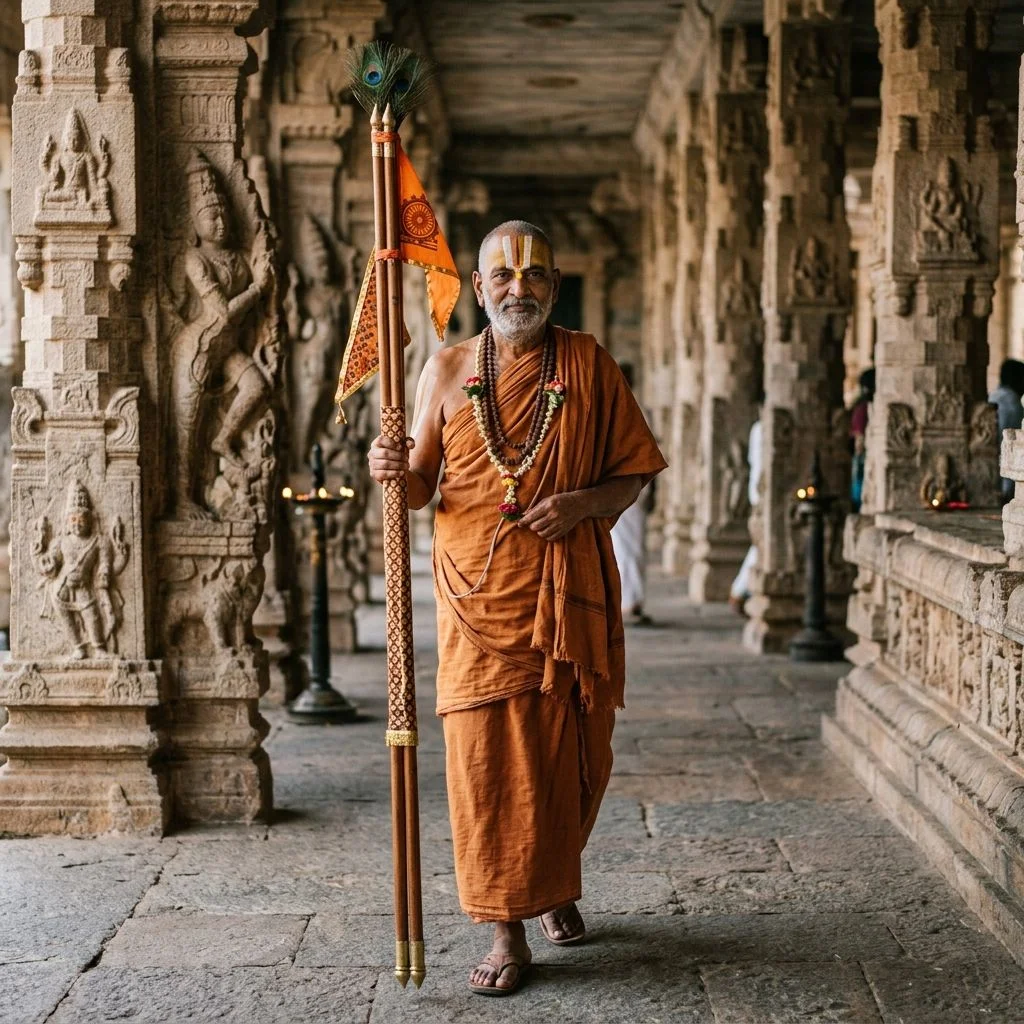
Ramanujacharya
Sri Bhashyakara
Brahman (Vishnu/Narayana) is one but qualified by an inner body of sentient (chit) and insentient (achit) reality. You are real, distinct, yet eternally inseparable from Him.
The teaching
God, soul, and matter are all real and ontologically distinct, yet the souls and matter constitute the body of God - they are inseparable from Him as a wave from the ocean. Liberation comes through prapatti (loving surrender) and bhakti directed at Sriman Narayana, with Lakshmi as the divine mediatrix. Every soul is eligible - Ramanuja famously climbed the Tirupati hill and shouted the Ashtakshari mantra to all castes, breaking the priestly monopoly.
Major works
- Sri Bhashya - magnum opus commentary on the Brahma Sutras
- Vedartha Sangraha - concise summary of his Vedantic position
- Gita Bhashya - commentary on the Bhagavad Gita
- Vedanta Dipa, Vedanta Sara - shorter primers
- Three "Gadyas" - Sharanagati Gadya, Sriranga Gadya, Vaikuntha Gadya - prose devotional poems of surrender
- Nityagrantha - manual of daily worship
What he changed
- Synthesised Tamil Alvar bhakti poetry (the Divya Prabandham) with Sanskrit Vedanta - created the "Ubhaya Vedanta" tradition
- Reformed temple worship at Srirangam and codified the Pancharatra Agama liturgy still used in Sri Vaishnava temples
- Opened mantra initiation to all jatis - radical for the 11th century
- Established the 74 simhasanadhipatis (succession seats) to ensure his teaching survived
Living lineage today
The Sri Vaishnava Sampradaya splits into two sub-schools after him: Vadakalai (northern, more Sanskrit-leaning, headquartered at Kanchi) and Tenkalai (southern, more Tamil-leaning, headquartered at Srirangam). The Ramanuja Mission and many Iyengar temples continue the tradition.
Where to read more
- Sri Vaishnava Granthamala edition of the Sri Bhashya (Madras)
- Swami Adidevananda · "Sri Ramanuja Gita Bhashya" (Sri Ramakrishna Math)
- John Carman · "The Theology of Ramanuja" (Yale UP)
- Vasudha Narayanan · "The Vernacular Veda" (South Carolina UP) - on the Divya Prabandham