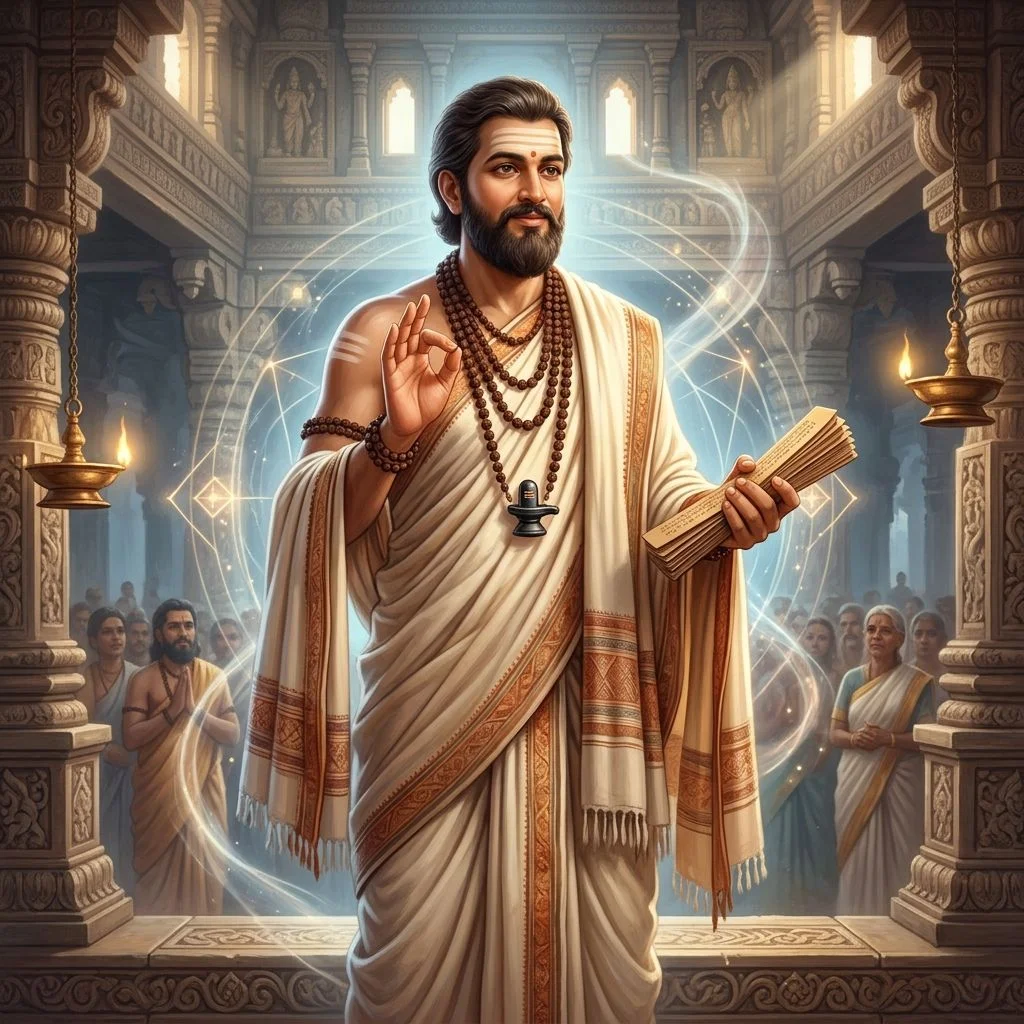
Basavanna
Basaveshwara
Wear Shiva on your body (the ishta-linga), worship Him without intermediary, work as worship, and treat every devotee as equal regardless of caste or gender.
The teaching
Direct, personal, casteless devotion to Shiva. The ishta-linga (a small linga worn on a thread around the neck) makes the deity portable and the worship private. Kayaka (work) is itself worship; dasoha (sharing) is its expression. Basavanna led a 12th-century social-religious revolution that included women (Akka Mahadevi) and lower-caste poets (Allama Prabhu, Madivala Machideva) as equal sharanas.
Major works
- Vachanas - short Kannada free-verse devotional sayings (over 1,300 attributed to Basavanna himself)
- Anubhava Mantapa - the assembly hall at Kalyana where sharanas debated; the recorded proceedings (Shunya Sampadane) are the canon
What he changed
- Anubhava Mantapa - perhaps the world's first public, casteless, gender-equal democratic religious assembly (12th century)
- Vachana literature - replaced Sanskrit with Kannada as the language of devotional philosophy, opening it to ordinary readers
- Eight-fold practice (Ashtavarana) and six-stage path (Shatsthala) - a complete soteriology grounded in personal life
Living lineage today
The Lingayat community of Karnataka, North Karnataka, and parts of Maharashtra/Telangana continues today. The Basava Samiti and many Veerashaiva mathas (Suttur, Murugharajendra, Siddhaganga) are active.
Where to read more
- A.K. Ramanujan · "Speaking of Siva" (Penguin Classics) - best English entry to Vachana literature
- H. Thipperudraswamy · "The Veerasaiva Saints" (Karnataka University Press)
- M.M. Kalburgi · "Marga" volumes - Vachana scholarship
- Basava Samiti, Bangalore - Kannada and English editions