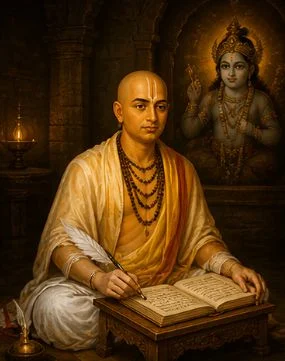
शुद्धाद्वैत · Shuddhadvaita · Pure non-dualism (with grace)
Vallabhacharya
1479–1531 CE Champaranya (modern Chhattisgarh)
The world is real and is Krishna himself - there is no Maya. Liberation is by His grace alone (pushti-marga, "the path of nourishment"), independent of merit.
The teaching
Brahman, souls, and the world are all the same Krishna (Krishna in three modes: as Brahman, as inner self, and as world). The path is pushti - the spontaneous gracious flow of Krishna into the devotee, requiring no discipline and earned by no work. Worship of the child Krishna (Bala-Krishna) at Nathdwara is the centerpiece. Sevak (servant) is a higher relationship than jnani (knower).
Major works
- Anubhashya - commentary on the Brahma Sutras
- Tattva-Dipa-Nibandha - three-volume systematic exposition
- Subodhini - commentary on the Bhagavata Purana
- 16 Granthas (Shodasha-Granthas) - short tracts including the Madhurashtakam
What he changed
- Founded the Pushti Marga and the Vallabha Sampradaya - distinct from the older Vaishnava sampradayas
- Established Krishna worship at Shrinathji, Nathdwara - perhaps the most important Krishna temple in north India
- Created the seven seva-routine (saat-jhanki) of Shrinathji that thousands of haveli-style temples still follow daily
Living lineage today
The Vallabha Sampradaya is led by his descendants, the Goswamis. Major centres at Nathdwara, Kankroli, Kamavan, Gokul, Jatipura, Mathura, Vrindavan (the seven seats - saat peeths).
Where to read more
- Pushti Vimal Vidya Mandal (Bombay) - sampradaya publications
- James Redington · "Vallabhacharya on the Love-Games of Krishna" (Motilal)
- Richard Barz · "The Bhakti Sect of Vallabhacharya" (Thomson Press)
Other acharyas
Adi Shankaracharya →
Advaita Vedanta · Pure non-dualism
Ramanujacharya →Vishishtadvaita · Qualified non-dualism
Madhwacharya →Dvaita · Dualism
Nimbarkacharya →Dvaitadvaita · Dual-non-dualism
Chaitanya Mahaprabhu →Achintya Bhedabheda · Inconceivable difference and non-difference
Abhinavagupta →Trika · Kashmir Shaivism (non-dualistic)
Basavanna →Lingayat / Veerashaiva
Vidyaranya →Advaita Vedanta