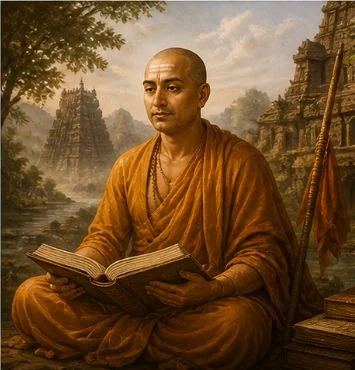
अद्वैत वेदान्त · Advaita Vedanta
Vidyaranya
12th Jagadguru of Sringeri
1296–1391 CE Pampakshetra (Hampi), Karnataka
A consolidator rather than an originator - wrote the most-used summary of Advaita Vedanta and helped found the Vijayanagara empire to defend Sanatana Dharma during a period of military pressure.
The teaching
Following Shankara strictly. The Panchadashi presents Advaita in fifteen chapters of clear, accessible Sanskrit verse - for many serious students it is the standard introduction. Vidyaranya is also remembered for the Sarvadarshana Sangraha, a survey of all sixteen schools of Indian philosophy seen from a Vedantic standpoint - still the best single overview written from inside the tradition.
Major works
- Panchadashi - 15-chapter Advaita Vedanta primer in verse
- Jivanmukti Viveka - on liberation while still embodied
- Sarvadarshana Sangraha - survey of all classical Indian philosophical schools
- Anubhutiprakasha - devotional and philosophical hymns
What he changed
- Together with his brother Sayana (the Vedic commentator), guided the Sangama brothers Harihara and Bukka in founding the Vijayanagara empire (1336) - a political project to protect dharma
- Presided as the 12th Shankaracharya of Sringeri at one of the tradition's critical historical junctures
Living lineage today
Sringeri Sharada Peetham continues. His texts (Panchadashi especially) are core curriculum at Vedanta schools worldwide.
Where to read more
- Swami Swahananda · "Panchadashi" with translation (Sri Ramakrishna Math)
- Hari Prasad Shastri · "Panchadasi" (Shanti Sadan)
- Cowell & Gough · "Sarvadarshana Sangraha" - translation (Trubner / reprinted Cosmo)
Other acharyas
Adi Shankaracharya →
Advaita Vedanta · Pure non-dualism
Ramanujacharya →Vishishtadvaita · Qualified non-dualism
Madhwacharya →Dvaita · Dualism
Vallabhacharya →Shuddhadvaita · Pure non-dualism (with grace)
Nimbarkacharya →Dvaitadvaita · Dual-non-dualism
Chaitanya Mahaprabhu →Achintya Bhedabheda · Inconceivable difference and non-difference
Abhinavagupta →Trika · Kashmir Shaivism (non-dualistic)
Basavanna →Lingayat / Veerashaiva